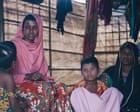
Salt air. Wet bamboo. Woodsmoke clinging to cheap tarpaulin.
Stand on a muddy hillside outside Cox's Bazar during the July monsoon, and those three sensations hit you before a single word is spoken. Rain drums a deafening rhythm on corrugated tin and blue plastic sheets stretched over timber poles. Water turns red clay paths into slick ribbons that swallow flip-flops. Somewhere nearby, a toddler coughs in a room no wider than a parking space.
When people read headlines about Rohingya refugees who escaped Myanmar's genocide, they usually encounter numbers first. Hundreds of thousands displaced in 2017. Over a million living in precarious conditions across Bangladesh and neighboring countries. Reports from human rights investigators. Legal filings in international courts.
Numbers are tidy. They fit on charts. They let distant readers nod with a quiet sorrow and scroll onward.
Yet numbers cannot tell you what it feels like to wake up in a place your family has farmed for generations and discover that the law says you do not exist. They cannot capture the weight of carrying a house key through a flooded rice paddy when you know there is no door left to lock.
I have spent years reporting on displacement and sitting beside survivors who survived atrocities in Myanmar's Rakhine State, and I have to admit something that makes me uncomfortable: even after listening to dozens of testimonies, my own mind sometimes stumbles trying to grasp the scale of deliberate erasure. When the horror is total—when villages are burned systematically, families are separated in the dark, and entire histories are declared fabricated—our ordinary vocabulary feels thin. So let me be plain about how I will tell this story. The core facts, dates, laws, and human rights findings here are grounded in verified reporting and documentation. Where I sketch a composite scene or hypothetical neighbor to help you step inside an everyday moment, I will say so openly, because truth deserves honesty about its scaffolding.
The Architecture of Erasure
To understand why Rohingya families ran for their lives in August 2017—and why earlier waves fled in 1978, 1991, and 2012—you have to look at paper before you look at fire.
Fire is loud. Paper is quiet, patient, and deadly.
For generations, Rohingya communities lived in northern Rakhine State along Myanmar's western coast, speaking a distinct Indo-Aryan language and practicing Islam in a predominantly Buddhist country. Many held identity cards or voted in elections during earlier periods. Then came Myanmar's 1982 Citizenship Law.
Think of citizenship like a house deed. Most people take for granted that if your grandparents built the porch, planted the mango trees, and paid taxes to the town clerk, the land belongs to you. The 1982 law rewrote the property rules overnight. It recognized eight "national races" and a broader list of groups deemed native prior to 1823, leaving the Rohingya outside the legal fold. Without recognized citizenship, a person becomes stateless—stripped of a passport, barred from university seats, restricted from traveling between townships without permission, and vulnerable to arbitrary arrest or extortion at checkpoints.
Once a group is labeled "non-national" or "illegal" on official forms, cruelty becomes easier to rationalize for those who wield power. Propaganda portrays neighbors as intruders. Curfews tighten. Health clinics run short of supplies. Young men face forced labor or detention.
Consider a hypothetical family—let us call them Rashid, his wife Halima, and their three children—living in a village near Maungdaw in early 2017. This family is a composite drawn from dozens of real testimonies documented by humanitarian agencies and journalists, rather than a single individual, to show how slow pressure turns into sudden flight. Rashid grows betel leaf and rice. Halima weaves mats and tends a small patch of chilies. Their eldest son, ten-year-old Tariq, dreams of learning to repair radios.
Even before gunfire breaks out, their world is shrinking. Getting to a hospital across a military checkpoint requires money they barely have and a gamble on whether the soldier on duty is angry that morning. A rumor spreads at the market that troops are moving along the coast. Nobody knows if it is panic or warning. That uncertainty is its own form of torture—living with one sandal half-on while trying to cook dinner.
When the Helicopters Came
In late August 2017, attacks by an armed Rohingya group on security posts gave Myanmar's military—the Tatmadaw—the pretext for what it called "clearance operations."
What followed was not a clash between two armies. It was collective punishment on a staggering scale.
Survivors who walked across the border into Bangladesh described a terrifyingly consistent pattern. Military columns surrounded villages. Gunships circled overhead. Soldiers fired into homes, separated men and boys from women and children, and set thatch and timber ablaze. Human rights investigators and United Nations fact-finding missions later documented widespread killings, sexual violence, torture, and the destruction of hundreds of villages across northern Rakhine.
Listen to the texture of how people survived those days. You do not pack a suitcase when smoke is already rising from the lane behind your house. You grab a pot of water, a bundle of clothes, a child's wrist. You run through tall wet grass, hiding in ditches while helicopters sweep low, praying a baby does not cry out of hunger or fear.
Then comes the river.
The Naf River separates Myanmar's Rakhine State from Bangladesh's Cox's Bazar district. In late summer and early autumn, it swells with monsoon rain and tide. Hundreds of thousands of people pushed toward the water and the Bay of Bengal coast—walking for days through mud and jungle without food, crossing on fragile wooden boats or bamboo rafts, watching loved ones slip into dark water or fall behind on the trail.
Imagine standing on a bank at dusk, listening to distant gunfire across the water, with wet clothes clinging to your skin and no idea whether the boatman coming back for your cousin will make it. Many people who reached Bangladesh arrived barefoot, exhausted, and hollow-eyed, carrying nothing except grief and the clothes they wore.
Life Inside the World's Largest Camp
Surviving the border crossing does not end the story. It changes the shape of the struggle.
Across the border in Cox's Bazar, Bangladesh opened its arms despite being a densely populated country with its own economic and climate pressures. Humanitarian workers, local volunteers, and aid agencies rushed in to build emergency shelters, water points, and clinics.
Yet emergency measures have a way of stretching into years.
Nine years after the massive 2017 influx, hundreds of thousands of Rohingya remain in cramped settlements around Cox's Bazar, while tens of thousands more live displaced inside Myanmar or scattered across Malaysia, India, Thailand, and the Middle East. Shelters built from bamboo and tarpaulin are vulnerable to landslides during heavy rain and devastating fires during dry months. Jobs are scarce or restricted. Formal schooling has faced years of hurdles, leaving a generation of children growing up between childhood and adulthood in limbo.
Still, walk through the lanes of a camp on a clear morning and you will see stubborn life refusing to surrender.
You will see teenagers teaching younger kids math on slates or notebooks in makeshift learning centers. You will see women tending small gardens in sacks of soil outside their shelters or sewing garments to earn a few taka. You will see elders sitting on woven mats sharing sweet tea, trading news from across the border, keeping alive songs and proverbs from villages that exist now only in memory and satellite photos.
When survivors speak about what hurts most today, many point to two things at once: hunger and invisibility. Funding for humanitarian aid has fluctuated sharply over the years, forcing food ration cuts that leave families skipping meals or choosing between cooking fuel and medicine. Meanwhile, the political crisis inside Myanmar—especially after the 2021 military coup and the widening civil conflict across the country—has made safe, voluntary, and dignified return feel distant for most families.
Why does that matter to someone reading this thousands of miles away?
Because when a million people are trapped without legal status, reliable food, or a safe path home, human desperation creates ripples that cross borders. Smugglers prey on families willing to risk rickety boats across open sea just to find work or reunite with relatives. Host communities shoulder strain on land, water, and wages. And when international attention drifts elsewhere, perpetrators face fewer consequences, sending a chilling signal to every authoritarian regime watching: erase a minority thoroughly enough, wait long enough, and the world may grow tired of looking.
Justice, Memory, and What We Owe the Truth
Accountability moves slowly—often painfully slowly for people who buried relatives in unmarked graves.
Still, the record has not been erased. Survivors have given detailed, harrowing testimony to investigators, journalists, and international legal bodies. The Gambia brought a case against Myanmar at the International Court of Justice under the Genocide Convention, while the International Criminal Court opened an investigation into alleged crimes against humanity and deportation across borders.
Those legal proceedings matter, even when verdicts take years. Genocide thrives on silence and denial; testimony is the antidote. Every recorded voice insists that the people burned out of their homes were not statistics or border problems. They were neighbors, parents, farmers, teachers, and children with names, jokes, habits, and futures.
Sometimes I wonder whether distant readers pull back because the story feels too heavy to fix. That reaction is human. Nobody reading an article can single-handedly rewrite Myanmar's constitution or rebuild a village in Rakhine State by tonight.
Yet indifference is not a neutral posture. It is a vote for forgetfulness. Paying attention—refusing to flatten complex human lives into a passing headline, supporting credible humanitarian relief, pressing leaders to keep diplomatic and legal pressure alive—keeps the light on in a dark room.
A survivor once showed me a small brass key wrapped in a piece of faded cloth, kept safe inside a plastic bag beneath a bamboo floor. There was no lock left on his family's old gate, and no certainty he would ever walk that path again. Yet he held onto the key as if letting go would make the loss final.
The rain keeps falling on the tin roofs. The key stays close. And the story belongs to all of us who choose to remember.


