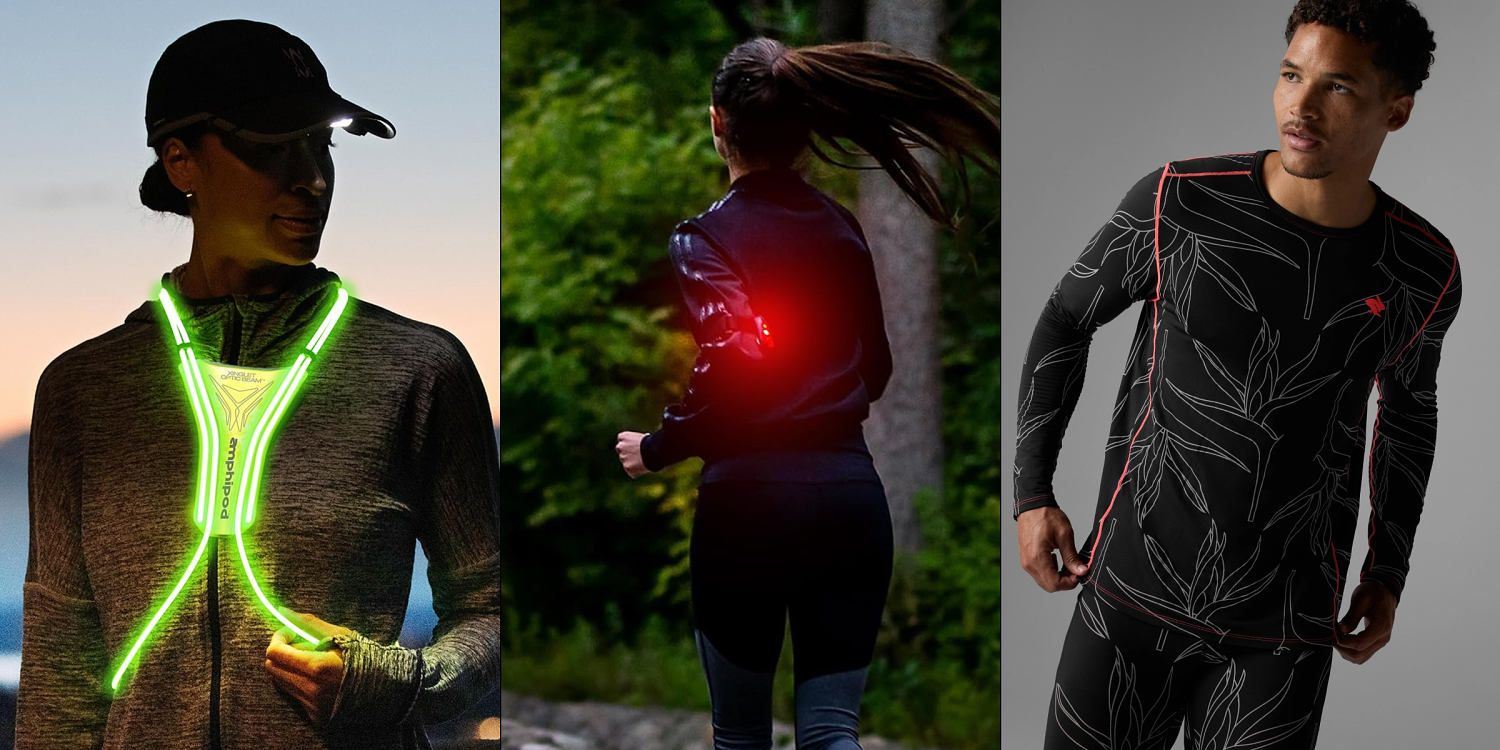
Your neon yellow jacket is a death trap.
Not because it fails to bounce light back toward a pair of oncoming headlights, and not because the textile engineers at your favorite running brand forgot how retroreflectivity works. It is a death trap because the moment you zip up that high-visibility vest, your brain quietly stops doing the one thing that actually keeps you alive on unlit roads. You assume you have been seen. You relax your vigilance at four-way intersections. You stop making eye contact with drivers rolling through stop signs. You outsource your personal survival to a fifty-dollar piece of polyester and a roll of glass-bead tape. Also making waves recently: Why Celebrating Nathan Rourke and Davis Alexander as CFL All-Stars Misses the Real Roster Trap.
Every winter, running publications churn out the exact same lazy listicles telling you to buy reflective vests, fluorescent windbreakers, and clip-on ankle bands to stay safe in the dark. Those articles treat visibility as a passive armor plating—put on the shiny clothes, and the two-ton steel boxes piloted by distracted, sleep-deprived humans will magically part like the Red Sea.
That consensus is dangerously incomplete. After fifteen years of logging pre-dawn miles on unlit rural highways, suburban collector roads, and chaotic urban bike lanes—and analyzing the biomechanics of human visual perception along the way—I can tell you that traditional reflective running gear solves the wrong half of the equation. Being seen is useless if the driver’s brain does not register what you are, where you are going, or how fast you are closing the distance. Worse yet, high-visibility apparel actively exploits a psychological flaw known as risk compensation, lulling runners into taking fatal chances they would never attempt in a plain black hoodie. Additional information regarding the matter are explored by FOX Sports.
The Physics of Retroreflection vs. Reality
To understand why standard reflective running gear fails when it matters most, you have to understand how the materials actually function. Running apparel brands love to toss around terms like "360-degree visibility" and "high-lumen reflectivity," banking on the fact that most buyers conflate fluorescence with retroreflectivity. They are entirely different optical phenomena, and confusing the two will get you clipped by a side mirror.
Fluorescence relies on ultraviolet light. Neon yellow, blaze orange, and electric lime fabrics absorb invisible UV rays from the sun and re-emit them as visible light. That makes fluorescent gear spectacular at dawn, at dusk, and on overcast afternoons. The second the sun drops fully below the horizon, however, UV radiation plummets to near zero. Under artificial streetlights or car headlights at 9:00 PM, that expensive neon yellow jacket turns into a dull, muddy gray blob. It offers zero optical advantage over navy blue.
Retroreflectivity, on the other hand, uses microscopic glass beads or microprisms to bounce light directly back toward its original source with minimal scattering. When a car’s low beams hit a retroreflective strip on your chest, that strip lights up like a flare—for the driver sitting directly behind those headlights.
Here is the catch that gear reviews conveniently gloss over: retroreflection is entirely dependent on the observation angle and the entrance angle.
- No direct light, no reflection: If a car is turning right at an intersection, its headlights are pointing straight ahead down the cross street until the final two seconds of the turn. Until those beams sweep across your body, your retroreflective piping is functionally invisible.
- The SUV blind spot: Modern trucks and SUVs sit higher off the ground, widening the angle between the headlights and the driver’s eyes. As the vehicle gets closer to you, the return cone of retroreflected light misses the driver's windshield entirely, bouncing straight back into the bumper.
- Ambient light washout: In suburban areas cluttered with LED streetlights, glowing storefront signs, and wet asphalt glare, a static reflective stripe on your torso blends seamlessly into the visual noise of road signs, mailbox reflectors, and parked car taillights.
Drivers are not ignoring you because they are malicious. They are failing to see you because human vision in low-light environments suffers from scotopic degradation—our rod cells take over from our cone cells, stripping away color perception, depth judgment, and visual acuity. A stationary dot of reflected light on your sternum gives a driver zero spatial context. They see a glint, assume it is a driveway marker five hundred feet away, and keep their foot on the gas.
Why Biomotion Beats Brightness Every Single Time
If you want to survive running in the dark, stop dressing like a traffic cone and start dressing like a human skeleton.
Decades of visual perception research, anchored by the foundational work of Swedish psychologist Gunnar Johansson on biological motion (biomotion), proved something extraordinary about how the human brain processes movement in total darkness. When researchers placed tiny points of light on the major joints of a walking person—ankles, knees, hips, wrists, elbows, and shoulders—observers recognized the figure as a human being within fractions of a second. When those exact same lights were clustered on the torso or arranged in static patterns, recognition times plummeted, and observers frequently misidentified the object as inanimate clutter.
The human visual cortex is hardwired through millions of years of evolution to detect the sinusoidal, rhythmic pendulum swing of human limbs. A driver’s brain does not need to see your entire body to know you are a person; it needs to see the unmistakable kinematic signature of your knees driving forward and your ankles swinging back.
Yet look at 90 percent of the reflective running gear on the market today. Where do manufacturers put the reflective logos? On the left breast. Across the shoulder blades. Down the center zipper of a vest.
Putting a massive reflective panel on your torso is the worst possible placement for nighttime safety. Your torso barely moves relative to the ground; it glides forward on a flat, horizontal plane, mimicking the exact trajectory of a slow-moving bicycle reflector or a piece of roadside debris. Meanwhile, your extremities—the parts of your body moving at double your running pace in a distinct, biological arc—are wrapped in matte black compression tights and dark socks.
How to Engineer Your Own Biomotion Profile
You do not need a three-hundred-dollar jacket with glowing chest panels. You need high-contrast movement at your joints:
- Prioritize the ankles and heels: Your feet travel through the widest arc and reach the highest peak velocity of any part of your body during a stride. Wrap retroreflective slap bands around both ankles, or buy shoes with aggressive heel and toe reflectivity.
- Target the knees and elbows: If you wear tights or long sleeves in the winter, apply iron-on microprismatic tape directly over the kneecaps and the back of the elbows. Every bend of the joint creates a flashing, unmistakable human silhouette.
- Skip the static chest vest: A vest without limb markers creates a disembodied floating square in a driver's field of vision. If you wear a vest, treat it as secondary to your joint markers, never as your primary defense.
The Risk Compensation Trap Nobody Talks About
Even if you nail your biomotion setup, you still have to contend with the biggest threat on the road: your own psychology.
In behavioral economics and safety engineering, the Peltzman Effect (or risk compensation) describes how people adjust their behavior in response to perceived levels of safety. When cars were mandated to include seatbelts and anti-lock brakes, drivers did not simply pocket the safety gains—they drove faster, followed closer, and braked later, eroding a massive portion of the theoretical lives saved.
I have watched this exact phenomenon play out among runners for over a decade. Put a runner in dark clothes on an unlit street, and they act like a prey animal. They hug the deepest edge of the shoulder, pause completely at driveways, crane their necks to check behind them every thirty seconds, and never step off a curb until a car has come to a complete, dead stop.
Put that exact same runner in a glowing LED chest harness and a neon reflective jacket, and their posture changes immediately. They run two feet further into the traffic lane. They keep their noise-canceling earbuds cranked up. They breeze across dimly lit crosswalks without breaking stride, operating under the subconscious delusion that their gear has wrapped them in an invisible force field.
The data on pedestrian fatalities backs up this grim reality. According to the Governors Highway Safety Association (GHSA), pedestrian deaths in the United States have surged dramatically over the past fifteen years, with the overwhelming majority—over 75 percent—occurring after dark. More telling is where they happen: not in pitch-black rural ditches, but on busy urban and suburban arterial roads, often near intersections where street lighting is present and pedestrians falsely assume they are clearly visible to turning motorists.
A driver looking at their phone screen, blinded by the oncoming high beams of a lifted pickup truck, or rushing to beat a yellow light will not save you just because your jacket meets ANSI/ISEA Type R Class 2 visibility standards. Passive gear cannot overcome active negligence.
Stop Relying on Reflected Light—Bring Your Own
If you take nothing else away from dismantling the standard running-safety playbook, burn this rule into your routine: never rely on someone else's headlights to announce your presence.
Retroreflective gear is entirely parasitic. It produces zero photons of its own. If a car approaches you from around a blind curve, crests a hill, or pulls out of a dark residential driveway with its daytime running lights off, your reflective stripes are completely dead.
Active illumination—lights you generate yourself—eliminates the angle-of-incidence problem entirely. When you emit light, you are visible from 360 degrees regardless of where a car's headlights are pointing. More importantly, active lighting gives you the power to communicate with drivers rather than simply waiting to be noticed.
Here is how to deploy active lighting like someone who actually understands traffic dynamics, rather than someone trying to look like a rolling Christmas tree:
- Ditch the static chest light: Chest-mounted running lamps are popular because they do not bounce on your forehead, but they have a fatal flaw: they point wherever your torso points. When you turn your head to check a cross street, your chest lamp stays locked straight ahead.
- Wear a high-output headlamp—and use your neck: A headlamp with at least 300 to 500 lumens does two jobs. First, it illuminates potholes, black ice, and uneven curbs so you do not snap an ankle. Second, it serves as an active signaling beacon. When you approach an intersection and see a car waiting to turn, turn your head and sweep the beam of your headlamp directly across the driver's windshield. That sudden flash of direct light triggers an immediate orienting reflex in the driver’s brain, snapping their eyes away from their dashboard or phone and locking them onto your position.
- Use amber or red rear strobes, never white: If you clip a blinking white light to the back of your shorts, you confuse drivers. On roadways, white lights mean oncoming traffic; red and amber mean receding traffic or hazards. A flashing white light on the side of the road causes drivers to hesitate as their brains struggle to determine which direction you are moving. Stick strictly to red or amber strobes on your heels or lower back.
The Unspoken Downsides of Active Gear and Aggressive Visibility
Let’s be brutally honest about the trade-offs of this approach, because pretending any gear setup is flawless is how bad advice gets written.
First, active lighting ruins your natural night vision. Strapping a 500-lumen spotlight to your forehead creates a bright tunnel of light ten feet in front of your shoes while plunging everything outside that beam into pitch-black contrast. Your pupils constrict, shutting down your peripheral scotopic vision. If you run on unlit trails or quiet neighborhood streets with zero traffic, blasting a high-lumen headlamp actually makes you less aware of your surroundings—including stray dogs, potholes outside your beam cone, or cyclists approaching from the side. In zero-traffic zones, dial your headlamp down to its lowest setting or turn it off entirely once your eyes adapt.
Second, sweeping your headlamp at windshields can momentarily dazzle drivers. If you point a high-powered LED beam directly into a driver’s eyes from twenty feet away, you induce temporary flash blindness—the exact opposite of what you want when a two-ton vehicle is rolling toward you. The windshield sweep is meant for distances of 50 to 150 feet, aimed at the hood or lower windshield to catch their peripheral attention, never held steady on their face at close range.
Third, ankle bands and joint lights are annoying to wear. Unlike a sleek reflective jacket you can throw on and forget, slap bands chafe against bare skin, slip down over your socks, and collect mud. Clip-on heel lights run out of battery at the exact moment you step out the door in January. Maintaining a biomotion and active-light kit requires friction—charging cables, spare batteries, and five extra minutes of prep before every run. Most runners abandon them within three weeks because convenience always beats discipline until the close call happens.
Common Questions Runners Ask (And Why the Premises Are Flawed)
"What is the single brightest color to wear when running at night?"
This question fundamentally misunderstands human optics. In true darkness, no color is bright. Color is a daytime illusion created by cone receptors in your retina reacting to specific wavelengths of abundant light. Once ambient light drops below twilight levels, your eyes operate in black, white, and shades of gray. Asking whether neon green is safer than blaze orange at 5:30 AM in December is like arguing over which paint color looks best inside a locked closet. Stop shopping by color swatch and start shopping by retroreflective surface area on moving joints.
"Should I run with traffic or against traffic in the dark?"
Run against traffic—facing oncoming vehicles—on every road without a dedicated, protected sidewalk. Running with your back to traffic is a massive gamble that surrenders 100 percent of your survival to the competence of every driver behind you. When you face oncoming traffic, you establish visual contact, you see drivers drifting onto the shoulder before they reach you, and you retain the physical agency to dive into the grass if someone fails to move over. The only exception is approaching a blind left-hand curve on a narrow road with zero shoulder, where crossing briefly to the outside of the turn gives oncoming drivers an extra hundred feet of sightline before you cross back.
"Are LED light-up vests better than traditional reflective vests?"
They are better at short-range, off-angle detection in unlit areas, because they generate their own light rather than waiting for headlights. However, most LED vests suffer from the exact same biomechanical flaw as reflective vests: they illuminate the static torso while leaving the limbs invisible. Worse, cheap fiber-optic vests emit a diffuse, low-lumen glow that completely washes out under modern city streetlights and oncoming HID headlights. If you buy an LED vest, treat it as a supplement to reflective ankle bands and a headlamp, never as a standalone replacement.
The Non-Negotiable Night Running Protocol
Throw out the generic advice to "wear bright clothes and stay alert." If you are stepping out the door before sunrise or after sunset, run this exact checklist before your first stride:
- Assume you are invisible until proven otherwise. Never cross in front of a moving vehicle, even in a marked crosswalk, until you see the driver's head turn toward you and the nose of the car dip under braking.
- Light up your limbs, not just your chest. Put retroreflective bands on both ankles and knees so oncoming drivers immediately register the unmistakable biological motion of a human stride.
- Carry an active beam and use it intentionally. Wear a headlamp capable of at least 300 lumens and actively sweep the beam across the hoods of turning cars at intersections to break drivers out of highway hypnosis.
- Ditch the headphones or switch to bone conduction. Blocking your auditory canal in low-visibility conditions strips away your primary early-warning system for approaching engines, gravel crunching on the shoulder, and electric vehicles gliding silently up behind you.
- Face the metal. Run against traffic on every unlit road, keep your eyes up, and leave your ego at home—ditching into wet grass beats winning an argument with a bumper every single time.