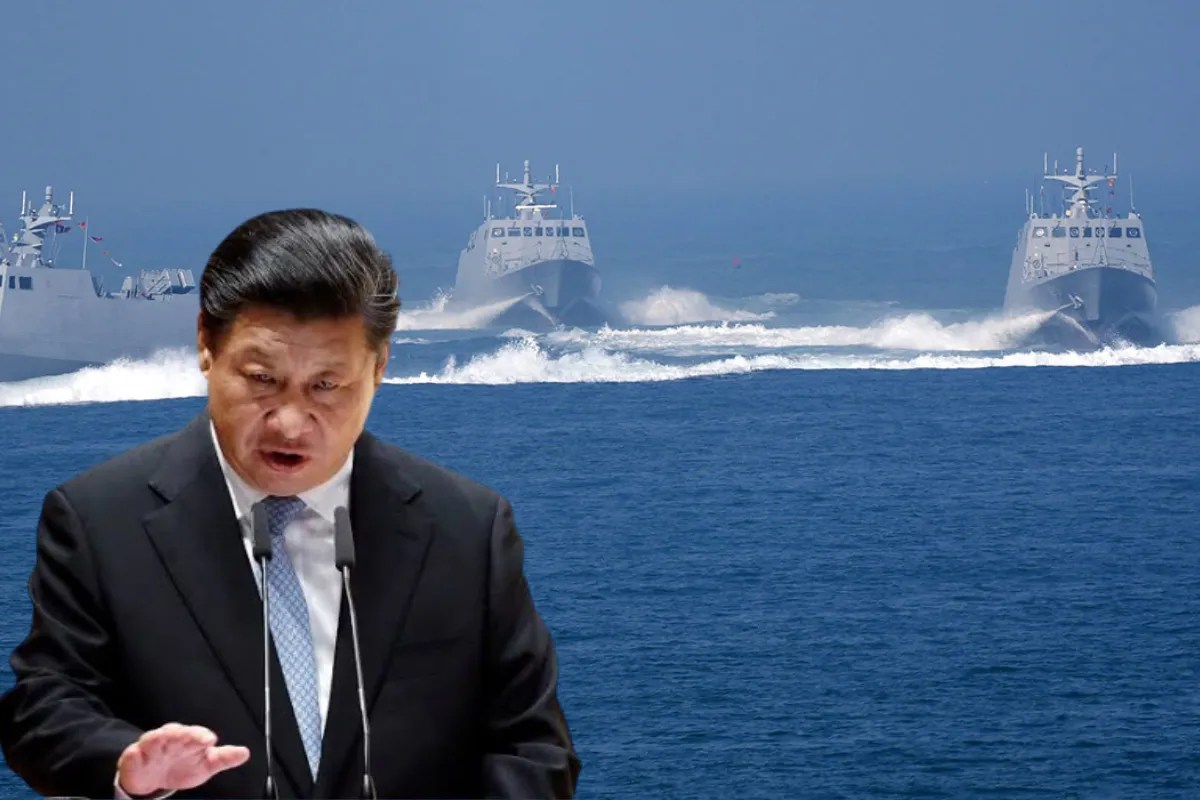
Donald Trump’s declaration of major military punishment against Yemen's Houthi movement and their Iranian backers follows a devastating strike on two Saudi oil tankers in the Red Sea. The attack on the vessels Encelia and Layla effectively reopened a second maritime front that threatens to derail global energy markets. Brent crude surged past $100 a barrel as traders realized the world’s two most critical maritime chokepoints, the Strait of Hormuz and the Bab el-Mandeb Strait, were now simultaneously engulfed in active combat operations.
Washington is running out of easy choices.
While the White House frames the threat of massive retaliation as a decisive deterrent, the reality on the water reveals a far more dangerous dilemma. Taking on the Houthis again, while simultaneously conducting night after night of air strikes against Iran, places unprecedented operational strain on American naval assets and air defense interceptor stockpiles.
The Dual Chokepoint Nightmare
Global commerce relies on predictability. The current reality offers none.
When Iran began obstructing commercial traffic through the Strait of Hormuz, Saudi Arabia adjusted its logistics by shifting millions of barrels of crude per day across internal East-West pipelines directly to its Red Sea ports. It was a logical workaround. It was designed to bypass Iranian harassment in the Persian Gulf and keep energy flowing to international markets.
The Houthis dismantled that strategy overnight.
By declaring a naval blockade on Saudi Red Sea terminals and subsequently striking the Encelia, the insurgent group proved that alternative routes are just as vulnerable. The tactical maneuvering forced energy giants to rethink their entire transit routes, driving shipping insurance rates into uncharted territory.
The arithmetic is ruthless. A single anti-ship cruise missile or attack drone costing tens of thousands of dollars can disable a multi-hundred-million-dollar tanker. To prevent that, American destroyers must fire multi-million-dollar Standard Missiles. The burn rate on naval air defense interceptors is unsustainable over a prolonged engagement.
Why Bombing Campaigns Keep Failing in Yemen
The threat of major military punishment sounds formidable from a briefing podium. In the mountains and coastal hideouts of western Yemen, it carries far less weight.
Military planners have learned this lesson repeatedly over the past decade. A massive bombing campaign conducted by a Saudi-led coalition failed to dislodge the movement. Later, sustained American air operations targeting Houthi radar sites, command centers, and weapons depots succeeded only in temporarily lowering the frequency of launches. The group’s decentralized command architecture and mobile launch platforms make total elimination of their strike capability practically impossible through airpower alone.
The Houthis do not operate like a traditional army. They do not depend on fixed airfields or massive supply depots that can be systematically erased from target lists. They hide launch vehicles in civilian structures, utilize deep underground storage, and rely on dispersed, highly mobile crews.
An air strike can obliterate a launch rail. It cannot destroy the institutional knowledge required to build another one out of smuggled components and improvised materials.
Furthermore, the group thrives on confrontation with major Western powers. Escalation serves their domestic political narrative, cementing their position as the dominant authority in northern Yemen and portraying their leadership as the sole regional force willing to challenge Washington directly. For the Houthis, absorbing military strikes is not a defeat. It is a validation of their strategy.
The Shrinking Stockpile Problem
Behind closed doors at the Pentagon, the primary concern is not willpower. It is hardware.
Naval surface combatants assigned to carrier strike groups carry a finite number of vertical launch cells. Rearming those ships requires them to leave their operational stations, transit to a specialized armory port, and undergo a lengthy, delicate reloading process. When a guided-missile destroyer expends dozens of interceptors in a matter of weeks to neutralize low-cost drones, its combat persistence declines rapidly.
American defense production lines were not built for long-duration, high-intensity surface warfare across multiple theaters simultaneously. Manufacturing complex surface-to-air missiles requires specialized defense contractors, delicate supply chains, and years of lead time.
Every Standard Missile 2 or Standard Missile 6 launched in the Red Sea is an interceptor that cannot be deployed to the Western Pacific or saved for a high-end conflict. Tehran and its regional partners understand this inventory dynamic perfectly. By forcing the United States Navy to play high-tech target practice against inexpensive platforms, they impose an asymmetrical cost curve on the American military budget and ammunition reserves.
Holding Tehran Directly Responsible
By explicitly warning that Washington will hold Iran accountable for subsequent Houthi strikes, the White House is attempting to alter the deterrence equation.
The logic assumes that Tehran exercises absolute control over its regional surrogates. In reality, the relationship between Iran and the Houthis is complex and transactional. While Iran supplies advanced technology, guidance systems, and strategic intelligence, the Houthi leadership retains significant operational independence. They frequently act based on local political calculations rather than direct orders from Iranian commanders.
Holding Tehran accountable for actions taken in Sanaa creates a direct path to conflict expansion. If the Houthis launch another salvo against Red Sea shipping, the White House will face an immediate credibility test. Failing to strike Iranian targets directly would appear indecisive. Carrying out major military strikes inside Iran in response to a Houthi missile launch risks triggering a direct interstate war that could completely shut down energy transport across the Middle East.
That is precisely the strategic trap the United States faces in the Red Sea. Rhetorical red lines create tactical commitments, and those commitments force military actions that can rapidly outgrow their original objectives.
The choice now facing military planners is not whether to respond, but how to break a cycle of escalation where every tactical victory at sea brings the global economy closer to an unprecedented supply shock. As long as asymmetric weapons can paralyze trillion-dollar shipping corridors, no amount of conventional airpower will guarantee safe passage through the Bab el-Mandeb.