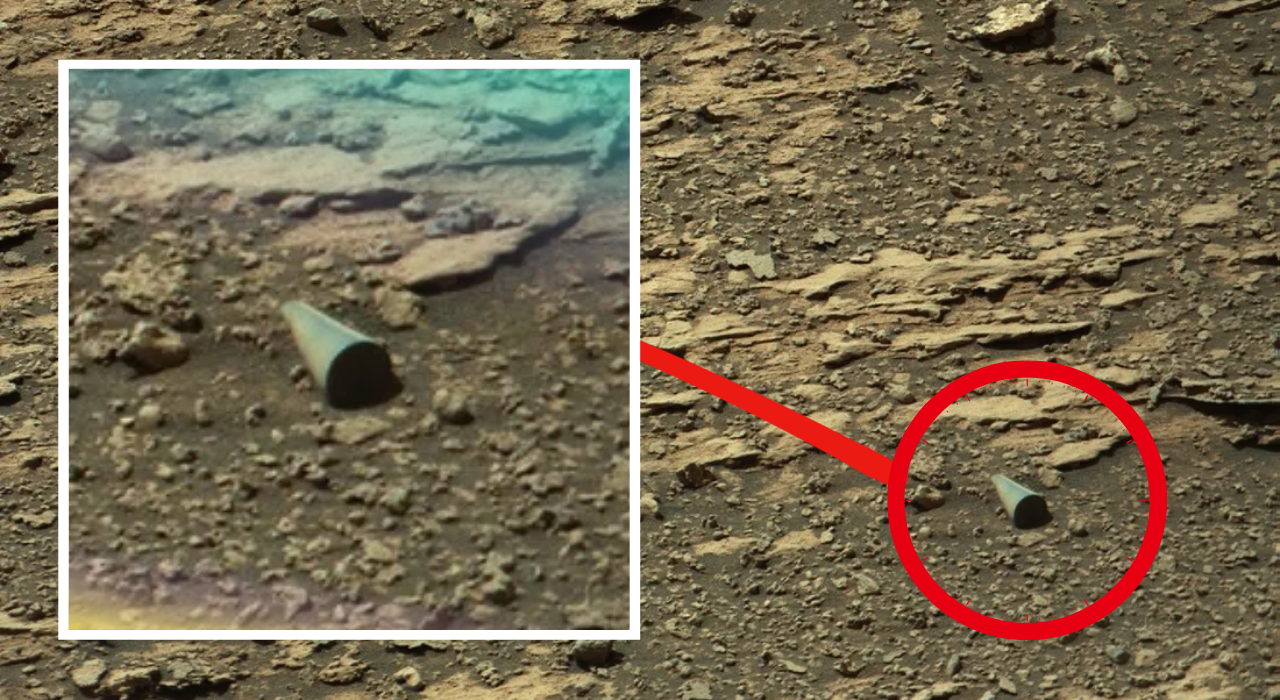
The hunt for life on Mars has hit a metallic snag. Recently, images beamed back from the Martian surface revealed a glinting, cylindrical object nestled among the rusted rocks of the Jezero Crater. While social media feeds erupted with theories of ancient civilizations or downed alien probes, the reality is far more grounded and, frankly, more concerning for the future of space exploration. This "shiny" object is almost certainly a piece of human-made debris—likely a bit of thermal shielding or a component shed during the harrowing landing of a recent rover.
The outcry from high-level academics, including vocal proponents of rigorous space debris tracking at Harvard, isn't about little green men. It is about biological integrity. If we are dumping industrial litter across the very sites we claim to be "pristine," we aren't just polluting another planet; we are actively sabotaging the most expensive scientific search in human history.
The Mechanics of a Martian Mess
Landing on Mars is a violent, chaotic affair. To get a rover safely onto the surface, NASA and other space agencies employ a complex sequence of heat shields, parachutes, and "sky cranes." These components are designed to be sacrificed. They are blown off with pyrotechnic bolts and discarded at high velocities.
When a heat shield hits the ground several kilometers away from the rover, it doesn't always stay in one piece. It shatters. It peels. It leaves a trail of foil, springs, and casing. The "mysterious" cylinder currently causing a stir is a byproduct of this engineering necessity. However, the sheer visibility of this latest fragment highlights a growing problem in the aerospace industry. We are treating the Martian surface like a desert junkyard before we have even confirmed if something is already living there.
The physics of the Martian atmosphere complicates the cleanup. With a density only 1% of Earth's, the wind doesn't just move dust; it can catch lightweight materials like thermal blankets and carry them for miles. This means a piece of debris from a 2021 landing could easily tumble into a 2026 excavation site, leading to a "false positive" that could cost billions of dollars and decades of wasted research.
The Threat of Forward Contamination
The real danger isn't the metal itself. It is what is hitching a ride on the metal. This is known in the industry as forward contamination. Despite the rigorous "clean room" protocols used at the Jet Propulsion Laboratory, no spacecraft is 100% sterile. Some Earth-based microbes, known as extremophiles, are capable of surviving the vacuum of space, the bombardment of UV radiation, and the freezing temperatures of the Martian night.
If a piece of debris carries even a handful of these spores into a "Special Region"—an area where liquid water might exist—we risk an ecological disaster. We could inadvertently seed Mars with Earth life, effectively "terraforming" it by accident before we can study its original state.
The False Discovery Trap
Imagine a scenario ten years from now. A sample-return mission brings a tube of Martian soil back to Earth. Scientists find traces of organic molecules. The world celebrates. But then, a more detailed analysis reveals the molecules are identical to a specific type of resin used in a 2020 parachute deployment system.
The mission is ruined. The data is junk.
This isn't a hypothetical fear; it is a mathematical probability if our current trajectory continues. The "shiny" object is a warning sign. It is a visual reminder that our footprints on Mars are currently made of non-biodegradable trash.
Accountability in the New Space Race
Historically, space was the playground of two superpowers. Today, it is a crowded marketplace. With private companies like SpaceX, Blue Origin, and international players like the CNSA (China) and ISRO (India) all eyeing the Red Planet, the volume of discarded hardware is set to explode.
The current legal framework, primarily the Outer Space Treaty of 1967, is woefully outdated. It mandates that nations avoid "harmful contamination" of celestial bodies, but it provides no specific standards for debris management or penalties for littering. We are operating on a "gentleman’s agreement" in an era of cutthroat commercial competition.
- Tracking Deficiency: There is currently no centralized database for every piece of hardware discarded on Mars.
- Design Flaws: Most landing systems are built for mission success first, with environmental impact as a distant secondary concern.
- Lack of Recovery: There are zero plans to ever "clean up" the Jezero Crater or any other landing site.
The Engineering Pivot
Solving this doesn't require stopping exploration. It requires better engineering. We need to move toward consumable entry systems—materials that might break down under intense UV radiation over decades, or landing sequences that move "discardables" to designated "sacrifice zones" far away from high-value scientific targets.
Some researchers are advocating for "orbital disposal" methods, where the bulk of the landing hardware is burnt up in the atmosphere or pushed into a long-term graveyard orbit rather than being allowed to impact the surface. This is more fuel-intensive and therefore more expensive. But the cost of a ruined planet is significantly higher.
The Price of Silence
The scientific community is often hesitant to scream "pollution" because they fear it will jeopardize funding. If the public perceives space travel as "dirty," political support might wane. But the veteran analysts in this field know that silence is the greater risk. If we don't demand an urgent probe into how we manage our Martian footprint now, we are essentially gambling with the only other habitable world in our reach.
The glint of sun on a metal cylinder in a Martian crater shouldn't be a source of wonder. It should be a call to action. We are no longer just visitors; we are becoming an invasive species.
Go look at the high-resolution images provided by the HiRISE camera. Look at the scars we are leaving. Then ask yourself if we want to find life on Mars, or if we just want to replace it with our own trash.
The next step is simple. Contact your regional space agency representatives and demand that Planetary Protection Protocols be updated to include mandatory debris mitigation and recovery strategies for all future surface missions.