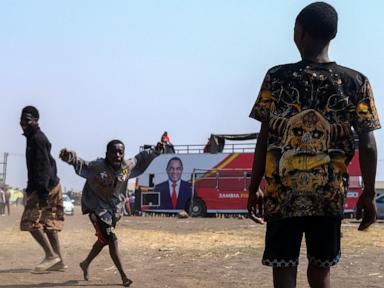
Dust settles on the campaign posters lining the sun-baked avenues of Lusaka. Beneath the glare of an unrelenting African sun, a nation holds its breath. Thursday is coming.
For millions of Zambians, the ballot box is not a theoretical exercise in democracy. It is a heavy, rusted anchor hauled up from the depths of a five-year storm. To understand what is happening here, one must look past the dry dispatches of international finance and watch the hands of a mother counting out crumpled kwacha notes at a crowded market stall, wondering if tomorrow's meal will stretch far enough.
Five years ago, Zambia collapsed.
In the chaotic, pandemic-choked winter of 2020, the southern African nation defaulted on its sovereign debt, becoming a grim global headline—a warning sign for the unsustainable burdens suffocating the developing world. Billions owed to international creditors, including China, piled up like boulders blocking the road forward. Inflation galloped. The local currency stuttered. The promise of independence felt, to many young people growing up in the townships, like an inherited mortgage on a house that had already burned down.
Then came Hakainde Hichilema.
A former corporate executive and massive cattle rancher who had lost five previous presidential bids stretching back to 2006, Hichilema finally captured the presidency in 2021 on a wave of desperate optimism. He inherited an empty vault and an impatient population.
Consider what followed: a grueling, high-stakes diplomatic marathon to restructure more than $12 billion in crushing foreign debt. International monetary funds stepped in. Inflation was reined in. The currency clawed back its footing. To the spreadsheet-holders in Washington and London, Hichilema became a textbook case of macroeconomic recovery.
But spreadsheets do not feel hunger.
Walk through the dense neighborhoods outside the capital, and the mood shifts from international triumph to quiet fatigue. While the macroeconomic vitals stabilize on paper, ordinary families still grapple with soaring food and energy costs.
"You expect a minimum of three years to be able to drive an economic agenda and turn around a country," notes Lusaka-based economist Trevor Hambayi, capturing the friction between executive metrics and kitchen-table realities. "That has passed and they've had five years. But these effects have not yet trickled down to the Zambian people."
The tension defines this election. Hichilema stands before roughly eight million registered voters asking for a second five-year term as the reward for architectural survival. His opponents argue that survival is not enough when cupboards are bare.
Yet, the stakes extend far beyond Lusaka's borders. Deep beneath the nation's red earth lies a silent treasure chest that the entire modern world is desperate to unlock.
Zambia is a geological titan. It is one of the world's premier producers of copper, and home to rich veins of cobalt, nickel, and other critical minerals that power everything from electric vehicle batteries to global digital infrastructure. As global superpowers race to secure the raw components of the energy transition, Zambia has found itself cast as a central stage in a quiet, high-stakes geopolitical tug-of-war.
On one side stands China, deeply embedded as a primary investor and trade partner in the nation's mining sector. On the other, Western powers, including the United States, casting anxious eyes toward the Copperbelt, eager to forge partnerships and secure supply chains.
Hichilema has laid out a staggering, high-risk gamble to capitalize on this global hunger: a long-term economic blueprint to more than triple Zambia's annual copper production to three million metric tons by 2031. If achieved, this leap would thrust Zambia past traditional global output giants, altering the industrial map of the twenty-first century.
To achieve this, the administration has rolled out red carpets for international mining conglomerates, inviting billions in fresh capital to modernize aging shafts and deploy advanced extraction technologies.
Power, however, is a jealous god. As the state apparatus races to court global capital and restructure the economy, the political atmosphere has tightened. Critics and opposition coalitions, such as the Tonse Alliance, have raised alarms over shrinking democratic spaces, pointing to recent law enforcement raids and the heavy hand of the Public Order Act used against political rivals. Freedom, once celebrated as freshly uncaged following the 2006-2021 era of political turbulence, feels to some observers increasingly fragile under the weight of state ambition.
On Thursday, roughly eight million people will step into voting booths across deserts, valleys, and bustling urban centers. They are not just choosing a president under a system that demands an outright fifty-percent-plus-one majority. They are rendering a verdict on whether elite economic reforms can ever truly translate into dignity for the person carrying the heaviest load.
Outside a polling station in Lusaka, a young man leans against a concrete wall, staring down at a flyer bearing the faces of the fourteen presidential contenders. Around him, the wind carries the faint, metallic scent of distant earth-movers chewing through rich northern veins of copper ore—the wealth that built empires elsewhere, while leaving local roads unpaved.
The ballot paper is blank, but it feels as heavy as stone.