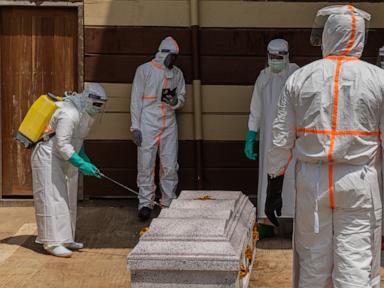
The legacy media is running its classic playbook on the latest Ebola outbreak in the Democratic Republic of the Congo. A headline screams about a record one-day increase in cases exactly a month after the official declaration, and right on cue, the public health apparatus starts drafting alarmist press releases. The narrative is as predictable as it is lazy: cases are up, the containment strategy is failing, and we are on the precipice of a global health catastrophe.
It is a comforting narrative for bureaucrats because it demands a simple, expensive response: dump more money into centralized emergency funds and deploy more international observers. You might also find this similar coverage useful: Stop Blaming Social Media For Teen Suicide.
It is also completely wrong.
When you look at epidemiology through the lens of ground-level reality rather than spreadsheet panic, a record surge in reported cases four weeks into an outbreak isn't a sign of failure. It is often the first measurable sign of success. The mainstream press looks at a spike in data and sees a virus spiraling out of control. Anyone who has spent time managing health crises in under-resourced regions looks at that same spike and sees a surveillance apparatus finally waking up. As reported in detailed reports by World Health Organization, the implications are notable.
We are measuring the wrong thing, asking the wrong questions, and drawing conclusions that actively sabotage effective public health responses.
The Surveillance Paradox: Why Higher Numbers Mean the Fog of War Is Lifting
Public health coverage suffers from a fundamental misunderstanding of baseline data. When an outbreak is first detected in a remote province like Équateur or North Kivu, the initial case count is never an accurate reflection of reality. It is a reflection of a broken, localized testing bottleneck.
Imagine a scenario where a highly contagious pathogen is moving through a population with zero community surveillance. For the first month, local clinics misdiagnose Ebola as malaria or typhoid—a common occurrence because early symptoms are identical. The official chart shows flat, reassuring lines. Is the outbreak contained? No. It is just invisible.
When international teams arrive, bring in mobile molecular laboratories, establish contact tracing networks, and train community leaders to recognize the signs, the data undergoes a dramatic shift.
- Week 1: 5 cases reported (Actual cases: 150)
- Week 4: 80 cases reported in a single day (Actual cases: 200, but now we are actually finding them)
The record one-day increase isn't an explosion of new infections that occurred yesterday afternoon. It is the clearing of a backlog. It means the contact tracers are doing their jobs. They are tracking down the chains of transmission, getting suspected patients into Ebola Treatment Centers, and converting hidden vectors into visible data points.
If your case count does not spike significantly a month into an intervention, you should not celebrate. You should panic. It means your surveillance infrastructure is blind, your community engagement is non-existent, and the virus is outrunning your clipboard.
Dismantling the Panic Premise
The internet is flooded with searches from anxious onlookers trying to make sense of international health dispatches. The queries reflect a deep-seated misunderstanding of how filoviruses operate in the modern era. Let's look at the actual mechanics behind these concerns.
Is Ebola going to become a global airborne pandemic this time?
No. The biology of the virus makes this practically impossible. Ebola is a filovirus that requires direct contact with bodily fluids—blood, vomit, feces—of an infected, symptomatic person or animal. It does not mutate into an airborne pathogen like influenza or a coronavirus because its structural integrity and replication mechanics are bound to fluid transmission.
When people ask this question, they are projecting anxieties from respiratory pandemics onto a completely different class of threat. The danger of Ebola is localized, intense, and structural, not atmospheric.
Why can't we just lock down the region and wipe it out?
Because draconian border closures and forced quarantines achieve the exact opposite of their intended goals. I have watched authorities try to seal off zones in West and Central Africa, and the result is always a disaster.
When you tell a population that they are locked inside an infection zone, you destroy trust. Families stop bringing their sick relatives to treatment centers because they view them as containment camps. Instead, they hide patients under floorboards, wash bodies in secret according to traditional burial customs, and bypass official checkpoints via unmonitored bush paths.
The blunt instrument of a lockdown doesn't stop transmission; it drives it underground, making it impossible to trace.
The Real Bottleneck: Trust vs. Technology
The global health community loves a technological savior. We pour hundreds of millions of dollars into developing better vaccines like Ervebo and Zabdeno, manufacturing advanced monoclonal antibody treatments like Ebanga, and deploying rapid diagnostic kits.
These interventions are triumphs of medical science. They are also entirely useless if a community believes the treatment center is an organ-harvesting facility run by outsiders.
The hard truth that top-heavy organizations like the World Health Organization often fail to operationalize is that epidemiology is 10% medicine and 90% anthropology. The surge in cases we see a month into an outbreak usually correlates directly with the time it takes to negotiate with local elders, religious leaders, and youth groups.
Until those negotiations succeed, your case numbers look low because nobody is talking to you. The moment a trusted local pastor or village chief tells their community that the treatment center can actually save lives—which it can, with early supportive care and therapeutics—people start showing up. The resulting "record increase" in the daily report is actually a line of people seeking help because they finally trust the intervention.
The Flawed Allocation of Crisis Funding
The current model of emergency response operates on a reactive funding loop. Money flows when the headlines get loud. A record case day triggers an influx of capital from international donors.
This creates a perverse incentive structure and a broken operational cycle:
- Neglect: Local health zones are starved of basic operational budgets for routine surveillance, clean water, and PPE during inter-epidemic periods.
- Explosion: A spillover event occurs, goes unnoticed for weeks due to missing diagnostic tools, and inevitably expands.
- Panic Funding: The international community floods the zone with short-term cash, foreign experts, and expensive logistics.
- Withdrawal: The outbreak is declared over, the circus leaves town, and the local healthcare infrastructure is left just as weak as it was before.
This reactive model is wildly inefficient. A fraction of the money spent on an emergency international deployment, if guaranteed as sustained operational funding for Congolese medical personnel over a decade, would allow local hospitals to crush these outbreaks before they ever reached the status of a national report.
The downside of my argument is obvious: shifting to a proactive, localized model means international agencies have to give up control. It means acknowledging that a well-paid Congolese nurse with a reliable supply of gloves and a functioning motorbike is infinitely more valuable than a team of Geneva-based consultants flying into an airfield four weeks too late. But that shift requires a level of institutional humility that the global health industrial complex rarely displays.
Stop Looking at the Curve, Look at the Ratios
If you want to know if an outbreak is actually spinning out of control, ignore the daily raw case count entirely. It is a noisy, manipulated variable dependent on testing capacity. Instead, focus on two specific operational metrics:
- The Proportion of Cases from Known Contact Lists: If 85% of new positive cases were already on a contact tracer's watch list as suspected exposures, the response team is ahead of the virus. If 85% of new cases are surprises showing up dead in the community or appearing from unmapped neighborhoods, you are losing the fight.
- Time from Symptom Onset to Isolation: If this number is dropping from five days down to less than 24 hours, the transmission chain is being choked off, regardless of how many total cases are being logged that week.
A high case number filled with known, isolated contacts is a controlled demolition of the outbreak. A low case number filled with anonymous, community-acquired infections is a ticking time bomb.
The media will continue to report the raw numbers because big figures generate engagement and drive fear. But if you want to understand the trajectory of a health crisis, you must look past the immediate shock value of a single daily update. Stop demanding flatlines in the first month of an intervention. Demand better eyes on the ground, expect the numbers to climb as the light gets turned on, and understand that an increase in known cases is often the very mechanism by which an outbreak is brought to an end.