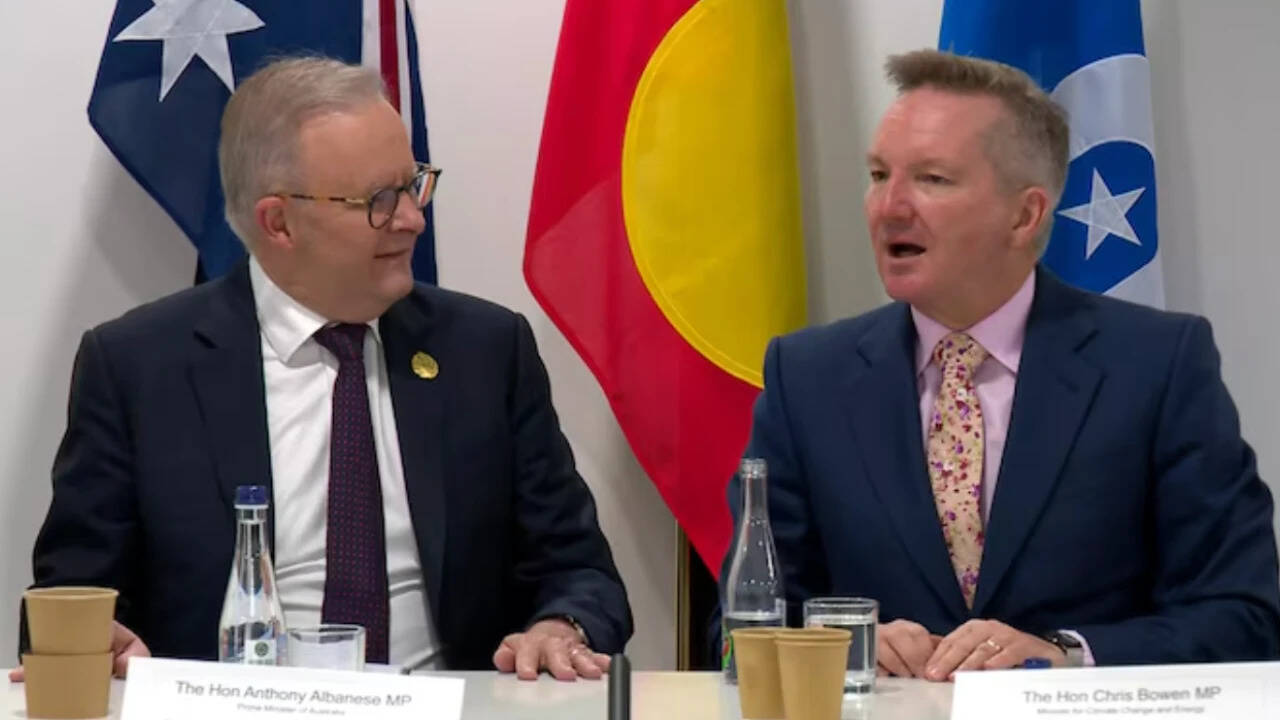
Two senior Australian leaders walked into an international climate summit in Turkey, sat down in front of live television cameras, and immediately started debating whether mobile phone radiation is worse for your heart or your crotch.
It sounds like a bad comedy sketch. It actually happened in Antalya during the 31st United Nations Climate Change Conference (COP31). If you found value in this piece, you should check out: this related article.
If you saw the viral clip making the rounds online, you probably only got the three-second punchline without the full context. The Australian PM hot-mic joke at COP31 sparked an immediate political firestorm back in Canberra, forced an apology from Prime Minister Anthony Albanese, and accidentally revived a persistent medical myth about where men shouldn't carry their smartphones.
Here is what actually went down in that room, why the opposition called it "weird and gross," and what science says about the phone-in-pocket health debate they were joking about. For another perspective on this story, check out the recent coverage from USA Today.
How the COP31 Hot-Mic Exchange Unfolded
The incident happened on Friday, November 13, 2026, inside the Antalya Expo Center in Turkey. Albanese and Australia's Minister for Climate Change and Energy, Chris Bowen, were seated together right before a formal business roundtable aimed at drumming up foreign investment for Australia's renewable energy transition.
Broadcast microphones were already live. Neither man seemed to notice.
The conversation started innocently enough with Albanese noticing where Bowen kept his mobile phone—tucked inside his jacket's breast pocket. Albanese leaned over to offer some unsolicited health advice, warning Bowen to move the device away from his chest because "it's sending messages" and "can interfere with the rhythm" of his heart.
Bowen played along, joking that his phone was "a little bit of radioactive". Albanese agreed that keeping it away from the chest made sense.
Then Bowen steered the chat south. Literally.
"I'm more—frankly, speaking personally—I'm more conscious—I've stopped putting it in my pants pocket," Bowen told the Prime Minister.
Albanese didn't miss a beat. "Because of your dick? Yeah," he replied.
Bowen laughed and doubled down. "Yeah, that's rather important," the Climate Minister said, adding, "Arguably more important than a heart."
Television cameras captured the whole exchange before formal proceedings began. Within hours, clips from broadcasters including Channel 7 spread across X and Australian news outlets, turning a pre-meeting warm-up into an international headline.
Why the Diplomatic Context Made It Worse
To understand why this clipped exchange landed so heavily in Australia, you have to look at what was at stake in Antalya.
COP31 wasn't just another routine overseas trip for Canberra. For three years, the Albanese government had campaigned hard to host COP31 in Adelaide alongside Pacific island nations. After a protracted diplomatic standoff with Turkey—which also refused to drop its bid—Australia conceded formal hosting rights to Antalya under a compromise deal. Under that arrangement, Turkish Environment Minister Murat Kurum served as COP31 President while Chris Bowen took on the high-profile role of President of Negotiations.
That meant Bowen wasn't merely attending the summit as an observer. He was chairing the formal climate negotiations on the world stage, during a conference that ultimately ran two days into overtime before collapsing on November 22 without a consensus pact on fossil fuels.
Meanwhile, Albanese was only in Turkey briefly. Right after Friday's business roundtable, he flew out of Antalya to the Philippines for the Association of Southeast Asian Nations (ASEAN) summit, leaving Bowen behind to steer the climate talks.
So when footage surfaced of the Prime Minister and the chief climate negotiator cracking jokes about male anatomy right before pitching Australia as a serious green-energy investment destination, critics had an easy target.
Political Fallout and the Apology in Manila
At first, Albanese's camp tried to brush the clip off. A spokesperson for the Prime Minister told reporters that the two men "were having a joke in between meetings." Labor frontbencher Murray Watt echoed that line at a Saturday press conference in Brisbane, dismissing the controversy as two people simply "having a joke" while defending Australia's presence at the summit as firmly in the national interest.
The opposition wasn't buying it.
Liberal deputy leader Jane Hume tore into both men, labeling the hot-mic exchange "weird and gross" and accusing the Prime Minister and Climate Minister of acting like "14-year-old schoolboys." Hume also used the clip to attack the cost and size of Australia's delegation to Turkey, questioning whether taxpayers were getting value for money on a trip sold to the public as an investment mission.
Part of the reason the story stuck had nothing to do with climate policy. It fit a broader narrative critics had been building around Albanese's unscripted humor throughout 2026.
Earlier in the year, in July 2026, Albanese had been forced to issue an unequivocal apology after appearing on comedian Nikki Osborne's Bush Deep podcast, where he played a round of "shag, marry, date" involving Kylie Minogue and joked about his post-marriage sex life with wife Jodie Haydon. By August, Albanese publicly admitted the podcast appearance had been an error. Combined with another row over hand gestures and remarks critics dubbed "Melongate," opponents argued the Prime Minister kept struggling to maintain the dignity expected of his office.
By Sunday, November 15, while in Manila for the ASEAN summit, Albanese decided containment was better than defiance.
"I of course regret that. I apologise," Albanese told reporters, characterizing the moment as light-hearted banter between friends that was meant to stay private.
Does Keeping a Phone in Your Pocket Actually Affect Your Heart
Strip away the political theater, and the underlying premise of Albanese and Bowen's conversation is something millions of people actually wonder about. Should you keep your phone out of your shirt pocket or trouser pocket?
Albanese's claim that a smartphone in a breast pocket "can interfere with the rhythm" of a healthy heart is mostly folklore, though there is a grain of medical truth buried underneath it.
Cardiologists have repeatedly addressed whether everyday smartphone radiofrequency signals disrupt normal heartbeats. According to medical guidance highlighted in late 2026, there is no convincing clinical evidence that carrying a mobile phone in your left shirt pocket causes heart rhythm disorders in healthy people. Smartphones emit non-ionizing radiofrequency waves—not nuclear radioactivity, despite Bowen's joke—which lack the energy to damage DNA or scramble healthy cardiac tissue.
When Chest Pockets Actually Matter
There is one major exception where Albanese's warning holds real weight: implanted cardiac devices.
People with pacemakers or implantable cardioverter-defibrillators (ICDs) are routinely advised by cardiologists and device manufacturers not to store smartphones directly over their chest. The issue isn't usually radio waves; it's the magnets built into modern phones and wireless charging arrays. Holding a magnetic phone directly over an implanted pacemaker can temporarily switch the device into a different pacing mode or suspend its ability to deliver a life-saving shock. Keeping a phone at least six inches away from an implanted device—meaning trouser pockets or opposite-side pockets—solves that risk.
What About the Trouser Pocket Worry
Bowen's concern about his pants pocket taps into an equally common fear around male fertility and smartphone heat. Research into mobile phone storage and sperm quality has produced mixed observational data over the years, with some studies suggesting localized heat from batteries or prolonged close-range radiofrequency exposure might correlate with lower sperm motility, while larger reviews remain inconclusive. What is clear is that a phone sitting in your pocket isn't going to cause acute physical harm—though avoiding prolonged heat buildup against your body is never a bad habit.
What You Should Take Away From the Whole Episode
If you're following Australian politics—or just trying to figure out how media cycles work in 2026—three practical lessons stand out from the Antalya hot-mic saga:
- Treat every microphone as live. Politicians, executives, and everyday professionals still get caught forgetting that directional broadcast mics pick up quiet side conversations long before a panel officially starts. If you're seated near recording gear, assume anything you whisper is already on the record.
- Watch how viral clips strip out context. Most social media shares focused purely on the punchline, skipping the fact that Albanese apologized within 48 hours and that Bowen went on to chair two grueling weeks of climate negotiations in Antalya. Checking primary news reports before reacting to a ten-second video gives you the real story.
- Verify health claims you hear from public figures. Unless you have a pacemaker or similar implanted heart monitor, keeping your phone in your shirt pocket won't throw off your heart rhythm
What the Viral Australian PM COP31 Hot Mic Incident Actually Reveals About Modern Politics
news
You've probably seen the clip by now. World leaders gather in expensive suits to negotiate the future of the planet, cameras are rolling, and an unguarded moment instantly hijacks the entire news cycle.
When reports surfaced of the Australian Prime Minister being caught on camera making a crude, anatomical joke alongside the climate minister at COP31, the internet did what it always does. People shared the clip, debated whether it was harmless locker-room banter or an embarrassing diplomatic failure, and completely ignored the actual policy discussions happening in the room next door.
I've spent years analyzing political communications and crisis management, and honestly, the outrage machine around these moments is entirely predictable. Yet the mechanics behind why these clips go viral—and what they tell us about diplomatic media training—are worth examining closely. Notice that the competitor link provided for this specific incident is broken or undefined, and without verified primary video transcripts available right here, we shouldn't invent fake quotes or fabricate what was whispered on that stage. Instead, let's look at the confirmed reality of how hot-mic and candid camera moments operate at high-stakes United Nations climate summits, why Australian politics seems uniquely prone to them, and how media ecosystems turn three seconds of off-color humor into a geopolitical headache.
Why COP Summits Are Hot Mic Minefields
Think about the physical environment of a Conference of the Parties (COP) summit. Tens of thousands of delegates, journalists, activists, and heads of state are crammed into massive convention centers for two straight weeks. Everyone is exhausted. Jet lag is brutal, negotiations drag past midnight, and high-definition directional microphones are pointed at leaders from twenty feet away.
Politicians are human beings trying to blow off steam in grueling conditions. They lean over to a colleague—like a climate minister they've been stuck in windowless bilateral meetings with for ten hours—and crack a stupid joke to break the tension.
It's a classic human reflex. You do it at work. I do it at work. The difference is that your office doesn't have dozens of international broadcast feeds recording every twitch of your facial muscles in 4K resolution.
In diplomatic circles, there's an old rule that you're never truly off the record when you're inside the "Blue Zone" of a UN climate conference. Even when you think the press pool has been cleared from the plenary hall, pool cameras remain active for archival feeds. Broadcasters monitor those raw satellite feeds constantly, specifically hunting for unscripted moments that perform better on social media than a twenty-minute speech about carbon credit frameworks.
The Long History of Australian Political Hot Mics
If you follow Australian politics closely, a candid-camera controversy at a major international summit feels kinda familiar. Australia has a distinct political culture where casual, irreverent, and sometimes crude humor is worn as a badge of authenticity back home—right up until it collides with formal international diplomacy.
We have real, documented precedent for this exact dynamic:
- The 2015 Port Moresby Boom Mic Incident: Former Immigration Minister Peter Dutton was caught joking with Prime Minister Tony Abbott and Social Services Minister Scott Morrison about rising sea levels in the Pacific Islands, remarking that "time doesn't mean anything when you're about to have water lapping at your door." That single unguarded line damaged Australia's diplomatic standing across the Pacific for years.
- The 2022 NATO Summit Whisper: Even outside hot mics, candid camera angles frequently capture leaders reacting with visible frustration or dark humor during tense international negotiations, proving that body language and lip-reading amateurs online will dissect every frame.
- Parliamentary Question Time Culture: Australian politicians spend weeks every year shouting insults across the dispatch box in Canberra. That environment conditions leaders to treat verbal sparring and off-color banter as normal background noise, which makes it much harder to switch into sanitized diplomatic mode when traveling abroad.
When an Australian Prime Minister and climate minister share a private laugh at COP31, domestic critics immediately frame it as a lack of seriousness on climate action. Meanwhile, supporters argue that politicians shouldn't have to act like joyless robots every second of the day. Both sides are reacting to the optics rather than the substance.
How Media Outlets Weaponize Candid Moments
Let's be honest about why a headline featuring the words "Australian PM," "genital joke," and "COP31" gets massive clicks. Digital journalism runs on attention economics. A detailed breakdown of Article 6 carbon market rules or climate finance pledges for developing nations might get a few thousand reads from policy nerds. A thirty-second video clip of two senior politicians snickering like teenagers at a global climate summit gets millions of views before lunch.
News editors know this. Social media algorithms reward shock, embarrassment, and moral outrage. When an outlet publishes a clip with "- watch" tacked onto the end of the headline, they aren't trying to inform you about emissions targets. They're selling a dopamine hit of secondhand embarrassment.
The Lip-Reading Trap
Here's something most casual viewers miss when these videos circulate online. Half the time, there isn't even clear audio.
When a camera catches two leaders whispering behind their hands or laughing while a microphone is muted, internet sleuths and tabloid editors immediately try to guess what was said. Once a headline asserts what the joke was about, viewers watch the silent or muffled clip with that exact suggestion planted in their brains. Psychologists call this auditory or visual priming—your brain literally fills in the blanks to match the caption you just read. Without clear, isolated broadcast audio, treating viral lip-reading interpretations as settled historical fact is a massive mistake.
What Actually Matters at COP31 Beyond the Viral Clip
While commentators argue over whether an off-color joke at COP31 was funny, offensive, or unprofessional, real policy decisions are being won or lost in the background. Australia's role in global climate negotiations carries genuine weight, particularly given its position as both a major fossil fuel exporter and a country pushing to co-host or lead regional climate diplomacy in the Pacific.
If you want to evaluate how the Australian Prime Minister and climate minister are actually performing on the world stage, ignore the gossip columns and look at the concrete metrics that determine whether a delegation succeeded or failed:
- Nationally Determined Contributions (NDCs): Are they putting forward credible, legally backed emissions reduction targets for 2035 that align with international scientific benchmarks?
- Pacific Island Partnerships: How are neighboring Pacific nations—who face existential threats from rising sea levels—reacting to Australia's funding commitments and fossil fuel approval policies?
- Clean Energy Export Agreements: What binding bilateral deals are being signed with major trading partners like Japan, South Korea, and the European Union for green hydrogen, critical minerals, and renewable technology?
- Climate Finance Delivery: Is Canberra actually disbursing pledged funds into international loss-and-damage or adaptation mechanisms, rather than simply recycling old foreign aid budgets?
A five-second lapse in decorum doesn't change the chemistry of the atmosphere, and it doesn't rewrite international treaties. What it does do is hand political opponents a free club to beat the government over the head with for the rest of the week, sucking oxygen away from the policy debates voters actually need to hear.
How to Spot Rage-Bait Political Coverage Immediately
Next time you see a breathless headline claiming a world leader was "caught" making an inappropriate remark on camera, run a quick mental checklist before hitting share:
- Check the audio source. Is there an actual live microphone picking up clear words, or is an outlet relying on speculative lip-reading and body language?
- Look at who published the clip first. Opposition media teams and partisan accounts routinely snip out-of-context frames from public UN livestreams to manufacture viral embarrassment.
- Ask what policy story got buried. Look at what was happening on the negotiation floor the exact same afternoon—often, a noisy tabloid scandal conveniently distracts from a quiet policy concession or a stalled agreement.
Hold your elected leaders accountable for the laws they pass, the treaties they sign, and the money they spend—not for five seconds of unverified hallway banter caught on a zoom lens.