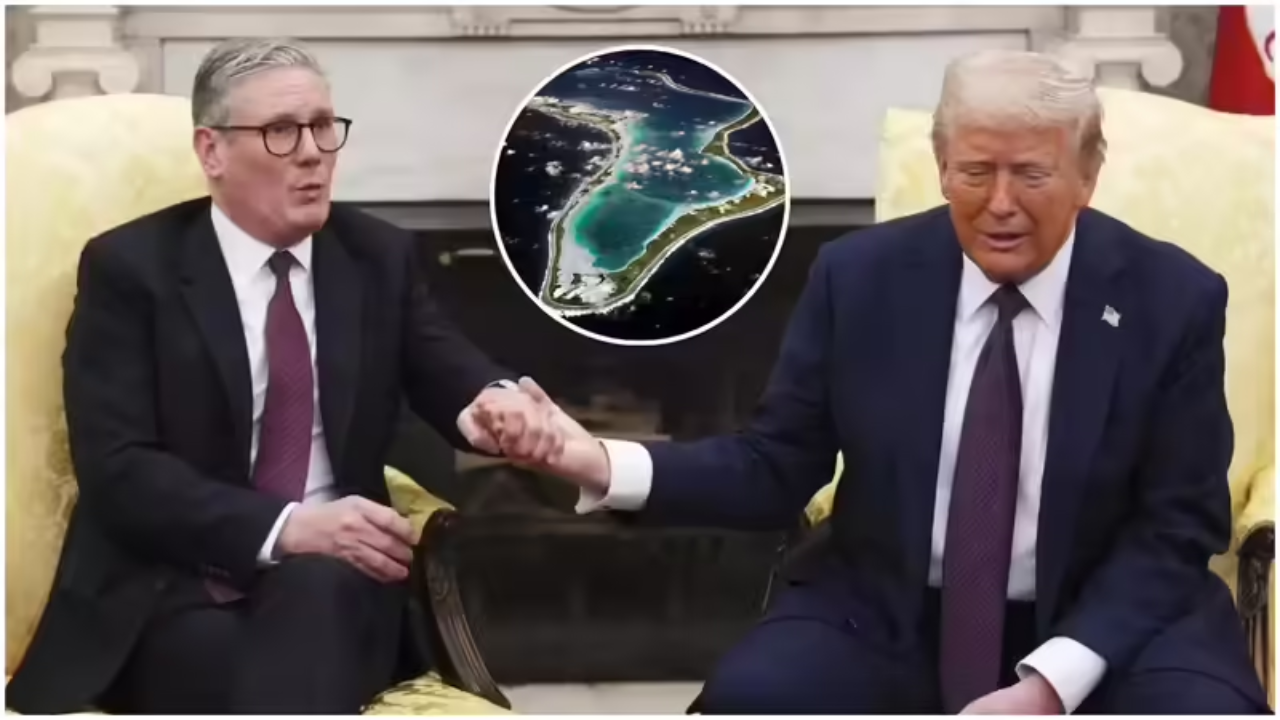
The United States is quietly drawing up options to buy the Chagos Archipelago outright from Mauritius. This extraordinary maneuver, engineered by Trump administration officials, aims to bypass the United Kingdom entirely and establish direct American control over Diego Garcia, the strategically vital footprint in the Indian Ocean. According to leaked policy drafts first detailed by The Telegraph, Washington is scrambling for an alternative to British Prime Minister Keir Starmer’s controversial plan to surrender sovereignty of the islands to Mauritius. The White House views London’s pending treaty as an unacceptable vulnerability that opens the door to hostile foreign espionage right on the fence line of America's most critical long-range bomber platform.
For decades, Diego Garcia has operated under a convenient diplomatic fiction. Britain claimed ownership of the British Indian Ocean Territory, while the Pentagon built a massive, secretive military compound on the largest atoll. But that arrangement fragmented when Sir Keir Starmer’s government signed a treaty to transfer the archipelago to Mauritius in exchange for a 99-year lease on the base. White House officials now see that deal as a critical security failure. By exploring a direct purchase of the territory, the United States is signaling that it no longer trusts London to safeguard Western security interests in the region. Meanwhile, you can read other events here: Inside the Cartoon Crisis Nobody is Talking About.
The Flaw in London's Lease
The British government pitched its treaty with Mauritius as a diplomatic victory that would secure the future of the joint military facility. Under the terms of the agreement, the UK agreed to pay Mauritius an average of £120 million annually, a sum that scales up with inflation over nearly a century. In exchange, the British military retained administrative control over Diego Garcia. British Defence Secretary John Healey argued the deal cost less than 0.2 percent of the UK national defense budget and guaranteed unrestricted access.
Washington looks at the exact same contract and sees a catastrophic blind spot. To understand the complete picture, check out the recent analysis by TIME.
While the treaty protects the runway and deep-water port on Diego Garcia itself, it leaves the surrounding "outer islands" of the Chagos Archipelago under the direct municipal and environmental jurisdiction of Mauritius. Mauritius maintains deep economic and diplomatic ties with Beijing. Trump administration officials fear that a sovereign Mauritian presence on nearby atolls like Peros Banhos or Salomon would inevitably lead to Chinese commercial infrastructure, signaling the arrival of sophisticated signals intelligence and surveillance facilities.
B-2 Spirit stealth bombers require pristine security environments when deploying for long-range missions across West Asia and the Middle East. If a rival superpower can position monitoring equipment on an adjacent island just a few miles away, the stealth advantage of those aircraft disappears. Washington's sudden pivot to a purchase model is an admission that a 99-year lease means nothing if the landlord invites your primary adversary into the backyard.
Bypassing Westminster
The geopolitical relationship between the US and the UK has hit a historic friction point over how the base is managed. The Starmer administration put the final ratification of the treaty on hold after intense pushback from the White House. Donald Trump explicitly called the handover a big mistake and an act of great stupidity.
The friction intensified during the early stages of recent Middle Eastern operations. Downing Street balked at allowing the US military to launch specific long-range strikes against Iranian targets from Diego Garcia, citing international law and local political sensitivities.
That refusal fundamentally altered the American view of the partnership.
UK-Mauritius Treaty Framework vs. Proposed US Purchase Option
+-----------------------+----------------------------------+----------------------------------+
| Feature               | UK-Mauritius Treaty (Stalled)    | Proposed US Purchase Option      |
+-----------------------+----------------------------------+----------------------------------+
| Sovereignty           | Transferred entirely to Port     | Transferred permanently to       |
|                       | Louis                            | Washington                       |
+-----------------------+----------------------------------+----------------------------------+
| Outer Island Control  | Controlled by Mauritius; subject | Controlled by the Pentagon;      |
|                       | to potential third-party access | strict military exclusion zones  |
+-----------------------+----------------------------------+----------------------------------+
| Financial Mechanism   | Ongoing UK payouts averaging     | One-time lump-sum purchase       |
|                       | £120M/year for 99 years          | direct to Mauritius              |
+-----------------------+----------------------------------+----------------------------------+
| Operational Veto      | London retains final say over    | US gains absolute autonomy over  |
|                       | combat mission launch approval   | all strike deployments           |
+-----------------------+----------------------------------+----------------------------------+
The Pentagon requires absolute operational autonomy. If British politicians can restrict the utility of a multi-billion-dollar military asset during an active conflict, the value of that asset plummets. By drafting a proposal to buy the islands directly from Mauritius, American strategists are aiming to remove both British diplomatic hesitation and Mauritian sovereignty from the equation simultaneously.
The Price of Port Louis
Negotiating a direct buyout will not be simple. Mauritius has spent decades fighting for the return of the Chagos Archipelago in international courts, leveraging a non-binding 2019 International Court of Justice advisory opinion to pressure London. Mauritian Prime Minister Navin Ramgoolam celebrated the UK treaty as the final step of national decolonization. Walking away from absolute sovereignty to accept an American bill of sale would require an immense political shift in Port Louis.
Everything has a price in international relations.
The current treaty structured by the UK promises Mauritius billions of pounds spread thin over ten decades. A direct American acquisition would likely involve an immediate, transformative lump-sum payout. For a developing island economy, a massive injection of hard American capital presents an alternative to long-term dependency on foreign aid or high-interest infrastructure loans from Beijing.
Furthermore, the United States holds significant leverage through global financial systems, trade access, and maritime security guarantees. If the White House presents an offer that guarantees Mauritian economic stability while preserving its fishing rights outside a strict military exclusion zone, the calculation in Port Louis changes.
The Chagossian Factor
Any attempt by the United States to purchase the territory will run directly into a historic human rights disaster. In the late 1960s and early 1970s, the British government forcibly evicted the entire native Chagossian population to clear the land for the American military. Families were loaded onto cargo ships and dropped into the slums of Mauritius and the Seychelles, their pets poisoned and their villages abandoned.
The stalled UK-Mauritius treaty explicitly allows for the resettlement of Chagossians on the outer islands of the archipelago, though it bars them from returning to Diego Garcia itself.
An outright American purchase would almost certainly kill those resettlement plans. The US military values isolation above all else. Managing a civilian population within the archipelago introduces legal liabilities, border control issues, and protest risks. If Washington takes full title to the islands, the Chagossian people will likely find themselves locked out of their homeland permanently, replaced by an expanded grid of American fences, radar domes, and restricted waters.
A New Era of Territorial Acquisition
The White House option paper marks a return to naked transactional diplomacy. While modern foreign policy favors complex leases, joint partnerships, and international mandates, the Trump administration favors permanent ownership. If you own the land under the runway, you never have to ask a foreign parliament for permission to defend your global supply chains.
The plan is still an internal policy option rather than a formalized diplomatic ultimatum. It requires navigating a minefield of British institutional pride and Mauritian constitutional law. Yet the mere existence of the proposal proves that the post-war model of shared Western defense is fracturing under the pressure of a shifting global order. Washington is preparing to buy its way to absolute control, ensuring that the unsinkable aircraft carrier of the Indian Ocean remains strictly an American asset.