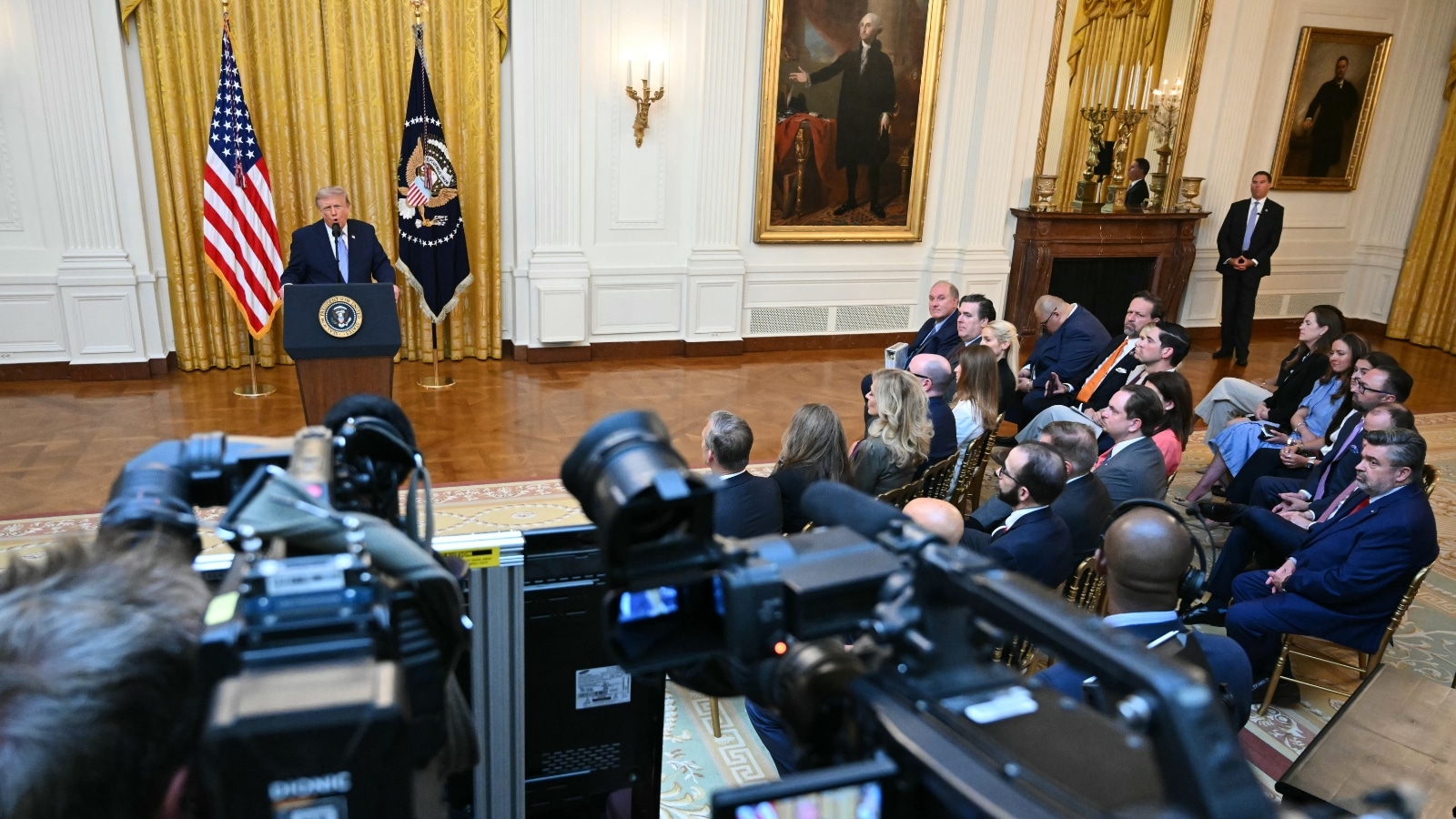
On Thursday night, the traditional relationship between the American presidency and broadcast television suffered a permanent fracture.
When President Donald Trump claimed the White House podium for a primetime address to resurrect debunked 2020 election theories and push a controversial voting bill, several major TV networks did something once considered unthinkable. They refused to air it live on their primary broadcast channels. While CNN, ABC, and NBC bypassed the live broadcast, CBS and Fox News carried the feed, exposing a deep industry rift over how to handle a president who treats the executive branch's most solemn communication tool as a campaign megaphone. This was not a sudden burst of journalistic courage, but a calculated business decision driven by liability concerns, shifting streaming economics, and the bitter lessons of multi-million-dollar defamation lawsuits.
The immediate fallout was loud, predictable, and entirely in character.
The Night the Presidential Bullhorn Cracked
For nearly seven decades, the primetime presidential address was a sacred media ritual. When a president requested airtime, the networks complied. It was an unwritten contract of the television age, built on the assumption that what the commander-in-chief had to say was, by definition, of national importance.
That contract is dead.
Trump's address was ostensibly called to discuss election integrity and the immediate declassification of documents pointing to Chinese interference in the 2020 vote. But within minutes, the speech reverted to a familiar litany of grievances, attacks on political opponents, and demands for the passage of the stalled SAVE America Act.
For the gatekeepers at NBC and ABC, the decision to reject the live feed came down to a simple editorial assessment. The material was highly partisan, repetitive, and factually compromised. NBC instead chose to run its scheduled nature documentary, The Americas, while ABC directed viewers to its digital streaming platform.
This was a calculated snub. It signaled that the broadcast networks no longer view a presidential request for airtime as an automatic command. Instead, they are treating the presidency as just another source of live programming, subject to the same standards of news value and commercial viability as any other show.
The White House reaction was swift and furious. Communications Director Steven Cheung publicly labeled the non-compliant networks "cowards". Trump himself escalated his rhetoric, suggesting that ABC and NBC should have their federal broadcast licenses revoked. It was a hollow threat, but one that highlighted the rising stakes of this corporate and political standoff.
The Streaming Compromise and the Math Behind the Blackout
To understand why some networks walked away from a primetime broadcast that guaranteed high ratings, you have to look at the financial architecture of modern television.
Broadcasters did not completely black out the president. Instead, ABC and NBC routed the live stream to their respective digital platforms, ABC News Live and NBC News NOW. This was a brilliant corporate compromise. It allowed network executives to claim they were still fulfilling their civic duty to cover the news, while simultaneously protecting their highly lucrative linear primetime advertising slots.
Linear television is in a fight for its life. Every minute of primetime broadcast programming is carefully budgeted. Preempting a scheduled program is an expensive nightmare. It triggers a cascade of lost advertising revenue, make-goods for sponsors, and disruption to local affiliate schedules.
By shifting the live broadcast of a highly controversial, potentially legally hazardous speech to their streaming channels, the networks achieved several objectives:
- Risk Mitigation: They avoided the immediate liability of broadcasting unverified, potentially defamatory statements to tens of millions of traditional households.
- Audience Segmentation: They kept their core broadcast audience happy with regular entertainment programming, while politically engaged viewers could easily find the feed online.
- Platform Promotion: They used a major national news event to drive traffic directly to their proprietary streaming applications, boosting their long-term digital growth metrics.
This strategy exposes the hypocrisy of the entire debate. If the speech was truly too dangerous or false to air on channel 4, why was it perfectly acceptable to broadcast it on a network-branded app? The answer has little to do with high-minded journalism and everything to do with the different legal and financial rules governing broadcast airwaves versus digital streams.
The Shadow of a Billion Dollar Libel Threat
The elephant in every network newsroom is the legal department.
In the years following the 2020 election, the media industry was rocked by massive defamation lawsuits. The historic $787 million settlement paid by Fox News to Dominion Voting Systems changed the risk calculation for live television forever. It proved that airing false claims made by public figures, even in a live format, could carry catastrophic financial consequences.
We saw the direct result of that legal trauma on Thursday night.
Even though Fox News chose to carry Trump's speech live, the network did not let the remarks stand unchallenged. Immediately after the address concluded, Fox News correspondent Aishah Hasnie appeared on screen to deliver a blunt disclaimer, stating that the network had not seen evidence to support the president's claims regarding vulnerable voting machines and was not in a position to verify his statements.
"Fox News has not seen the evidence yet, is not in a position to evaluate the accuracy of the president's statements and claims at this time."
— Fox News Disclaimer, July 16, 2026
This was not a standard news recap. It was a legally mandated shield. Fox News attorneys knew that allowing unchecked allegations about election machinery to flow over their airwaves without immediate, on-air clarification was a recipe for another ruinous lawsuit.
At MS Now, the network formerly known as MSNBC, the anxiety was equally visible. Host Jen Psaki warned her audience before the speech started that this would not be a typical White House address. The network cut away from the feed halfway through to fact-check the claims in real time. CBS did the same, interrupting the broadcast after twenty minutes to bring on anchor Tony Dokoupil and correspondent Major Garrett to dissect the inaccuracies.
These are the desperate actions of an industry that knows it can no longer afford to let the White House speak directly to the public without a filter. The financial risks of doing so are simply too high.
The Legislative Hustle Behind the Intelligence Declassification
Beyond the media drama, the actual substance of Trump's address revealed a highly coordinated political strategy aimed directly at the upcoming 2026 congressional midterm elections.
Trump used the authority of his office to announce the immediate declassification of intelligence documents that he claimed showed critical vulnerabilities in the 2020 voting infrastructure. To help build this narrative, the administration recently hired John Solomon, a conservative writer known for promoting complex election theories, as a special White House adviser.
Yet, the investigative reality of this declassification is far less dramatic than the primetime presentation suggested.
Solomon himself admitted to reporters outside the White House shortly after the speech that the newly released documents contain absolutely zero evidence that any foreign actor actually altered or flipped a single vote in the 2020 election. Even CIA Director John Ratcliffe released a carefully worded statement confirming that while the agency produced intelligence on potential foreign capabilities, it did not find evidence of actual, successful election manipulation.
The real goal of this declassification push is not historical revisionism, but legislative leverage. Trump is using these selectively released documents to pressure a divided Congress to pass the SAVE America Act. This bill, which would impose strict federal voter ID requirements and ban non-citizens from voting, is currently stalled in the Senate.
By using the Oval Office to frame this legislative battle as an active national security crisis, the administration is trying to force moderate lawmakers into a corner. If they vote against the bill, they will be painted as soft on foreign interference. If they vote for it, they risk alienating their base. It is a classic political squeeze play, disguised as a national address.
A Permanent Break in the American Civic Airwaves
This episode has exposed a deeper, more permanent change in how Americans consume political information.
For decades, the central broadcast networks functioned as a shared national town square. Even if viewers disagreed with the president, they all watched the same address on the same three channels. That shared experience is gone, replaced by a fractured media ecosystem where the very act of carrying a speech is viewed as a partisan statement.
The legal realities also run counter to the administration's aggressive rhetoric. Trump's demand that ABC and NBC lose their broadcast licenses reveals a fundamental misunderstanding of American media law. The Federal Communications Commission does not issue licenses to national networks; it issues them to individual local station affiliates. Furthermore, under established first amendment precedent, the government cannot revoke a station's license simply because it chose not to carry a political broadcast.
But the legal facts matter less than the political theater. By attacking the networks for skipping his speech, Trump is able to reinforce his long-standing narrative of a hostile, biased establishment working to suppress his message. For his supporters, the network blackout is proof of a conspiracy. For his detractors, the networks' reluctance is a necessary defense of democratic norms.
In this environment, television executives have realized that neutrality is an illusion. Every decision—whether to broadcast, to stream, to fact-check, or to ignore—carries a political cost and a corporate risk. The era of the unchallenged primetime presidential address is over, and it is never coming back.