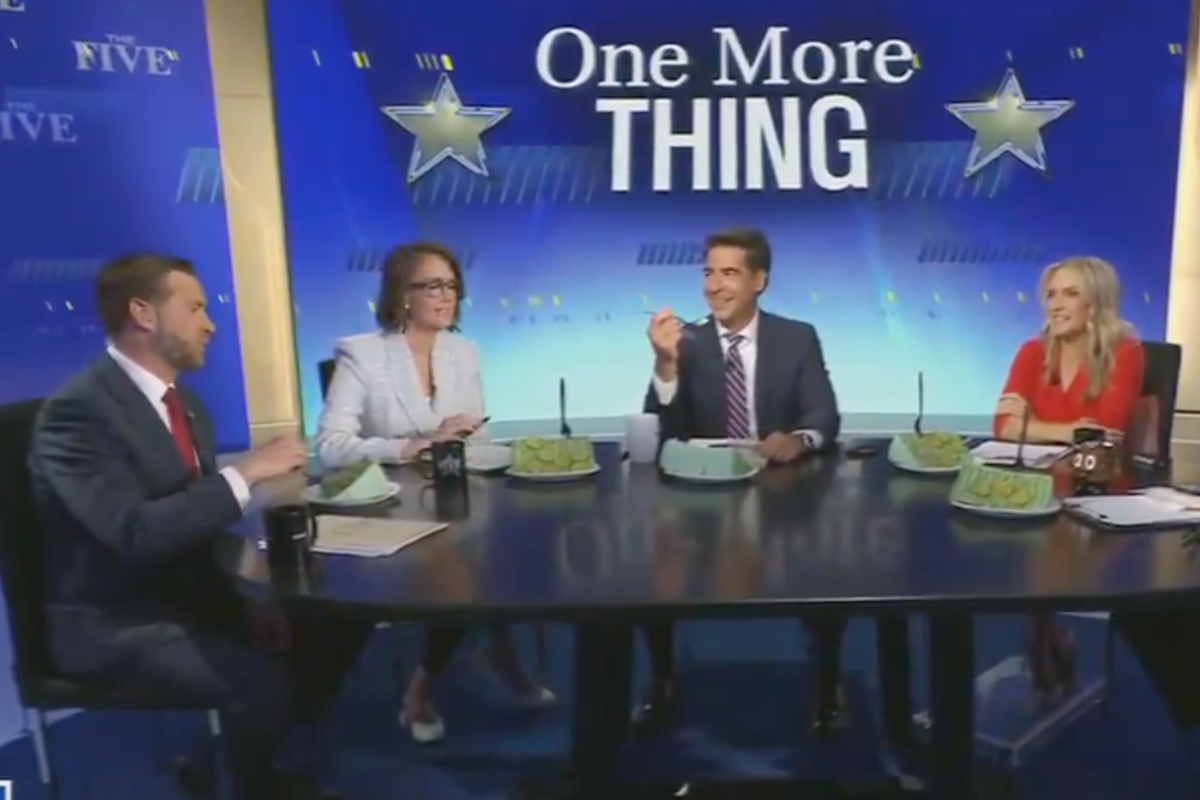
The corporate media spent forty-eight hours hyperventilating over a brief, awkward handoff on the set of Fox News. During Vice President JD Vance’s promotional tour for his new spiritual memoir, Communion: Finding My Way Back to Faith, host Jesse Watters attempted a characteristically crude joke about National Fudge Day, declaring the dessert "too gay" for the Vice President and offering him a "pickle cake" instead. Outlets rushed to report that Vance laughed at the slur, framing the moment as a catastrophic failure of Christian witness.
This fixation misses the actual story. The hyper-fixation on a cable news host’s lowbrow banter is a deliberate distraction from a much more significant political reality. Vance is actively executing a sophisticated, long-term theological campaign designed to reshape the American right, and the traditional press corps lacks the vocabulary to cover it.
The media class treats faith as a superficial campaign prop, a sequence of church photo-ops designed to placate Midwestern voters. Vance treats it as an ideological operating system. By reducing his multi-platform book tour to a micro-controversy over an on-air quip, commentators reveal their own inability to engage with the actual substance of the Vice President's post-liberal Catholic framework.
The Performance Mechanics of Conservative Media
Television studios are built on an unspoken agreement between the politician and the entertainer. Jesse Watters operates as a media provocateur, an anchor whose brand relies on maintaining a high-energy, transgressive environment designed to outrage liberals and amuse the base. Vance, by contrast, is a disciplined ideologue who understands that surviving a live studio appearance requires letting the host's jokes land without creating a secondary confrontation.
When Watters made his bizarre dessert pivot, the reaction from the panel was a mix of habitual laughter and polite deflection. Dana Perino quickly pivoted to thank the Vice President for his time. Vance laughed along, a standard survival mechanism for any politician caught in the crosshairs of live opinion television.
To interpret this defensive reflex as a definitive statement on Vance's personal theology is a fundamental error in media literacy. Political actors on cable news prioritize the preservation of the alliance over the policing of the host's vocabulary. Vance needed the Fox platform to launch a book that addresses structural issues within modern American Christianity, and he was not going to derail that launch to litigate a joke about fudge.
What the Press Missed in Communion
The real substance of Vance's media blitz lies within the pages of Communion, a text that outlines his departure from and eventual return to organized religion. In his discussions on the tour, Vance focused heavily on the concept of spiritual isolation, noting that his youthful drift into atheism was accelerated by a lack of communal infrastructure.
"I, unfortunately, had a lot of friends who were not people of faith," Vance noted during his broadcast appearances. "I had a lot of people who just did not properly support me in my own faith journey, and so I kind of just lost it."
This is not standard political testimony. It is an explicit critique of atomized, modern secular life, framed through the lens of traditionalist Roman Catholicism, the faith he converted to in 2019. The memoir positions his spiritual recovery not as an emotional experience, but as an institutional necessity. It provides the intellectual scaffolding for his broader policy agenda, which treats the traditional family unit and religious communities as the primary counterweights to corporate power and state overreach.
The book also reveals how deeply personal tragedy and conservative solidarity have shaped his worldview. Vance and his wife, Usha, disclosed that their decision to have a fourth child was catalyzed by the assassination of activist Charlie Kirk. Sitting with Kirk’s grieving widow, who expressed profound regret over not having a larger family, fundamentally altered the Vances' approach to their own domestic life. This integration of raw, real-world trauma with structured religious conviction is precisely what makes Vance a formidable cultural figure, far beyond the caricatures presented by his detractors.
The Strategic Function of the Cultural Disconnect
By focusing exclusively on the "too gay" comment, progressive commentators allowed Vance to preserve his outsider credentials with the populist base while avoiding any rigorous public debate over his actual political theology. This dynamic functions as a mutual benefit society for both sides of the media divide.
- The Left-Leaning Media secures easy traffic by highlighting offensive rhetoric, satisfying their audience’s desire for moral clarity.
- The Conservative Infrastructure uses the predictable outrage to demonstrate that the mainstream press is hostile to any authentic expression of traditional values.
- The Politician emerges unscathed, his core intellectual thesis unexamined by his opponents.
The true challenge Vance poses to the current political order is his rejection of the old conservative consensus, which fused corporate deregulation with surface-level religious rhetoric. Vance is attempting something entirely different: a state-backed populist nationalism that uses traditional Catholic social teaching to justify market intervention, pro-family subsidies, and an aggressive skepticism of global institutions.
Lacking the tools to critique this ideological shift, the press defaults to the familiar territory of the culture war. They hunt for gaffes, analyze facial expressions, and treat a three-second chuckle as a window into a man's soul. Meanwhile, the systematic transformation of American conservatism continues unabated, driven by an intellectual project that the cameras completely fail to capture.