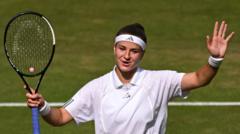
Coco Gauff did not lose her Wimbledon semifinal because Karolina Muchova outplayed her in the third-set tiebreak. She lost because, with a place in her first All England Club final resting on a single short ball, she chose to hide from her own weaknesses. The 6-2, 1-6, 7-6 (12-10) scoreline will go down as a classic, an epic display of modern grass-court tennis that pushed both athletes to their physical absolute limits. Yet the autopsy of this match reveals a darker reality for the American star. When the pressure reached its absolute peak at 9-8 in the final tiebreak, Gauff defaulted to panic.
A routine short ball stood between Gauff and Saturday’s final. Instead of driving through the ball with the conviction of a major champion, she attempted a cute, low-percentage drop shot that died miserably in the net cord.
A Masterclass in Tactical Panic
Tennis matches between elite defenders often devolve into waiting games. For the first two sets, the semifinal on Centre Court felt like two entirely separate matches stapled together. Muchova ran away with the first set in 32 minutes, using deep groundstrokes to expose Gauff's erratic forehand wing. Then the script flipped. Gauff raised her intensity, hitting heavier balls and exploiting Muchova’s sudden drop in physical energy to claim the second set 6-1.
The third set was a grueling slog where neither player could break away.
By the time they reached the 10-point tiebreak, the tennis became completely frantic. Muchova was visibly ailing, clutching her abdominal muscle and struggling to catch her breath in the sweltering heat. She looked done. Gauff had all the momentum, the superior physical conditioning, and a history of winning four consecutive deciding sets just to reach this stage.
The tactical breakdown started when Muchova jumped to a 6-3 lead. Gauff fought back with pure athleticism, clawing her way to 8-9 and earning a match point on her own serve. Muchova scrambled to return a massive first serve down the T, leaving an elementary short ball floating near the service line.
An open court. A ticket to the final. Gauff froze.
The Drop Shot That Costs Grand Slams
In her post-match press conference, Gauff defended her decision-making by arguing that if the drop shot had cleared the net, everyone would have called it clutch. This is a fundamental misunderstanding of high-stakes sports strategy. Good decisions are based on percentages and technical execution, not the hope of a lucky bounce.
The drop shot was a technical disaster because Gauff’s feet were entirely out of position. She approached the ball with hesitation, trying to manipulate the racket face at the last millisecond rather than committing to a fluid swing.
The underlying problem remains her forehand. Under extreme stress, Gauff’s extreme western grip and long take-back make it incredibly difficult to time low or mid-court balls cleanly. She knew it. Subconsciously, she chose the drop shot because it felt safer than trusting her drive forehand to hit an aggressive target. She tried to soften her way out of a moment that required blunt force.
"I was telling myself if I'm going to lose this, I want to lose on my own terms," Muchova said afterward. "My terms is going forward, playing aggressive, going to the net."
That contrast in philosophy was the defining difference. While Gauff looked for an escape hatch, Muchova looked for a weapon.
Muchova Defiance in the Face of Physical Collapse
To understand the magnitude of Muchova’s victory, you have to look at where she was just months ago. Wrist surgery sidelined her for a massive stretch of her career right after her breakthrough run to the 2023 French Open final. Her comeback has been defined by brilliant but fragile tennis.
During the tiebreak, her body looked ready to give out entirely. She was visibly massaging her right side, fighting off a severe side stitch that threatened to derail her entire season.
Muchova vs Gauff Tiebreak Key Points
========================================
3-6  -> Muchova leads, looks in control
6-6  -> Gauff fights back to level
8-9  -> Gauff match point, hits net cord drop shot
10-9 -> Muchova match point, Gauff saves with passing shot
12-10-> Muchova seals it with aggressive hitting
Instead of letting the physical pain dictate her execution, Muchova adjusted her tactics. She shortened the points. She forced herself to move forward, knowing that staying in extended baselines rallies with Gauff would kill her lung capacity. Even after blowing her early leads and facing a match point against her, she remained steady.
When Gauff gave her a second chance by netting that tragic drop shot, Muchova didn’t hesitate. She struck a clutch service winner to save the match point, then pressed the issue with heavy, aggressive groundstrokes to take the final two points of the match.
A Pattern the Gauff Camp Cannot Ignore
This loss cannot be swept under the rug as a simple bad day at the office. It fits into a broader, worrying trend for Gauff when facing elite opposition who possess tactical variety.
Gauff’s athletic gifts are unmatched on the WTA tour. Her backhand is a world-class weapon, and her defensive coverage allows her to win matches she has no business winning. But relying on survival skills wears thin in the final rounds of a Grand Slam. When opponents refuse to beat themselves, Gauff must find ways to actively take the match from them.
Her coaching team has spent countless hours trying to restructure her forehand mechanics and stabilize her second serve, which leaked a critical double fault at 7-7 in the tiebreak. The technical adjustments are coming along, but the mental execution under maximum duress is still lagging. Until Gauff can step up to a short ball on match point and drive it with zero hesitation, she will continue to find herself on the wrong side of these historic battles.
Muchova moves on to an all-Czech final against Linda Noskova, a historic moment for her country and a testament to her incredible variety and mental fortitude. Gauff flies back across the Atlantic with plenty of prize money, a mountain of regret, and the harsh realization that her biggest opponent is still her own hesitation.