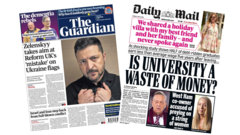
The ink on a morning newspaper has a specific smell. It is sharp, slightly chemical, and entirely cold. When you hold a freshly printed broadsheet in a quiet kitchen while the rest of the city sleeps, that ink rubs off on your thumbs. You carry the world's anxieties on your skin before you even pour your coffee.
On this particular morning, the front pages are splitting themselves across two entirely different scales of human existential dread.
To look at the headlines is to witness a strange duality in how we live today. On the left side of the page, the geopolitical tectonic plates of the Middle East are shifting, hovering inches away from a catastrophic conflict. On the right side, an eighteen-year-old is sitting at a wooden desk in a suburban bedroom, staring at a laptop screen, wondering if signing away the next thirty years of their financial life for a degree in English literature is a profound mistake.
One headline chronicles the movements of nations. The other chronicles the quiet crisis of the kitchen table. Both are about survival. Both are about the terrifying gamble of predicting the future.
The Silence Between the Blasts
Sirens do not just make noise; they leave a vacuum when they stop. In Jerusalem and Tehran, millions of people recently held their breath. The rhetoric flying between Israel and Iran had moved past the usual proxy shadow-boxing into the realm of direct, state-on-state confrontation. Missiles were launched. Drones swarmed. The world braced for the inevitable slide into a regional war that could pull global superpowers into its wake.
Then, something unusual happened. The machinery of war slowed down.
It was not a peace treaty. It was not a sudden burst of mutual affection. It was a calculated, deliberate step back from the edge of the cliff. Analysts call it strategic deterrence, but on the ground, it feels like the collective exhale of people who realized that the fire they were playing with would consume everyone.
Consider a hypothetical family living in Tel Aviv, or another in Isfahan. They do not view geopolitics through the lens of map symbols or troop movements. They view it through the lens of grocery store shelves, air-raid shelters, and the terrifying sound of a smartphone notification alert. When the news anchors report that both governments have decided to signal a de-escalation, it means those families can sleep through the night without their shoes on.
But this step back is fragile. It is an equilibrium built on thin ice. The core grievances have not vanished; they have merely been managed. The newspapers call it a diplomatic success, but anyone who has ever watched a fire die down knows that embers can stay red under the ash for a very long time. The stakes are invisible until they are suddenly blinding. We live in the quiet spaces between the headlines, hoping the people with their fingers on the buttons are as afraid of the dark as we are.
The Architecture of a Modern Promise
Meanwhile, thousands of miles away from the missile trajectories, a different kind of calculation is happening. It involves no explosives, yet it shapes the trajectory of lives just as permanently.
For three generations, a simple, unspoken social contract existed in the West: go to school, work hard, get a university degree, and your place in the middle class will be secured. It was a conveyor belt. You stepped on at eighteen, and you stepped off at twenty-one into a graduate scheme, a salary, and eventual homeownership.
That conveyor belt is broken.
Now, British teenagers face a staggering reality. Tuition fees, combined with the soaring cost of living, mean that graduating from a UK university regularly saddles a young person with over £60,000 of debt. The interest rates on these loans are tied to inflation, turning a financial stepping stone into a mountain that grows faster than most graduates can climb.
Let us look at Sarah. She is a fictional composite of a dozen young people I have interviewed over the last year. She grew up in a town where the local factories closed twenty years ago. Her parents viewed her acceptance letter to a prestigious Russell Group university as a golden ticket, a redemption arc for the family's financial struggles.
Sarah arrived on campus with two suitcases and a sense of destiny. Three years later, she graduated with a high upper-second-class degree in history. Today, she works in a logistics fulfillment center, sorting packages to pay rent on a room she shares with two strangers. Every month, her student loan statement arrives. The balance is higher than it was when she graduated, despite the automatic deductions from her modest paycheck.
She was told that university would teach her how to think. Instead, it taught her how to worry.
The Value of an Unmeasured Mind
The debate over whether higher education is a waste of money usually devolves into a cold war of statistics.
Economists point to the "graduate premium"—the data showing that, on average, university graduates still earn more over their lifetimes than those who enter the workforce straight from school. They produce charts showing the employment rates of doctors, engineers, and computer scientists.
But averages are a comfort only to those who are not drowning in the statistics. If you look closer at the numbers, the premium is collapsing for all but the most elite or technical courses. For arts, humanities, and many social sciences, the financial return on investment is approaching zero, or worse, dipping into the negative.
But the real problem lies elsewhere. We have turned a cultural rite of passage into a purely transactional financial product.
When we ask if university is a waste of money, we are using the language of the ledger to evaluate the human soul. University was never meant to be just a job-training seminar. It was meant to be the place where you learned how to argue, how to fail, how to meet people who disagreed with you, and how to understand your place in human history.
How do you put a price tag on the night you stayed up until 4:00 AM discussing philosophy with someone from the other side of the world? What is the return on investment for learning how to analyze a text, spot propaganda, or write a coherent argument?
When we price these experiences out of reach for the working class—or turn them into a debt trap that punishes curiosity—we change the nature of society itself. We turn learning into a luxury item. We create a system where only the wealthy can afford to study things that do not have an immediate corporate application. The rest are forced to choose between financial survival and intellectual exploration.
The Intersection of Big and Small Worlds
It seems absurd to compare the threat of war in the Middle East with the cost of a British university degree. One is a matter of life and death on a global scale; the other is a matter of personal finance and domestic policy.
Yet, they are bound together by the same fundamental human crisis: the loss of certainty.
We are living in an era where the institutions we trusted to keep us safe and help us progress are showing their age. The global diplomatic architecture that was supposed to prevent state-level warfare is creaking under the strain of regional rivalries. The educational infrastructure that was supposed to guarantee social mobility is buckling under the weight of financialization.
The young person staring at the university application form is doing so under the shadow of the geopolitical headline. They know the world is volatile. They know the job market they enter in three or four years might be unrecognizable, disrupted not just by economic shifts but by artificial intelligence and shifting global alliances. They are being asked to place a massive financial bet on their future at the exact moment the future has never looked more unpredictable.
The Price of the Tomorrow We Build
If you sit in a university lecture hall today, you will notice a different atmosphere than the one that existed twenty years ago. The casual, chaotic energy of the past has been replaced by a quiet, intense seriousness. Students do not skip classes as much. They treat their professors like service providers. They are hyper-focused on internships, resumes, and networking.
They have to be. When you are paying ten thousand pounds a year just for tuition, fun feels like a financial liability.
This shifting perspective changes how people grow up. It forces eighteen-year-olds to become risk-averse managers of their own personal brands before they even know who they are. It replaces the wild, experimental freedom of youth with a rigid, desperate pursuit of security.
The ultimate irony is that both of the morning’s headlines reveal the same truth. Whether you are a diplomat trying to prevent a war or a parent trying to guide a child toward a stable career, we are all just trying to buy a little bit of time. We are trying to build walls against chaos.
The diplomats stepped back from the brink because they realized the cost of moving forward was too high. Perhaps it is time for a similar pause in how we treat our young people. We need to step back from a system that demands eighteen-year-olds sign away their financial futures for the basic right to an education.
The ink on the broadsheet is dry now. The sun is fully up, and the city outside the window is moving, loud and indifferent to the anxieties printed on paper. The world will keep turning, the nations will keep posturing, and the teenagers will keep clicking "apply," hoping against hope that the promises they were made will be kept.