At four in the morning, the Ambassador Bridge does not look like a geopolitical battleground. It looks like a ribbon of wet asphalt, humming under the weight of eighteen-wheelers hauling auto parts from Windsor to Detroit and steel coils back the other way.
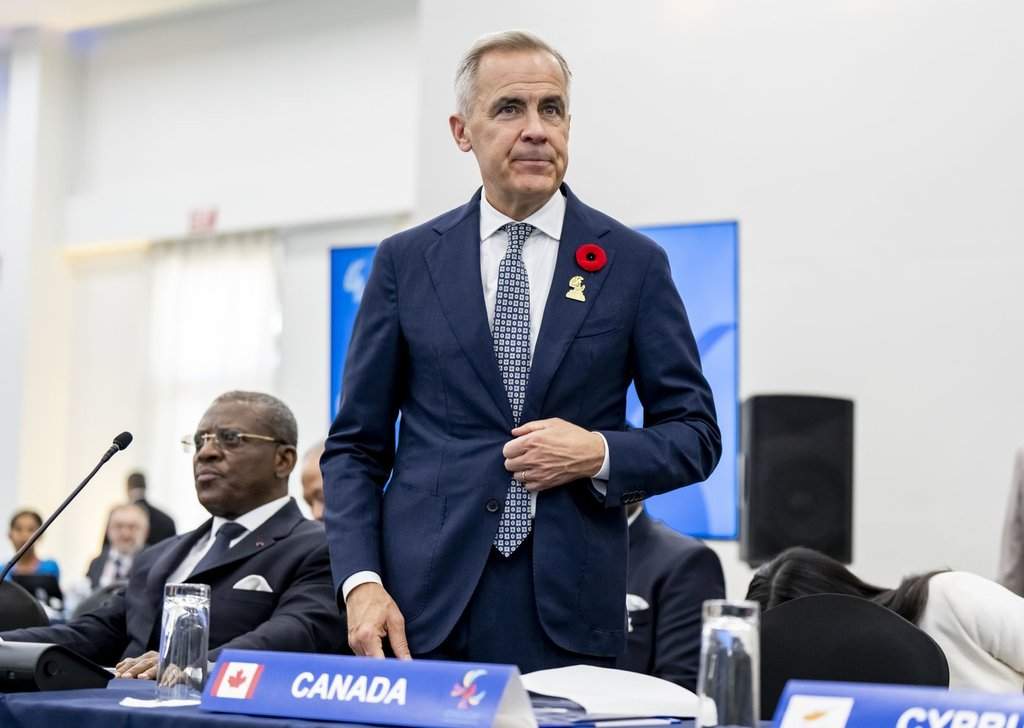
If you stand near the toll plazas in the freezing mist, you can smell diesel, damp concrete, and stale coffee from thermos flasks. You cannot smell a tariff. You cannot see a renegotiation clause hanging in the fog. Yet when Prime Minister Mark Carney stepped up to a bank of microphones in Ottawa and announced that "more intense" trade negotiations with the United States had officially begun, the air over that bridge changed temperature.
Most headlines treated the remark like another routine weather report from the capital. Diplomatic. Measured. Predictable. That is the trap of financial journalism: it translates existential dread into polite nouns. "Intensification." "Bilateral friction." "Review mechanisms."
Let us strip away the anesthetic. When the leader of a G7 nation—a former central banker who spent his career measuring systemic risk to the decimal point—uses the word intense to describe talks with Washington, he is not making small talk. He is telling anyone paying attention that the floorboards of the North American economy are creaking.
The Anatomy of a Three-Billion-Dollar Heartbeat
To understand why those two words matter, you have to stop looking at spreadsheets and start looking at an assembly line.
Consider a hypothetical character we will call Elena, a shift supervisor at a mid-sized precision stamping plant in Guelph, Ontario. Elena does not follow diplomatic cables. She cares about whether the stamping presses run on time and whether her forty-two machinists make their mortgage payments. On Tuesday morning, a block of raw aluminum arrives at her loading dock from Quebec. By Wednesday afternoon, it is shaped into a transmission housing and trucked across the border to a facility in Ohio. By Friday, it comes back into Ontario inside a finished engine assembly, only to cross back into Michigan before it ever touches a dealership lot.
That single piece of metal crosses the border up to seven times before a consumer turns the key.
Economists call this integrated supply chains. Elena calls it Tuesday.
Every single day, roughly $2.5 billion to $3 billion in goods and services moves across the Canada-United States border. That is not merely trade; it is a shared circulatory system. When diplomats in Washington and Ottawa sit down behind closed doors to hammer out new rules of origin, tariff exemptions, or energy quotas, they are performing open-heart surgery on a patient who is still awake and walking around.
I remember the last time the surgical instruments came out, during the bruising renegotiations of the North American Free Trade Agreement between 2017 and 2018. I spent months talking to freight brokers in Niagara and dairy farmers in Wisconsin. What struck me was not the anger, though there was plenty of it. It was the paralysis. A factory owner in Hamilton told me he had two million dollars sitting in a bank account earmarked for new robotics, and he refused to spend a dime of it because he did not know if his product would be taxed out of existence six months later.
Uncertainty is a silent tax. It does not show up on a customs manifest, yet it kills expansion faster than an interest rate hike.
Why Mark Carney Chose His Words Like Scalpels
Mark Carney is not a man given to theatrical exaggeration. Before entering Canadian politics, he steered the Bank of Canada through the 2008 financial crisis and later ran the Bank of England through the chaotic aftermath of Brexit. He understands, better than almost anyone in public life, that markets do not react to reality; they react to the trajectory of reality.
When Carney tells reporters that negotiations with the U.S. have entered a more intense phase, he is doing two things at once.
First, he is signaling to Washington that Ottawa is awake to the stakes. The United States has shifted toward aggressive industrial protectionism—a bipartisan reflex that favors domestic manufacturing subsidies, strict "Buy American" mandates, and the ever-present threat of broad-based import tariffs. Under the scheduled review mechanics of the United States-Mexico-Canada Agreement (USMCA), what was once envisioned as a routine six-year health check has morphed into a high-stakes renegotiation of who gets to build the future.
Second, Carney is preparing Canadians for turbulence.
Think of the relationship between Canada and the United States like two neighbors who share a single well, a single power grid, and a single driveway, except one neighbor weighs ten times as much as the other. Most of the time, the arrangement is wildly prosperous for both. About 75 percent of Canadian exports head south. At the same time, Canada buys more American goods than China, Japan, and the United Kingdom combined, supporting millions of U.S. jobs across dozens of states.
On paper, that mutual dependence looks like an unbreakable shield. In practice, asymmetry creates vulnerability. When the larger neighbor decides to rearrange the furniture, the smaller neighbor gets pinned against the wall.
The Invisible Friction Behind Closed Doors
What actually happens when trade talks turn "intense"?
Forget the staged handshakes under flags. Real trade negotiations happen in windowless conference rooms smelling of cold takeout and dry-erase markers, where teams of trade lawyers argue over four-word clauses for fourteen hours straight.
Right now, the friction points are structural, deep, and painfully expensive:
- Rules of Origin and Autos: Washington wants higher percentages of North American—and specifically American—content in electric vehicles and batteries. For Canadian plants, missing a threshold by two percentage points can trigger tariffs that wipe out an entire year's profit margin.
- Softwood Lumber and Critical Minerals: The decades-old brawl over Canadian timber has never truly ended, costing builders on both sides billions. Meanwhile, the race for lithium, cobalt, and nickel has turned Northern Ontario and Quebec into strategic prizes that Washington wants locked into U.S.-aligned supply chains without giving away market access elsewhere.
- Digital Services and Dairy: Ottawa's digital services taxes on American tech giants and Canada's supply-managed dairy system remain perennial red flags in Washington—political lightning rods that U.S. lawmakers use to prove they are fighting for American workers.
Notice how none of these issues exist in isolation. Trade negotiators treat them like weights on a multi-dimensional scale. If Washington demands concessions on dairy access, Ottawa pushes back on procurement rules for infrastructure. If the U.S. threatens tariffs on steel or aluminum, Canada quietly pulls out a list of retaliatory targets chosen with surgical political precision—bourbon from Kentucky, orange juice from Florida, motorcycles from Wisconsin.
It is chess played with livelihoods.
The Human Ledger Nobody Audits
It is easy to get lost in the elegance of diplomatic strategy and forget who pays the bill while the grandmasters think.
Let us return to Elena in Guelph, and introduce another hypothetical figure across the water: Marcus, a logistics dispatcher in Toledo, Ohio. Marcus coordinates the flatbed trucks carrying rolled steel from Indiana to Ontario and finished stampings back to Michigan. His margins are razor-thin—often less than four percent after fuel, insurance, and driver wages.
When trade talks intensify, rumors leak. A headline drops at noon suggesting the U.S. might slap a temporary ten-percent duty on imported components. By one o'clock, Marcus's phone is ringing off the hook. Clients want to rush shipments across the border before midnight to beat a hypothetical deadline. Port-of-entry wait times double. Drivers burn through their federally mandated hours of service sitting idle in traffic jams on the Blue Water Bridge.
Nobody passed a law. Nobody signed an executive order. Yet Marcus just lost three thousand dollars in overtime and demurrage fees, and Elena had to send her night shift home four hours early because the steel coils were stuck on a bridge forty miles away.
Multiply Elena and Marcus by half a million businesses across both countries. That is the true cost of prolonged trade friction.
I will admit something that analysts rarely say out loud: even the people inside those negotiating rooms do not fully know where the breaking points are until something snaps. Global supply chains are not neat diagrams on a whiteboard; they are chaotic, emergent ecosystems built over forty years of trial, error, and trust. Once you sever a link—once an American automaker decides it is safer to source a component from Tennessee rather than Windsor to avoid border headaches—that factory in Ontario does not come back when the treaty is eventually signed. Capital has a long memory and zero sentimentality.
History's Warning Label
We have been here before, and the lesson from history is blunt.
In 1930, facing economic distress, the United States passed the Smoot-Hawley Tariff Act, raising duties on thousands of imported goods. Canada, its largest trading partner, immediately retaliated with tariffs of its own. Within three years, trade between the two neighbors collapsed by more than half. Sawmills shuttered from British Columbia to Maine. Farm equipment rusted in fields on both sides of the 49th parallel. Economic nationalism promised protection; it delivered shared misery.
Nearly a century later, nobody in Ottawa or Washington wants a repeat of 1930. Both sides know the numbers. They know that North America's only hope of competing economically with massive industrial blocs in Asia and Europe is to operate as a unified, high-efficiency continental powerhouse.
Yet knowing the rational path and walking it are two different things.
Domestic politics on both sides of the border rewards toughness. Voters rarely cheer for a leader who says, "I made a nuanced, mutually beneficial compromise on customs valuation." They cheer for the leader who pounds the podium and promises to protect local jobs from foreign competition.
That is the tightrope Mark Carney is walking right now. He must project unyielding resolve to a domestic audience anxious about American economic dominance, while simultaneously convincing hard-nosed negotiators in Washington that crippling Canada's economy is an act of self-harm for the United States.
Reading the Signals in the Fog
So what should you actually watch for in the weeks ahead? Ignore the press conferences filled with polite handshakes and vague assurances of "productive dialogue." Watch the indicators that cannot be faked:
- Corporate Capital Expenditures: Watch whether major manufacturers announce new plant investments in Ontario, Quebec, and the American Midwest—or whether they quietly pause projects "pending regulatory clarity."
- Currency Fluctuations: The Canadian dollar acts as a real-time barometer of trade anxiety. Sharp drops against the greenback usually signal that institutional investors expect tariff headwinds to erode Canadian export competitiveness.
- Specific Retaliatory Lists: If Ottawa begins circulating draft lists of targeted U.S. goods for public comment, the negotiations have moved from tense to combative.
The true test of these talks will not be measured in the grand rhetoric of trade ministers, nor in the triumphant press releases issued when ink finally touches paper.
It will be measured at four in the morning on the Ambassador Bridge, in whether the trucks keep rolling without stopping, and whether the coffee in the thermos is still hot when the driver clears customs on the other side.