The red earth of Rakhine State sticks to the soles of your boots like wet clay, heavy and impossible to shake off.
If you stand on the shoreline of Kyaukphyu, looking out over the Bay of Bengal, the air smells of diesel and salt. Deep-water cranes rise against the monsoon clouds like steel skeletons. Beneath the murky water, massive twin pipelines begin a silent, subterranean journey—snaking northeast across jagged mountains, through contested jungles, and straight into China’s Yunnan province. For Beijing, these pipes are arteries. They carry crude oil and natural gas from the Indian Ocean directly into landlocked southwestern China, bypassing the narrow, American-patrolled waters of the Malacca Strait.
Less than two hundred miles north of those quiet cranes, the earth holds a different kind of memory. In 2017, nearly three-quarters of a million Rohingya fled across the Naf River into Bangladesh, carrying stories of burned villages, mass graves, and systematic slaughter by Myanmar’s military, the Tatmadaw.
For years, those two realities—Beijing’s concrete-and-steel ambitions and the Rohingya’s shattered lives—existed in separate diplomatic universes. One was talked about in boardrooms and summit halls as "regional connectivity." The other was mourned in muddy refugee camps in Cox’s Bazar as an unspeakable human tragedy.
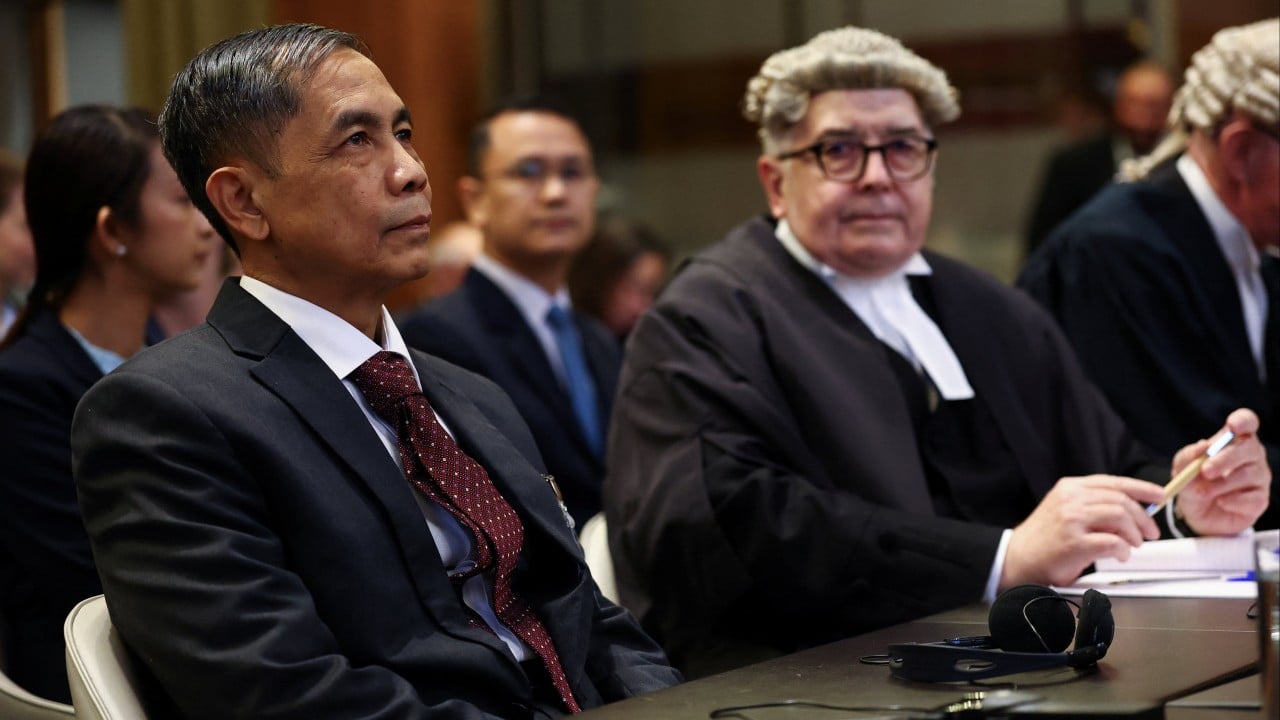
Then the judges in The Hague took their seats.
When the International Court of Justice (ICJ) delivers a ruling on whether Myanmar committed genocide against the Rohingya, the gavel does not merely echo through the wood-paneled Peace Palace in the Netherlands. Its shockwaves travel eight thousand miles east, rattling the steel foundations of Beijing’s grandest geopolitical bet. The legal reckoning forces a question that Chinese diplomats have spent nearly a decade trying to dodge: What happens to an empire's most prized trade corridor when its business partner is officially branded a genocidal regime?
The Illusion of the Neutral Neighbor
To understand the bind Beijing finds itself in, consider a hypothetical scenario on a quiet street in Kunming, the capital of Yunnan province.
Meet Wei, a mid-level logistics coordinator for a state-backed construction firm. For years, Wei’s job has been simple. He tracks shipments of steel girders, turbines, and telecommunications equipment heading south across the border into Myanmar. To Wei, politics is background noise. His superiors operate under an unspoken rule that has defined Chinese foreign policy since the 1950s: non-interference. Beijing builds the roads; whoever holds the keys to the capital city collects the tolls. Whether Myanmar is run by Aung San Suu Kyi’s civilian government or Senior General Min Aung Hlaing’s military junta, Wei’s trucks keep rolling.
That doctrine of non-interference is an intoxicating illusion. It allows a superpower to present itself as a pragmatic friend to all, unbothered by Western lectures on human rights.
Yet an ICJ genocide ruling strips away the comfortable gray areas of diplomacy. Unlike political sanctions imposed by Washington or Brussels—which Beijing routinely dismisses as hypocritical meddling—the International Court of Justice is the highest judicial organ of the United Nations. Both China and Myanmar are signatories to the 1948 Genocide Convention. When the world’s highest court weighs in on the darkest crime in international law, neutrality stops looking like wisdom and starts looking like complicity.
If the court rules against Myanmar, the legal designation changes the gravity of every handshake, every loan, and every arms shipment passing across the Yunnan border. Wei’s shipments of dual-use technology—surveillance cameras, telecom networks, transport vehicles—suddenly fall under a harsh new spotlight. Under the Genocide Convention, states have a legal obligation not just to refrain from genocide, but to prevent and punish it. Continuing business as usual with a state formally adjudicated as genocidal transforms Beijing from a bystander into an enabler in the eyes of the Global South.
And Beijing cares deeply about how the Global South sees it.
A Corridor Built on Shifting Sand
Look at a map of the China-Myanmar Economic Corridor (CMEC). On paper, it looks like a masterpiece of engineering—a 1,700-kilometer wishbone of high-speed railways, industrial zones, and deep-sea ports connecting Kunming to Mandalay, Yangon, and Kyaukphyu. It is the crown jewel of the Belt and Road Initiative in Southeast Asia, designed to turn China’s impoverished southwest into a maritime powerhouse.
On the ground, however, the corridor is a nightmare.
Since the military coup of February 2021 plunged Myanmar into a brutal civil war, the junta has steadily lost control of the country. Ethnic armed organizations and pro-democracy resistance forces now hold vast swaths of the borderlands. The very highways Chinese engineers hoped to pave run straight through active war zones. In northern Shan State, rebel alliances have seized key border crossings, choking off billions of dollars in overland trade.
Think of Beijing’s position in Myanmar like a homeowner who bought a luxury house built directly over an active fault line. For years, the homeowner ignored the hairline cracks in the plaster, repainting the walls and installing expensive new fixtures. When the earth finally begins to shake, the homeowner realizes that the foundation cannot be saved simply by propping up the roof.
The military junta in Naypyidaw is that crumbling foundation. Beijing never actually liked Min Aung Hlaing; Chinese diplomats privately viewed the generals as erratic, incompetent, and dangerously nationalistic. Yet China propped them up because they seemed like the only force capable of guaranteeing security for Chinese pipelines and mines.
An ICJ genocide ruling shatters whatever remaining legitimacy the generals cling to. Even if Beijing vetoes punitive measures at the UN Security Council—as it has done repeatedly in the past—a veto cannot put troops on the ground to protect a pipeline. It cannot force resistance fighters in Rakhine State, like the Arakan Army, to lay down their arms. In fact, the Arakan Army has already overrun most of Rakhine State, standing right at the doorstep of the Kyaukphyu port.
By clinging too tightly to a junta stained by a genocide ruling, China risks alienating the very resistance groups that now control the territory around its multi-billion-dollar investments.
The Moral Trap in the Global South
There is a deeper, quieter cost that rarely shows up in trade ledgers.
Over the past decade, China has worked relentlessly to position itself as the champion of the developing world—a voice for fairness, anti-colonialism, and international law against what it portrays as Western dominance. Beijing brokered a historic rapprochement between Saudi Arabia and Iran. It positioned itself as a peacemaker in global conflicts, courting goodwill across the Middle East, Africa, and Southeast Asia.
The Rohingya crisis sits directly on the fault line of that diplomatic project.
The case at the ICJ was not brought by the United States or Europe. It was brought by The Gambia, a tiny, predominantly Muslim nation in West Africa, backed by the 57-member Organization of Islamic Cooperation (OIC). For millions of people across the Muslim world—from Jakarta to Riyadh—the fate of the Rohingya is not a peripheral geopolitical issue. It is a visceral wound.
I remember speaking with a Rohingya schoolteacher in a crowded shelter in Bangladesh a few years ago. He held a laminated photograph of his flooded village, his thumb tracing the roofline of a collapsed mosque. He did not speak of geopolitics or pipelines. He asked a simple, devastating question: "How can a country that builds bridges everywhere else help the men who burned ours?"
That question haunts Chinese diplomats in Kuala Lumpur, Jakarta, and Dhaka. Indonesia and Malaysia—two of ASEAN’s heaviest hitters and vital partners in China’s economic orbit—have been vocal critics of Myanmar’s atrocities. When Beijing shields Naypyidaw from accountability at the United Nations, it burns through the soft power it has spent billions cultivating across the Islamic world.
Following an adverse ICJ ruling, the diplomatic cost of shielding Myanmar skyrockets. Every time a Chinese envoy blocks a resolution or welcomes a junta minister to Beijing, headlines across Southeast Asia and the Middle East will pair China’s name with a court-verified genocide. No infrastructure loan can easily erase that stain.
How Beijing Adapts When the Ground Shifts
So, how does an empire pivot without admitting it was wrong?
Chinese foreign policy rarely makes dramatic U-turns. It moves like water—seeping around obstacles, eroding resistance quietly, shifting weight from one foot to the other until the stance has completely changed.
First, expect Beijing to widen its diplomatic hedging inside Myanmar. China has already begun quiet, pragmatic outreach to Myanmar’s opposition National Unity Government (NUG) and powerful ethnic armies. Notice how the NUG itself has formally accepted the jurisdiction of the International Court of Justice and vowed to grant the Rohingya full citizenship—a dramatic reversal from the years when Aung San Suu Kyi defended the military at The Hague. For Beijing, engaging with opposition actors who embrace the ICJ ruling offers a clean exit ramp from the junta’s sinking ship.
Second, Beijing will likely double down on bilateral mediation while keeping the United Nations at arm's length. China has repeatedly tried to broker repatriation deals between Myanmar and Bangladesh, hosting tri-lateral talks in Kunming to send small groups of Rohingya refugees back to Rakhine State. Those efforts failed miserably because refugees refused to return to a land still ruled by their killers, with no guarantee of citizenship or safety. Yet an ICJ ruling gives China new leverage to press whoever holds power in Naypyidaw—or Rakhine—to make tangible concessions on Rohingya rights, simply so Beijing can point to "constructive progress" and deflect international criticism.
Third, watch the money. State-owned Chinese banks are notoriously risk-averse when projects become politically toxic. While strategic assets like the Kyaukphyu deep-sea port and the existing oil and gas pipelines will remain non-negotiable priorities, secondary investments along the China-Myanmar Economic Corridor will quietly stall. Capital will freeze. Feasibility studies will drag on indefinitely. Beijing will keep the lights on in Naypyidaw just enough to prevent total state collapse on its border, while withholding the massive capital infusions the junta desperately needs to survive.
What the Ruling Cannot Fix
It is tempting to believe that a gavel falling in The Hague will immediately sever the umbilical cord between Beijing and Myanmar’s generals. That would be a dangerous misreading of geography.
China shares a rugged, 1,300-mile border with Myanmar. Millions of people, billions in illicit and legal trade, methamphetamine networks, cyber-scam compounds, and critical rare-earth minerals flow across those mountains every year. Unlike Western nations, which can impose sanctions from across an ocean and walk away, China has to live next door to whatever chaos unfolds inside Myanmar.
The ICJ has no police force. It cannot send peacekeepers into Rakhine State or arrest generals in Naypyidaw. Legal rulings do not automatically stop bullets, nor do they lay bricks.
Yet laws shape the boundaries of what is acceptable. They change the price of loyalty.
Before the Hague proceedings, China could treat the Rohingya catastrophe as an internal Myanmar squabble—an unfortunate mess to be swept under the rug while surveyors mapped out railway tracks. That era is gone. The ruling permanently binds the fate of China’s infrastructure ambitions to the unresolved justice of a persecuted people.
Down on the coast of Kyaukphyu, the waves still slap against the concrete pilings of the deep-sea port. The oil still flows northward through the dark, pressurized steel beneath the mountains, warming homes and powering factories thousands of miles away. On the surface, nothing has stopped moving.
Look closer at the red earth around those pipes, though, and you realize the truth. You can bury steel deep enough to hide it from the sky, and you can build walls high enough to block out the noise of the world, yet no empire has ever figured out how to lay a lasting foundation over unmarked graves.



