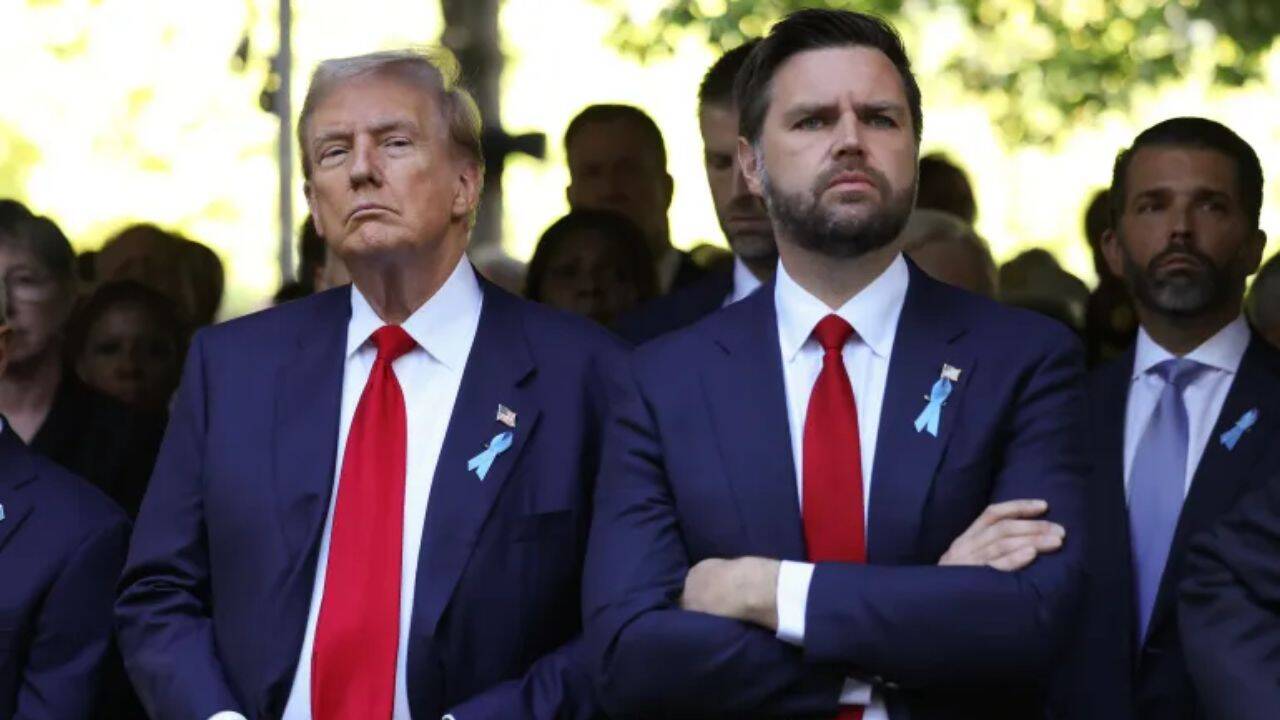
The tarmac hums with turbine heat long after the doors of Air Force One lock. You feel it in the soles of your shoes, a low vibration that makes your ribs buzz while cameras click and microphones rustle against wool coats. In a moment like that, every word spoken into a boom mic sounds heavier than it should. When Donald Trump tells reporters that it is simply too early to talk about endorsing Vice President JD Vance for the 2028 presidential nomination, the pause between his syllables carries a weight that has nothing to do with calendars.
Vance expects the nod if he runs. Trump says not yet.
On paper, that exchange looks like routine Washington choreography. Term-limited presidents guard their leverage; ambitious vice presidents keep their eyes on the horizon. Yet once the November 2026 midterm dust settles, that simple tension between expectation and restraint stops being a parlor game for cable panels. It becomes a question about identity, loyalty, and what happens to a political movement when its founding force approaches the exit.
I have spent years watching political campaigns up close from the back rows of gymnasiums, folding chairs squeaking under tired knees, coffee going cold in Styrofoam cups while county chairs argue over precinct maps. What strikes you in those rooms is how rarely voters care about inside-baseball maneuvering until they feel their own footing slip. A campaign promise feels real when you are standing in a drafty VFW hall in October, smelling floor wax and damp wool, trying to figure out whether the person at the podium actually sees your town or just sees a zip code.
To understand why a non-endorsement matters right now, it helps to use a metaphor. (Note: This is a metaphor to illustrate political dynamics, not a literal event.) Picture a long-haul freight train climbing a steep mountain grade. For ten years, one engine at the front has set the throttle, blown the whistle, and rattled every coupling behind it. The cars coupled right behind that lead engine know the rhythm of its pull. If the lead engineer steps down at the summit and refuses to say whether the second engine gets full steam or has to fight for coal on its own, every brakeman on the line starts checking the couplings.
That is the quiet drama hovering over the 2028 Republican field. Early polling after the 2026 midterms still places Vance near the front of GOP primary preferences—hovering around 40% in surveys—ahead of figures like Secretary of State Marco Rubio, who has also been floated alongside Vance in discussions of future tickets. Other names keep circulating too, from Georgia Governor Brian Kemp, whose term ends in 2027, to senators like Ted Cruz and Tom Cotton. Yet numbers in November of a midterm year are soft clay. They shift with every new headline, every local race, and every signal from the White House.
When Expectation Meets Caution
Watch how two men can look at the same chessboard and see completely different moves.
Vance has stood beside Trump through the second term, carrying the administration's arguments into interviews, conventions, and tough broadcast appearances. In interviews, he has indicated that while he has not finalized his own plans for 2028, he expects Trump would back him if he chooses to run. From Vance's vantage point, that expectation is logical. He has worked to align himself with the movement's priorities and defend its record in real time.
Trump, meanwhile, has praised Vance as talented and good while keeping his own cards close to his vest, insisting it is too early to commit before seeing how things shake out. He has even suggested combinations involving both Vance and Rubio without locking in a single coronation.
Politically, holding back preserves options. An early endorsement before a primary race even takes shape can freeze donors, lock in alliances too soon, or hand rivals a clear target before they have tested their appeal. After midterm losses that left Republicans dissecting what went wrong with voters, caution inside the party has grown even sharper. Even some reports have suggested Vance himself has weighed his options carefully in the wake of the midterms.
Let me admit something honest here: trying to read the motives of seasoned politicians from the outside can feel maddening. You listen to the same clip three times, dissecting tone and phrasing, only to realize that certainty is a luxury nobody in that room actually possesses. Voters feel that uncertainty too. People who work double shifts, watch grocery receipts climb, or worry about interest rates on a used truck do not wake up thinking about primary calendars—until a candidate's name starts showing up on signs and they wonder who will actually fight for them.
The Invisible Stakes for Everyday Voters
Why does a delay over an endorsement ripple outward into ordinary lives? Because a presidential nomination shapes which problems get attention and which ones get shelved.
Consider a hypothetical scenario to make the human stakes concrete. (Note: This is a hypothetical scenario created for illustration.) Imagine a machinist named Dale in rural Ohio who voted Republican in 2024 because he wanted factory jobs protected and Washington kept at bay. In 2026, he watches local races, sees party leaders trading blame after tough midterm results, and hears whispers about a crowded 2028 field. Dale doesn't care about cable pundits trading insults. He cares whether the next nominee will push for domestic manufacturing or pivot toward donor wish lists, whether trade policy will help his plant stay open, and whether the party's energy will stay focused on working towns or fracture into internal feuds.
Across the country, millions of voters sit in Dale's shoes, though their priorities vary wildly. Some care most about border enforcement and immigration policy; others focus on inflation, healthcare costs, foreign entanglements, or judicial appointments. When the party's most influential voice holds off on naming a preferred successor, it signals that the baton has not yet been cleanly passed.
Historically, American parties rarely hand off power without friction. Think back to past eras when a dominant president neared the end of a second term: successors often tried to inherit the coalition while carving out enough independence to win a general election. That balancing act is notoriously tricky. Lean too hard into every past battle, and you risk alienating swing voters who grew weary of constant friction; step too far back from the base, and you risk losing the very supporters who show up first in primary states.
What Comes Next in the Waiting Game
Right now, the 2028 race is less a sprint than a slow gathering of breath.
Vance holds name recognition, administration visibility, and early support among surveyed Republicans, yet he has not declared a formal bid and faces questions about how midterm headwinds affect the road ahead. Rubio brings foreign policy experience and high-level cabinet standing. Figures like Kemp represent an alternative governing lane within the party, while other senators and governors watch to see whether the field widens or narrows.
Meanwhile, Trump holds the biggest megaphone in the room. Until he decides whether—and when—to put his weight behind a specific contender, every candidate is operating in a half-lit room, reading expressions and waiting for the door to open.
Out on the highway between small towns, the wind still bends the tall grass along the shoulder and headlights cut through the early dusk. Nothing is decided yet, and the noise of Washington rarely reaches that stretch of asphalt without losing half its meaning. Yet every mile closer to 2028 brings that quiet hesitation one step closer to a real choice, standing right in front of the people who will live with the result.
Trump doesn't commit to endorsing JD Vance for president in 2028 election
This short news clip directly shows President Donald Trump declining to commit to an early endorsement of Vice President JD Vance for the 2028 race, capturing the exact tension at the heart of the article.