Gravity does not care about your engagement metrics.
It does not pause while you adjust your angle, nor does it soften the landing when a century-old plaster hand slips from your grip. In the quiet Baltic town of Šiauliai, or along the windswept, pine-scented hills of Lithuania where wooden and stone crosses lean against one another like old friends, the air usually carries the weight of memory. People come to these places to whisper. They come to leave behind the heavy, invisible burdens of grief, gratitude, and hope.
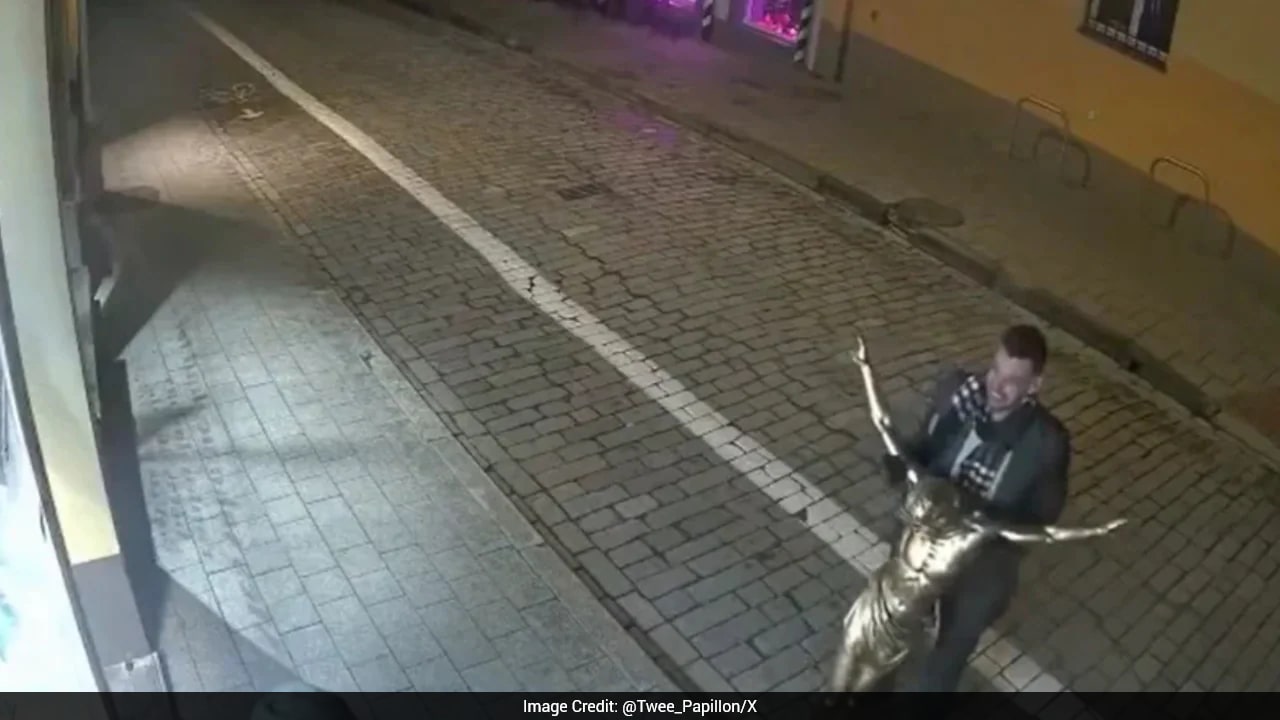
Then came the click of a camera shutter, followed immediately by the sickening, hollow crunch of shattered sacred art.
When news broke that a man had broken a statue of Jesus Christ into pieces while posing for a photograph in Lithuania, the internet reacted with its usual, predictable cycle of outrage and dark humor. Headlines reduced the event to a punchline. Man breaks Jesus statue. Tourist ruins everything. Another idiot with a smartphone. We scrolled past, shook our heads at the audacity of a stranger, and moved on to the next outrage.
But the real problem lies elsewhere.
That broken statue on the Lithuanian pavement is not an isolated incident of clumsiness. It is a symptom of a quiet, global transformation in how human beings inhabit physical space. We have slowly traded presence for performance, turning sacred ground, historical monuments, and fragile works of devotion into mere backdrops for our digital autobiographies.
The Anatomy of a Shattered Moment
To understand what actually happens in the second before a monument falls, you have to step inside the mind of the person holding the phone. Imagine—purely as a hypothetical reconstruction of a scene played out thousands of times across the globe—a traveler standing before a revered figure in a quiet Lithuanian square or sanctuary. Let’s call him Tomas.
Tomas is not a vandal. He did not wake up that morning with a hammer in his bag and malice in his heart. In fact, he likely admired the craftsmanship of the statue. He felt moved enough by the atmosphere of the place to want to capture it, to prove to the invisible audience waiting on his screen that he was there, that he had witnessed something profound.
So he steps closer. He crosses the unspoken boundary that separates observation from intrusion. To make the photo dynamic—to make it worthy of a double-tap—he reaches out. Maybe he drapes an arm around the weathered shoulders of the figure. Maybe he leans his weight against an outstretched arm, treating painted plaster or aged wood as if it were reinforced steel.
For three seconds, he smiles into the lens.
And then the physics of time take over.
Materials like aged wood, limestone, and hollow plaster are not built to bear the sudden, shifting weight of an adult human leaning in for a casual pose. Over decades, moisture seeps into microscopic fissures. Frost expands those cracks during harsh Baltic winters, and summer heat dries the core until it becomes brittle as dried bone. A statue can stand proudly against wind and rain for a hundred years, yet surrender instantly to the sideways torque of a single careless embrace.
The collapse is never cinematic. There is no slow-motion warning. One moment the figure is whole, holding the silent prayers of generations; the next, it is a jagged heap of white dust, severed limbs, and splintered history at the feet of a horrified bystander.
Why Sacred Spaces Have Become Content Farms
I learned the cost of this visual hunger firsthand years ago, standing inside a dimly lit European chapel where centuries-old frescoes were flaking off the damp walls. A sign at the entrance pleaded with visitors in four languages to keep their distance and turn off their flashes. Yet within five minutes, I watched a young couple press their backs directly against the fragile pigment so they could frame a symmetrical shot for their travel feed. When a local caretaker gently asked them to step away, they looked genuinely confused—not malicious, just utterly blind to the idea that the wall was anything other than wallpaper for their portrait.
That blindness is the defining psychological quirk of modern travel and public life. Psychologists who study digital behavior call it the photo-taking-impairment effect. When we view the world through the viewfinder of a smartphone, our brains offload the responsibility of memory and spatial awareness onto the device. We stop experiencing the environment and start curating it.
Think of a physical monument like a delicate, hand-blown glass heirloom passed down through a family. If you hold it with both hands, acknowledging its fragility and its history, it survives. If you toss it casually from hand to hand while trying to film a trick shot, it shatters. Our cultural heritage—whether it is a religious icon in Lithuania, a sandstone formation in Utah, or a marble bust in Rome—is that glass heirloom.
Consider what happens next:
- The erasure of context. When a statue of Christ in Lithuania is reduced to a prop, the profound history behind it vanishes. Lithuania’s relationship with Christian iconography is deeply intertwined with survival and resistance. During the Soviet occupation, when religious expression was suppressed and symbols of faith were bulldozed under the cover of night, Lithuanians risked imprisonment to secretly erect and restore crosses and statues. Those figures were not decorations; they were acts of quiet rebellion.
- The illusion of invincibility. Modern urban environments are built out of concrete, tempered glass, and steel—materials engineered to withstand careless human contact. We lean against subway pillars, sit on metal railings, and bump into store displays without consequence. When we enter historical or sacred spaces, we carry that same muscle memory with us, forgetting that old things are fragile things.
- The tyranny of the novel angle. Standard photographs no longer register on crowded social feeds. To stand ten feet back and take a respectful picture feels boring. The algorithm rewards proximity, physical interaction, and irreverence—pushing people to climb, touch, hug, and hang from structures that were never meant to be touched.
A Trail of Broken History
Lithuania is hardly alone in counting the cost of the perfect shot. Across the continent, the ledger of accidental destruction grows longer every summer.
In Italy, a tourist snapped the toes off a nineteenth-century plaster model by Antonio Canova while reclining across the sculpture for a photograph. In Portugal, a man climbed onto the pedestal of a 126-year-old statue of King Dom Sebastião in Lisbon to take a selfie, bringing the entire stone monarch crashing down onto the cobblestones. In Brussels, a visitor climbed onto a historic monument outside the Stock Exchange, snapping off a sculpted arm in full view of the street.
Each time, the aftermath follows the exact same script. The perpetrator looks shocked, mutters an apology, and often claims they had no idea the object was so fragile. Local authorities assess the damage, realizing that even when a statue can be glued back together, its original integrity is gone forever. A repaired fracture is still a scar.
It is easy to look at these stories and feel a surge of moral superiority. I catch myself doing it, too. I want to believe I would never be that careless, that my respect for art and faith would always keep my hands at my sides.
Yet if I am honest with myself, I know how seductive the lens can be. I have stepped slightly off a marked trail to get a better view of a canyon. I have lingered a second too long in a doorway blocking foot traffic because the afternoon light hit the cobblestones just right. The line between an appreciative visitor and a destructive one is thinner than most of us care to admit. It is simply a matter of degrees—and a momentary lapse in attention.
What Restores Reverence
If fines, warning signs, and velvet ropes were enough to protect our shared heritage, the statue in Lithuania would still be standing whole. Most people know the rules. What we are missing is a shift in how we teach ourselves to look at the world.
True reverence—whether religious, historical, or artistic—requires restraint. It asks us to accept that some things in this world do not exist for our personal use. They are not interactive exhibits, and they do not owe us a photograph.
When you stand before an old statue in a quiet Lithuanian town, or walk past a weathered roadside shrine, the most radical thing you can do today is keep your phone in your pocket. Let your eyes adjust to the texture of the carved wood or painted plaster. Notice the small offerings left at the base by people whose names you will never know. Feel the weight of the years it took for that object to survive wars, regimes, and storms just to stand in front of you on an ordinary afternoon.
Because once the plaster hits the pavement, no apology can put the dust back together. All that remains is an empty pedestal, a handful of broken pieces, and a photograph nobody wants to look at anymore.