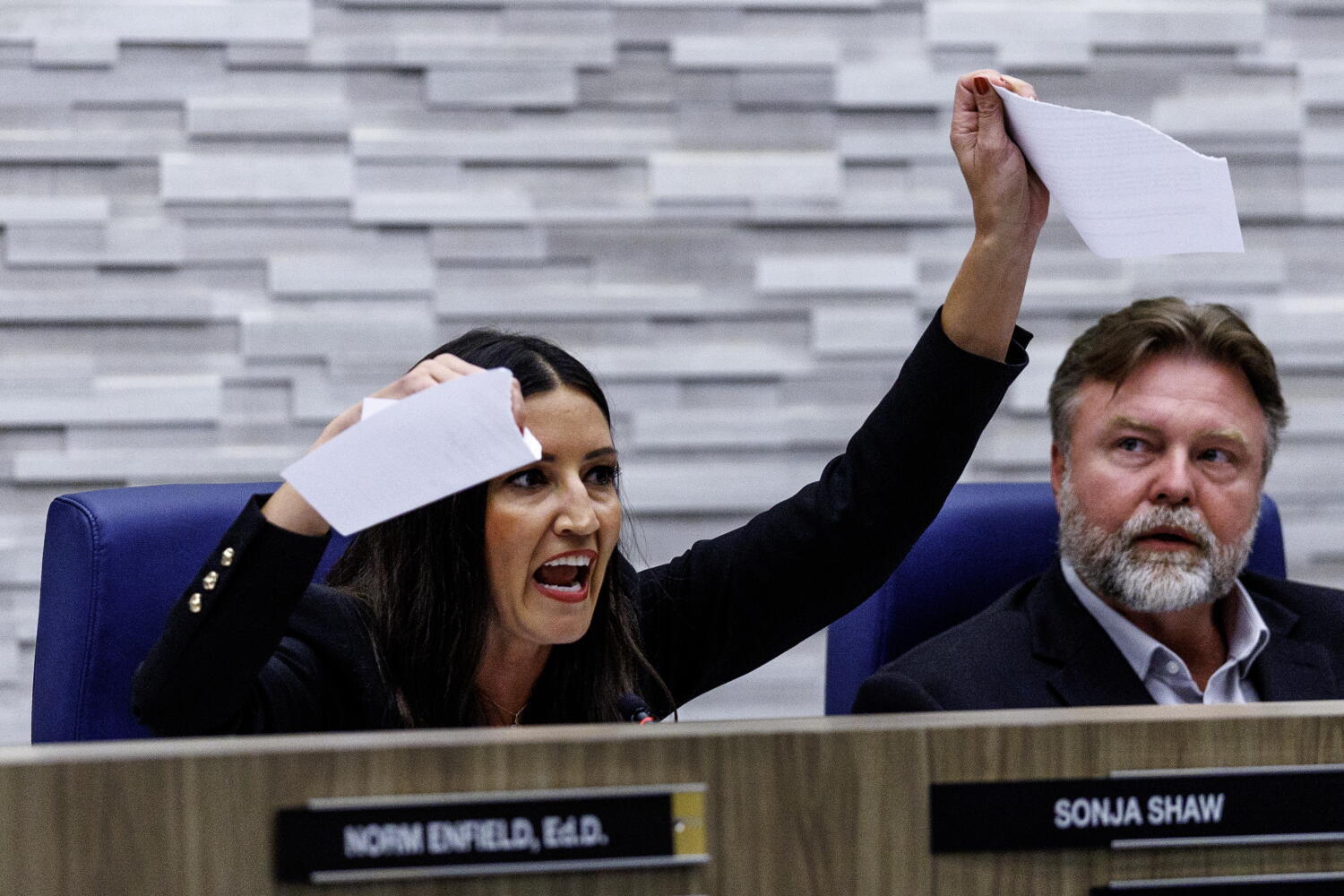
Fluorescent lights hum differently at 10:30 p.m. inside a suburban school district boardroom.
During the day, a school building smells like floor wax, cafeteria pizza, and dry-erase markers. At night, when the public comment microphones are finally switched off and the folding chairs are stacked against the cinderblock walls, the air turns stale and heavy. People gather up their tote bags, adjust their lanyards, and walk out to the parking lot under sodium-vapor lamps. A gavel falls. A vote is recorded in the minutes. Everyone goes home to sleep.
Except for the teenagers who have to walk through those same double doors at 7:45 the next morning.
In Southern California’s Inland Empire, the Chino Valley Unified School District has spent the better part of three years turning routine school board meetings into a national flashpoint. Most recently, in a parting salvo coinciding with board president Sonja Shaw’s exit from the dais, the board moved to bar transgender students from participating in girls’ sports and from using girls’ restrooms and locker rooms. To an outside observer reading a wire brief over morning coffee, the headline looks like just another volley in an endless, exhausting culture war. One side declares victory for fairness and privacy. The other promises lawsuits and warns of state intervention.
Then the news cycle moves on.
What gets lost in the noise of cable news panels and partisan press releases is the quiet, suffocating mechanics of what happens inside a high school hallway when a policy stops being a talking point and becomes a rule enforced by a vice principal with a clipboard.
The Architecture of a Normal Tuesday
To understand the weight of a bathroom ban or a roster restriction, you have to step away from legal briefs and step onto the scuffed linoleum of a tenth-grade corridor.
Consider a hypothetical student—let’s call her Maya. Maya is sixteen, plays junior varsity volleyball, and spends too much time worrying about her AP Chemistry grade and whether her bangs look right in the fluorescent mirror between third and fourth period. She is not a legal test case. She is not a political operative. She is a teenager trying to survive the daily social minefield of adolescence without drawing unnecessary attention to herself.
Under a policy that bars transgender girls from female facilities, Maya’s Tuesday morning ceases to be about chemistry or volleyball. It becomes a logistical puzzle governed by anxiety.
Between classes, students have five minutes. Five minutes to pack a backpack, navigate a crowded stairwell, reach a locker, and use the restroom. If Maya is forbidden from entering the girls’ restroom, where does she go? According to district administrators who favor these restrictions, the standard answer is a single-stall, gender-neutral bathroom—often located inside the nurse’s office or tucked away near the administrative wing on the far side of campus.
Walk that route in your head. To use the restroom, Maya has to leave the normal flow of her peers, walk across campus to the front office, ask a secretary for a key or sign a logbook, and return to class five minutes after the bell has already rung. Every single day, her absence announces itself to thirty classmates. Every single day, a basic biological function becomes a public spectacle.
So what do teenagers actually do when faced with that choice?
They stop drinking water.
Pediatricians and school nurses across the country have documented this phenomenon for years, long before Chino Valley became a household name in political circles. When access to a restroom carries stigma, surveillance, or logistical humiliation, adolescents simply dehydrate themselves from 7:00 a.m. until 3:30 p.m. They develop urinary tract infections. They sit in sixth-period algebra with splitting headaches, unable to focus on quadratic equations because their bodies are running on empty.
The policy document calls this "protecting student privacy." Inside the building, it feels a lot more like exile.
Two Truths Colliding at the Net
It is easy, if you stand on one side of the cultural divide, to look at the board’s defenders and see only malice. It is just as easy, standing on the other side, to look at transgender advocates and see only a disregard for biological reality. Both caricatures are lazy, and neither helps us understand why this specific issue keeps tearing communities apart.
Let’s be honest about the confusion and the fear at the heart of this debate, because pretending it isn't there only deepens the distrust.
Ask a parent who has spent twelve years driving their daughter to 6:00 a.m. swim practices or weekend soccer tournaments why they supported the Chino Valley resolution. Many of them will not quote political pundits. They will talk about fairness. They will talk about male puberty—the measurable physiological differences in bone density, lung capacity, muscle mass, and hemoglobin levels that develop during adolescence. To a parent watching their daughter fight for a spot on a varsity roster or a partial college scholarship, the question isn't abstract philosophy. It is physics. They worry that a biological advantage, once conferred, cannot be undone simply by good intentions.
At the same time, look at the other side of that same gymnasium.
In the entire state of California—a state with roughly six million K–12 public school students—the number of transgender girls competing in high school girls' sports at any given time can typically be counted on two hands. Research from organizations like the Williams Institute at UCLA School of Law indicates that transgender youth make up roughly 1.4 percent of teenagers aged thirteen to seventeen nationwide, and only a tiny fraction of those students participate in competitive interscholastic athletics.
For those few kids, high school sports are rarely about athletic scholarships or state championships. They are about survival.
Adolescence is a brutal proving ground where identity is forged in groups. Being on a team means having a place to sit at lunch. It means learning how to lose gracefully, how to push past physical exhaustion, and how to belong to something larger than your own insecurities. Decades of public health data—including recurring surveys from the Centers for Disease Control and Prevention—show that transgender youth experience dramatically higher rates of depression and suicidal ideation than their cisgender peers, yet those rates drop sharply when students have supportive school environments and trusted adults.
Think of the competing imperatives like two gears grinding against each other without oil. One gear is driven by a desire to preserve fair competition and clear boundaries for cisgender girls. The other gear is driven by a duty to protect a tiny, vulnerable group of students from isolation and harm. When a school board passes a sweeping, blanket ban without nuance, it doesn't solve the friction. It just strips the teeth off the smaller gear.
The Collision Course With Sacramento
What makes Chino Valley Unified’s vote particularly jarring isn't merely the human cost inside its campuses. It is the near-certainty of what happens next in court.
California is not a legal blank slate on this question. In 2013, the state legislature passed Assembly Bill 1266, known as the School Success and Opportunity Act. Since January 2014, California Education Code Section 221.5(f) has explicitly stated that a pupil shall be permitted to participate in sex-segregated school programs and activities, including athletic teams and competitions, and use facilities consistent with their gender identity, irrespective of the gender listed on the pupil's records.
Furthermore, the California Interscholastic Federation—the governing body for high school sports across the state—has operated under gender-identity participation guidelines aligned with state law for over a decade.
Board members in Chino Valley know this. Their legal counsel knows this. California Attorney General Rob Bonta knows this, having already sued the district in 2023 over its mandatory parental notification policy regarding student pronouns and gender identification—a battle that resulted in a San Bernardino County Superior Court judge blocking key portions of the district's policy and the state later enacting Assembly Bill 1955 to prohibit forced outing rules statewide.
Look closely at the sequence of events. When a local school board adopts a resolution that directly contradicts an explicit California statute, it is not acting as a sober steward of local tax dollars. It is stepping onto a legal tripwire with its eyes wide open.
Public school districts are funded primarily through state allocations based on average daily attendance. Every dollar spent defending an indefensible statutory conflict in Superior Court is a dollar not spent on reading specialists, air conditioning repairs, AP exam subsidies, or school counselors. According to public records and local reporting from previous legal clashes in the Inland Empire, districts entangled in ideological litigation routinely burn through hundreds of thousands—and sometimes millions—of dollars in outside legal fees.
As Sonja Shaw prepares to exit the board, the political spotlight moves with her. The cameras pack up. The out-of-town activists who fill the public comment slots return to their respective corners of the state. Meanwhile, the district itself is left holding the legal invoice, while principals and athletic directors are caught in an impossible bind: obey the local school board and violate state law, or follow state law and face the wrath of their employers.
What Remains After the Gavel
If you have ever sat through a contentious school board meeting in a mid-sized American town, you know the strange theater of it all.
People step up to the podium with three minutes on a digital countdown clock. They read prepared remarks into a microphone, aiming their words not at the neighbors sitting three rows behind them, but at the livestream camera mounted on the back wall. Everybody speaks in absolutes. Nobody concedes a millimeter.
Yet outside the boardroom, life refuses to organize itself into clean talking points.
I remember talking years ago with a veteran high school track coach in Southern California who had spent thirty years coaching teenagers from every conceivable background. When asked how he handled thorny locker room and roster questions long before they became cable news fodder, he didn't cite legal statutes or ideological manifestos. He shrugged and said that when you actually know the kids—when you see them every afternoon at 3:30 p.m. tying their spikes on the bleachers—you realize that ninety-nine percent of problems get solved quietly by adults who care more about the teenagers in front of them than the adults yelling from the bleachers.
That quiet pragmatism is precisely what vanishes when school governance turns into political performance art.
Consider what happens next in Chino Valley. Over the coming weeks, civil rights organizations and state officials will inevitably scrutinize the policy. Letters of warning will be drafted. Injunctions will be sought. Board meetings will stretch past midnight again, packed with speakers who have no children enrolled in the district.
And tomorrow morning, at 7:45 a.m., the bell will ring at Chino Hills High, Don Lugo High, and Ayala High.
Thousands of teenagers will surge through the gates, carrying heavy backpacks, half-finished homework, and the fragile, unspoken hope that the adults running their school are paying attention to them. Most of them will walk straight past the trophy cases and the administrative offices without giving a second thought to the minutes of last night's meeting.
A few of them will stop at the edge of the hallway, look at the sign on the bathroom door, and quietly turn around to walk across campus alone.