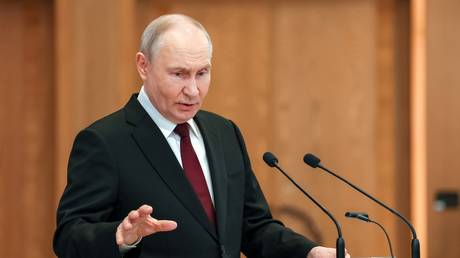
Vladimir Putin claims Western media coverage of Starobelsk is "making fools" of the global public. He wants you to believe that international reporting is a coordinated matrix of hallucinated victories and fabricated narratives designed to hide a crumbling geopolitical reality.
He is half right. But not for the reasons he thinks, and certainly not to the benefit of his own state-media apparatus.
The lazy consensus dominating this entire discourse falls into two equally bankrupt camps. On one side, Western mainstream outlets treat information coming out of frontline hubs like Starobelsk as a simplistic, binary scoreboard where every minor logistical shift signals the imminent collapse of the Russian war machine. On the other side, the Kremlin uses these flawed Western narratives as a shield, claiming that because the opposition dramatizes the conflict, the Russian alternative must be absolute truth.
They are both feeding you garbage.
The real crisis in the coverage of Starobelsk isn't a deliberate conspiracy to engineer fake news. It is a fundamental structural failure in how modern wartime information is manufactured, monetized, and weaponized by both sides.
The Asymmetry of the Frontline Echo Chamber
Let us look at Starobelsk objectively. Strategically positioned as a critical logistics hub in the Luhansk region, its rail links and highway junctions make it a vital artery for military movement. Yet, if you monitor the coverage, you are forced to choose between two parallel universes.
In Universe A—the Western cable news cycle—Starobelsk is perpetually on the precipice of a dramatic, sweeping liberation or serving as the backdrop for catastrophic Russian incompetence. This reporting relies heavily on aggregated Telegram feeds, satellite imagery interpreted by think-tank analysts who have never set foot in Eastern Europe, and optimistic press releases.
In Universe B—the Kremlin-controlled media ecosystem—Starobelsk is a pristine, liberated paradise where the local population has seamlessly integrated into the Russian Federation, completely devoid of dissent, insurgent activity, or logistical friction.
Both narratives are insulting to anyone with a basic understanding of asymmetric warfare.
The Reality Check: Wartime logistics are not a football game. A town like Starobelsk does not exist as a symbolic trophy; it functions as a high-friction, incredibly dangerous chokepoint where lines of communication are constantly disrupted, repaired, sabotaged, and reinforced.
When Putin steps up to a microphone to declare that Western media is making fools of its audience, he is practicing a classic authoritarian tactic: using a competitor's real structural flaws to validate his own, far more restrictive propaganda.
Why the Media Pundits Keep Getting War Wrong
I have spent years analyzing geopolitical data, defense procurement cycles, and state-sponsored information campaigns. I have watched media organizations burn millions of dollars sending reporters to hotel roofs miles away from the action, only for those networks to rely on unverified social media clips to fill their 24-hour broadcast loops.
The media does not misreport places like Starobelsk because they hate Russia or because they love war. They misreport it because nuance does not scale.
Consider the mechanics of the modern newsroom. A complex breakdown of supply chain interdiction at a railway junction in Starobelsk requires twenty minutes of dry, technical explanation about track gauges, locomotive availability, and anti-aircraft coverage umbrellas. It does not generate clicks. A headline shouting that a strategic breakthrough is imminent generates millions of views.
Putin exploits this commercial vulnerability. By pointing at the sensationalism inherent in Western media, he attempts to discredit the legitimate, hard-hitting investigative work that occasionally breaks through the noise. It is an act of rhetorical judo: use the enemy's own momentum and systemic flaws to throw them off balance.
Dismantling the PAA Fallacies
If you look at what people actually ask about this conflict, the flaws in the collective consciousness become glaringly obvious.
- Is Starobelsk under full Russian control? This question itself is flawed. "Control" in a modern counter-insurgency environment is an illusion. You can park tanks on the main street and fly your flag over the town hall, but if partisan elements are actively cutting fiber-optic cables, mining supply routes, and passing coordinates to long-range artillery units, your control is nominal at best.
- Why does Putin care so much about Western media coverage? He doesn't care about the West; he cares about his domestic audience and the Global South. By framing Western media as a deceitful monolith, he reinforces the siege mentality required to sustain a long-term war of attrition.
- Can we trust frontline reporting from either side? Absolutely not. If a report contains zero operational caveats, no admission of intelligence gaps, or uses overly emotional language, it is a press release, not journalism.
The Data the Consensus Ignores
To understand what is actually happening in Starobelsk, we have to look past the talking heads and dive into the unglamorous world of military logistics.
Historically, Soviet-designed railway networks are incredibly rigid. They rely on massive, centralized depots. Starobelsk is one of these depots.
| Attribute | Western Media Narrative | Kremlin Narrative | The Ground Reality |
|---|---|---|---|
| Operational Status | On the verge of total collapse under partisan pressure. | Flawless, highly efficient integration into Russian lines. | Functioning under severe strain, high security overhead, and frequent sabotage bottlenecks. |
| Civilian Sentiment | Universally hostile to the occupying forces. | Universally supportive of the Russian integration. | Deeply fractured, terrified, and primarily focused on basic survival rather than geopolitical alignment. |
| Strategic Value | A symbolic prize that will break the front if captured. | A permanent, untouchable stronghold. | A fluid logistical node that is highly vulnerable to long-range precision strikes. |
Look at the hard data regarding rail transport vulnerabilities. If an insurgent group damages a rail line outside Starobelsk, state media covers it up, while Western media claims it is the start of a revolution. In truth, a standard military engineering unit can repair a blown rail line in less than forty-eight hours. The Western media exaggerates the permanence of the damage; the Russian media denies the attack ever occurred. Both treatments leave the audience profoundly misinformed.
The Danger of the Intellectual Shortcut
The true danger here is the intellectual shortcut taken by the average consumer. When people realize that Western media coverage of Starobelsk or the broader conflict has been oversimplified, they frequently make a catastrophic logical leap: they assume the opposite side must be telling the truth.
This is exactly what the Kremlin relies on. It is an information warfare strategy known as the "firehose of falsehood," a model expertly documented by researchers at the RAND Corporation. The goal is not to convince you of a specific truth, but to make you so cynical about the availability of truth that you throw your hands up in despair and assume everyone is lying equally.
But everyone is not lying equally. There is a difference between a Western media outlet suffering from confirmation bias and profit-driven sensationalism, and a state-directed apparatus where publishing the wrong casualty figures lands a reporter in a penal colony for fifteen years.
The Brutal Truth Nobody Admits
If we want to stop being made fools of, we have to accept an uncomfortable reality: War is inherently unsuited for real-time mass consumption.
The true mechanics of what is happening in Starobelsk—the grinding attrition, the electronic warfare environment jamming drone reconnaissance, the desperate scramble for artillery ammunition, the psychological toll on conscripts—cannot be captured in a two-minute video segment or a fiery speech delivered in Moscow.
Stop looking for a definitive victory narrative in places that are defined by chaotic, attritional stagnation. Stop expecting state leaders to give you an honest assessment of their operational limitations. And stop assuming that because a news network got a prediction wrong, the entire underlying geopolitical reality has vanished.
Turn off the television. Ignore the pre-packaged video clips designed to trigger an emotional response. Look at the topography, look at the supply lines, track the ammunition expenditure rates, and accept that the truth of this conflict is far colder, uglier, and more boring than either Putin or your local news anchor wants you to believe.