They want you to believe it was magic.
A casual stroll through London. A sudden whim. The Purple One deciding, on a sleepy Friday evening in 2014, to wander onto the soundstage of The Graham Norton Show like a rock-and-roll fairy godmother blessing the masses with his presence. Also making news in this space: Why Celebrity Traitors Left on a Knife Edge Hits Harder Than Standard Reality TV.
That is the lazy, romanticized myth that entertainment journalists have been regurgitating for over a decade. Every single time a retrospective clip circulates, the headlines repeat the same breathless lie: Prince drops in on BBC's Graham Norton.
Stop insulting the man’s intelligence. More information on this are detailed by Entertainment Weekly.
Prince Rogers Nelson did not "drop in" on anything in his entire adult life. He was one of the most calculating, hyper-controlling, media-literate architects in the history of the music industry. Framing his legendary February 2014 appearance on the BBC as an impulsive, off-the-cuff favor reduces a masterclass in guerrilla public relations to a happy accident. It erases the ruthless precision that actually made him an icon.
If you want to understand how modern celebrity promotion actually works—and why today’s pop stars look utterly amateurish by comparison—you have to strip away the fairy tale and look at the machinery behind that red couch.
The Anatomy of a Calculated Ambush
Let’s look at the timeline, because the timeline destroys the "spontaneous" narrative on contact.
In early February 2014, Prince was in London. He was not there on vacation. He was executing the "Hit and Run" tour with his all-female backing band, 3RDEYEGIRL. The entire premise of this tour was engineered chaos: announcing secret, last-minute gigs at intimate venues like the Electric Ballroom in Camden and the Shepherd’s Bush Empire, charging ten pounds at the door, and forcing the British press into a feeding frenzy.
To pull off a guerrilla tour in one of the most saturated media markets on earth without paying for traditional billboard or television ad buys, you need an atomic bomb of earned media. You need a broadcast moment that bypasses the music press and lands directly in the living rooms of millions of casual consumers.
Enter Graham Norton.
At the time, The Graham Norton Show was the undisputed heavyweight champion of British late-night television. Unlike American talk shows—which are rigidly segmented, sanitized, and dominated by pre-approved anecdotes—Norton’s format is a pressure cooker. He puts all the guests on the couch at the exact same time, plies them with alcohol, and lets the chemistry combust.
On the night in question, Norton’s couch was already stacked with heavy hitters: Matthew McConaughey (riding the peak of the Dallas Buyers Club Oscar campaign), Julianne Moore, and Alan Davies.
Notice the dynamic. You have two Hollywood A-listers and a beloved British comedian. There is no musical guest scheduled on the official press release. The audience expects a standard, albeit star-studded, chat show broadcast.
Then, Norton casually mentions that Prince is "in the building."
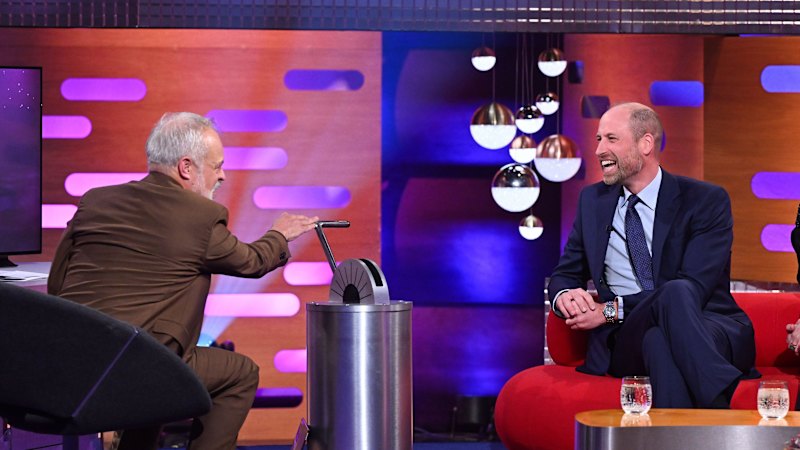
Suddenly, the cameras cut to the backstage corridor. There stands Prince, flanked by 3RDEYEGIRL, dressed to the nines, looking like he just stepped off the cover of a 1984 import single. He walks out, sits down, answers three questions in a whisper-quiet register that forces the entire studio to lean forward, and declines to perform—only to tease his secret London club dates.
That wasn't a drop-in. That was a hostile takeover of BBC One’s primetime airspace.
Why the "Unplanned" Myth Exists (And Who Benefits)
I’ve spent fifteen years watching publicists burn seven-figure budgets on traditional rollout campaigns that die on arrival. They buy the late-night performance slot. They send the artist out to play the single. The artist shakes the host's hand, waves to the crowd, and by Monday morning, nobody remembers it happened.
Why? Because the audience recognizes a transaction when they see one.
When a viewer sees a pop star booked on a talk show, their subconscious defense mechanisms go up. They know the artist is there to sell an album, a tour, or a fragrance. The performance is priced into the viewing experience. It is background noise.
Prince understood human psychology better than any marketing executive at Warner Bros. Records. He knew that perceived scarcity and disruption create exponentially more value than standard exposure.
By having the BBC omit his name from the advance press listings, Prince engineered a pattern interrupt. Viewers sitting on their sofas weren't expecting him. When he appeared, the brain registered it as an anomaly—a glitch in the matrix of routine television programming.
Both sides won from maintaining the illusion of spontaneity:
- The BBC and Graham Norton got to look like the coolest, most unpredictable show on television—a place so magnetic that even the notoriously reclusive Prince couldn't resist wandering through the door.
- Prince got six minutes of uninterrupted, reverence-soaked promotion for his Plectrumelectrum album and his London club dates without having to play by standard promotional rules. He didn't even have to bring his instruments out to dominate the broadcast.
When entertainment writers repeat the phrase "drops in," they are willingly acting as stenographers for a decade-old PR illusion. They are mistaking the magic trick for real sorcery.
What People Get Wrong About Prince’s Media Strategy
If you look up discussions around Prince’s television appearances, you constantly run into the same flawed questions: Why did Prince hate doing interviews? Was Prince shy on talk shows? Why didn't he perform on Graham Norton?
Every single one of these questions starts from a broken premise.
Prince did not hate the media; he hated surrendering leverage to the media.
In the late 1980s and 1990s, during his war with Warner Bros. over master recordings and his own name, Prince learned a brutal lesson about corporate media ecosystems. When you sit down for a traditional 15-minute interview, the network owns the footage, the editors control the narrative arc, and the host dictates the framing. If you say something weird, they cut it for laughs. If you talk about artistic ownership, they trim it for time.
So Prince stopped playing the game on their turf. Instead, he weaponized mystery.
Let’s dismantle the three biggest misconceptions about that night on the BBC:
1. "He was being shy and aloof on the couch."
Watch the tape again, but turn off the fanboy nostalgia and watch it like a behavioral analyst. When Prince sits next to Matthew McConaughey, he speaks barely above a murmur. McConaughey—a man famous for commanding every room he enters—literally has to lean in, squint, and strain to hear him.
That isn't shyness. That is a textbook dominance tactic.
In high-stakes negotiation and status dynamics, the person who forces the room to quiet down holds the power. By refusing to project his voice for the boom mics, Prince forced Graham Norton, the studio audience, and an Academy Award nominee to physically alter their posture to accommodate him. He made the loudest room in British television go dead silent.
2. "He didn't perform because it was too last-minute to set up gear."
This is pure fantasy. Anyone who has ever worked inside a BBC television studio knows the union, technical, and insurance protocols required just to get a guest past the security desk at The London Studios, let alone wired for sound and cleared for broadcast.
You do not accidentally walk past BBC security with a three-piece rock band, hair and makeup teams, and management, and end up miked and lit on a live-to-tape network broadcast.
Prince didn't perform on Graham Norton because performing would have diluted his objective. If he had played a song on TV, the millions of people watching at home would have gotten their Prince fix for free. By sitting on the couch, looking untouchable, and casually mentioning that he was playing secret gigs around London for ten pounds, he weaponized FOMO (fear of missing out). He used the BBC as a billboard to drive foot traffic to his live shows, where he controlled the sound, the lighting, and the ticket revenue.
3. "He was doing Graham Norton a favor."
Norton is a brilliant broadcaster, and his genuine shock and delight on the couch made the segment sing. It was undeniably a massive ratings and viral coup for the show.
However, framing it as charity misses the ruthlessness of the exchange. In early 2014, Prince was operating independently, distributing music outside the traditional major-label machine, and trying to prove that a 55-year-old legacy artist could still generate the cultural heat of a twenty-something pop phenomenon. He needed the UK public to view him not as a nostalgia act playing greatest hits in arenas, but as a dangerous, unpredictable force of nature.
Norton’s couch gave him instant cultural relevance with a younger demographic that mostly knew him through Dave Chappelle sketches.
The Masterclass Today’s Artists Refuse to Learn
Compare Prince’s five-minute surgical strike on the BBC to the bloated, desperate promotional campaigns of modern artists.
Today, when a major musician wants to generate buzz, they hire a crisis firm, leak a fake relationship to TMZ, post seventeen cryptic TikToks, go on three different podcasts to trauma-dump for two hours, and still struggle to move tickets in mid-sized theaters.
Why does modern promotion feel so cheap? Because over-explanation kills mystique.
When an artist explains every lyric, documents every studio session on Instagram Live, and begs the algorithm for attention, they strip away the very thing that makes stardom compelling: distance. You cannot worship someone who is constantly asking you to like and subscribe.
Prince operated on the exact opposite principle. He understood the economics of attention long before the internet turned attention into a quantifiable currency.
Imagine a scenario where a modern pop star—say, someone at the level of Billie Eilish or Harry Styles—attempted the exact same maneuver today. They wouldn't just show up unannounced on a talk show; their team would immediately post forty behind-the-scenes clips from the green room, ruin the surprise with "leaked" paparazzi photos outside the studio doors three hours prior, and flood the internet with pre-cut vertical videos before the broadcast even aired. They would optimize the magic right out of the moment.
Prince left zero breadcrumbs. He arrived, delivered a masterclass in minimal-effort maximum-impact branding, dropped a single tantalizing piece of information about his live shows, and vanished back into the London night.
The Downside of the Iron Fist
Now, let’s be brutally honest about the cost of this approach, because romanticizing Prince’s control-freak genius without acknowledging the collateral damage is just another form of lazy writing.
Operating with that level of calculated opacity is exhausting, isolating, and commercially risky.
By refusing to play by standard industry rules, Prince frequently kneecapped his own commercial reach. His relentless scrubbing of his music and live performances from YouTube during that exact era meant that while his Graham Norton appearance was a sensation on broadcast television, millions of international fans couldn't easily watch the clip online for years afterward. He won the battle for control, but he often lost the war for algorithmic ubiquity.
Furthermore, you can only pull off the "unannounced ambush" strategy if you have already banked decades of undeniable musical equity. When a twenty-two-year-old indie artist tries to act mysterious and whisper on a talk show, they don't look like Prince—they just look rude, unprepared, and unemployable. You have to earn the right to break the rules by proving you can master them first.
Stop Calling It a Drop-In
Language shapes how we understand power.
When we say someone "dropped in," we imply passivity. We imply luck. We imply that greatness just sort of happens when talented people wander around town with nothing better to do on a Friday night.
That narrative is comforting to mediocre creatives and lazy marketers because it excuses their own lack of strategy. If Prince’s legendary BBC appearance was just a spontaneous fluke, then nobody has to do the hard work of studying how he actually engineered it. Nobody has to analyze the timing, the withholding of press releases, the deliberate vocal pacing, or the asymmetrical leverage he exerted over a major broadcast network.
Prince didn't wander onto The Graham Norton Show by accident. He kicked the door down in six-inch heels, took over the broadcast without playing a single note, sold out his entire London tour in minutes, and convinced the world he hadn't even planned to be there.
That isn't spontaneity. That is war by other means.