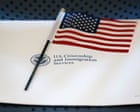
The modern immigration office does not smell like freedom. It smells like industrial carpet cleaner, stale coffee, and the distinct, metallic tang of collective anxiety.
For years, thousands of applicants seeking a green card while already living inside the United States shared a unspoken luxury: stability. They sat in these waiting rooms knowing that while the wheels of bureaucracy turned agonizingly slowly, their lives were rooted here. They bought groceries. They paid mortgages. They tucked their children into bed. For an alternative look, consider: this related article.
A single policy shift from the Department of Homeland Security shattered that floor.
Under the new directive, a vast swath of green card applicants can no longer adjust their status from the comfort of an American living room. They must pack their bags, buy a ticket, and return to their countries of origin to process their applications through overseas consulates. Related insight on this trend has been shared by NPR.
It sounds like a simple procedural tweak. A logistical detour. It is not.
To understand what this actually means, look at Elena. Elena is a composite of three different individuals currently navigating this sudden shift, but her stakes are entirely real. She has lived in Ohio for seven years. She is an architectural draftsperson, a wife, and a mother to a four-year-old boy who thinks the sparklers on the Fourth of July are just for him.
Elena’s visa status required an adjustment. Under the old framework, she would file her paperwork, attend an interview in Cleveland, and wait. Now, she faces a mandate to board a flight to Bogota.
Fear has a specific weight. It sits in the stomach like a stone.
The core of the issue rests on a legal mechanism known as the provisional unlawful presence waiver. Previously, applicants who entered the country or stayed beyond their visa limits could apply for a waiver inside the US before leaving for their ultimate consulate interview. This gave them a safety net. They knew, with reasonable certainty, whether they would be allowed back before they ever stepped onto an airplane.
The new DHS policy effectively yanks that safety net away.
By forcing applicants to return home to initiate and complete the process, the government turns a bureaucratic step into a high-stakes gamble. The moment Elena steps across the threshold of the international terminal, she triggers a legal trapdoor. If her interview abroad goes sideways, or if a consular officer interprets a single line of her decade-old history differently, she faces a bar from entering the United States.
Not for weeks. For years. Sometimes a decade.
Imagine explaining that to a four-year-old who just wants you to read him a bedtime story.
Legal experts argue the policy is designed to streamline a heavily backlogged system. The official narrative suggests that processing applications through home consulates reduces the administrative burden on domestic citizenship offices, which are currently drowning in millions of pending cases. On paper, it is an exercise in efficiency.
But efficiency looks very different depending on which side of the bulletproof glass you are standing on.
Consider the mechanics of the overseas consulate. Unlike domestic offices, which operate under strict regulatory oversight and offer robust avenues for legal appeal, a consular post abroad is a fiefdom. Consular absolute authority means that a denial at an embassy in San Salvador or Manila is often final. There is no judge to appeal to. There is no supervisor to review the fine print.
The system operates on an intuitive analogy: it is the difference between fixing a engine while the car is parked in your garage versus tearing it apart while coasting down a mountain highway. If you lose a bolt in the garage, you search the floor. If you lose it on the highway, the car crashes.
The economic ripple effects of this policy will hit communities that have never even heard of the Department of Homeland Security.
When a skilled worker, a small business owner, or a vital healthcare provider is suddenly forced to leave the country for an indeterminate period, the local economy takes the blow. Companies lose project leads overnight. Local banks face sudden defaults on car loans. School districts lose active, tax-paying parents.
The human mind craves certainty. We can endure hardship, long hours, and heavy taxes if we know the rules of the game remain constant. What kills the spirit is the shifting of the goalposts while the ball is mid-air.
The psychological toll on families is already manifesting in immigration law offices across the country. Phones are ringing off the hooks. Paralegals are listening to crying clients who are forced to make a choice that no one should have to make: do I risk a permanent separation from my family to pursue a legal green card, or do I slip back into the shadows and live with the constant fear of deportation?
The policy aims to encourage legal compliance. The irony is that it may achieve the exact opposite. By making the legal path look like a minefield, it incentivizes people to stay exactly where they are, undocumented, unmapped, and hiding in plain sight.
Elena stands in her hallway, looking at two suitcases open on the floor. One is filled with summers clothes for Bogota. The other is empty, waiting to see if she will ever bring it back to Ohio.
The policy change is now law. The flights are being booked. The paperwork is being printed.
Across America, thousands of porch lights are being left on, burning through the night, waiting for travelers whose return dates have just become terrifyingly blank.


