The Mediterranean wind smells of salt and rot. If you stand on the coast of Tripoli and look north, the water seems infinite, a flat blue sheet stretching toward a Europe that feels, to those trapped on the wrong side of it, like the only safe place left on earth.
But the sea is a mirage. The real journey doesn't end at the water's edge. For thousands of migrants chasing a life in the United Kingdom or continental Europe, the journey stops abruptly in the dark. It stops in concrete warehouses, in abandoned farms, and in the sound of a phone ringing thousands of miles away in a terrified mother’s kitchen.
We talk about migration in numbers. We talk about policy, border control, and small boats crossing the English Channel. But numbers are comfortable. They let us look away. They shield us from the market value of a human life in the lawless stretches of North Africa.
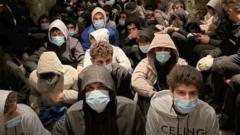
Let us look at a composite reality instead. Call him Ali. He is twenty-four, from Sudan, fleeing a war that swallowed his neighborhood whole. His goal is the UK, a place where he speaks the language, where he believes a man can work without a gun pointed at his ribs. He paid a broker. He crossed the desert. He thought the hardest part was behind him.
Then the pickup truck stopped in western Libya.
The Market of the Unseen
Libya today is not a country in the traditional sense; it is a patchwork of shifting fiefdoms. In the power vacuum that followed years of civil strife, human trafficking has evolved from an illicit trade into a highly sophisticated, multi-million-dollar industry. Migrants are no longer just customers paying for a passage; they have become the commodity itself.
When Ali was forced out of the truck, he wasn't taken to a boat. He was taken to a compound.
The business model of modern kidnapping networks in Libya relies on a simple, brutal psychological lever: leverage. Once inside these informal detention centers, run by armed militias operating completely outside the control of the fragile central government, the price of freedom changes. The initial smuggling fee is forgotten. A new debt is manufactured.
The captors hand over a satellite phone. They give a command. Call your family. Tell them to send five thousand dollars, or you die here.
This is not a vague threat. It is a orchestrated performance. Often, the beatings are timed to coincide with the phone call so that mothers, fathers, or siblings across the globe can hear the precise agony of their loved ones in real-time. The audio becomes the invoice.
But what happens when the family has nothing left? What happens when the village has already been scraped clean to pay the first smuggler?
The market adapts. It finds new inventory.
The Ultimate Currency
When cash runs out, the human body is disassembled for profit.
In the shadows of these illicit camps, a darker trade has solidified. The threat is no longer just a bullet or a starvation diet. It is surgery. Captors have begun presenting trapped migrants with a horrific ultimatum: secure the ransom from your impoverished families, or your organs will be harvested to clear the balance.
To understand how a human kidney becomes a transactional currency, one must understand the absolute vulnerability of an undocumented traveler. In Libya, an illegal migrant has no legal status, no biometric footprint that the state tracks, and no embassy fighting for their rights. If they vanish, they vanish completely. They are ghosts in a bureaucratic wasteland.
Consider the logistics of this cruelty. This is not the work of amateur street thugs. The extraction of organs requires a network that bridges the criminal underworld with corrupt medical professionals. It requires sterile environments, preservation technology, and a pipeline to a global black market where wealthy buyers are desperate enough to ask no questions about where their new kidney came from.
For a young man like Ali, the realization comes slowly, then all at once. The human body ceases to be a temple of life; it becomes a parts warehouse. A kidney can fetch thousands on the illicit market, easily clearing the "debt" the migrant supposedly owes for the privilege of being captured.
The choice is an illusion. Pay with paper, or pay with your flesh.
The Pipeline to the Coast
Why do they keep coming? Why would anyone walk into this meat grinder?
The answer lies in the profound failure of imagination on the part of those who live in safety. It is easy to say, "Do not go," when your home has a roof, your currency has value, and your children are not being conscripted by warlords. To the desperate, the risk of a Libyan warehouse is still a smaller gamble than the certainty of a slow death at home.
The path toward the UK is fueled by hope, the most dangerous drug on earth. Smugglers use TikTok and WhatsApp to market their services, showing glossy videos of calm seas and smiling faces arriving on British shores. They don't show the concrete rooms. They don't show the scars left by a surgeon’s knife in a back-alley clinic.
The international community watches this from a distance, paralyzed by geopolitical gridlock. Financial aid is poured into Libyan coast guard initiatives, hoping to stop the boats before they reach European waters. But this strategy addresses the symptom while ignoring the engine. By turning the Mediterranean into a wall, the West has inadvertently created a captive market inside Libya. The more difficult it is to leave, the longer migrants are trapped in the cycle of extortion, recapture, and abuse.
Every policy decision made in London, Brussels, or Rome ripples down to the compounds of Misrata and Khoms. When borders tighten, the price of smuggling skyrockets. When the price skyrockets, the desperation of the traffickers increases. The human cost is passed directly down to the most vulnerable link in the chain.
The Weight of the Scars
Imagine surviving. Imagine that somehow, against every statistical probability, the money was found. A cousin in London took out a loan; a mother sold her last piece of gold. The ransom was paid, or perhaps you escaped into the night, running until your lungs burned, hiding in the orchards until you found a different boat, a luckier crossing.
You make it to the UK. You step onto the shingle beaches of Kent, wrapped in a grey blanket, shivering as the flashbulbs of news cameras blink in your face.
The public sees another statistic. A number to be debated on talk radio. A political problem to be solved before the next election.
They do not see the phantom pain under the shirt. They do not know that under the damp fabric lies a jagged, poorly healed scar along the flank, a permanent reminder of the price paid to cross the world. They do not see the psychological fragmentation of a person who had to watch their friend be led away to a room from which he never returned, simply because his family didn't own a phone.
The debate about migration is often framed around sovereignty and economics. We argue about hotel costs, visa processing times, and international treaties written in a different century.
But the true crisis of our era is not one of geography. It is a crisis of empathy. As long as we treat the victims of human trafficking as an anonymous tide rather than individuals with names, faces, and irreplaceable lives, the warehouses will stay full. The phones will keep ringing in the middle of the night. And the horizon will continue to demand its price in blood.
A young man sits in an immigration holding center in the south of England, looking out at the grey British rain. He presses his hand against his side, feeling the dull, persistent ache beneath his ribs. He is alive. He is safe from the militias. But he left a piece of himself behind in the desert, and the silence in the room is louder than any gunshot.