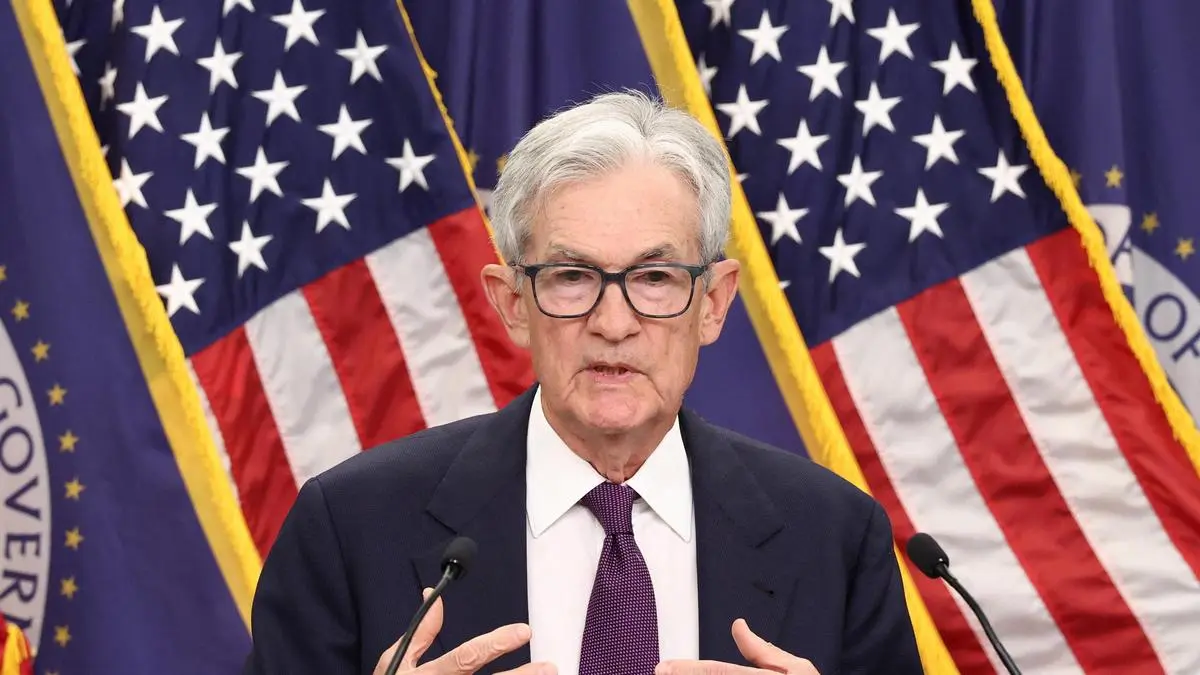
Jerome Powell’s tenure as Chair of the Federal Reserve concludes not with a victory lap, but with a complex handoff of a dual-mandate architecture that has been fundamentally altered by post-pandemic structural shifts. While media narratives focus on the sentimentality of his final press conference, a rigorous analysis reveals a transition defined by three systemic risks: the erosion of the "Fed Put," the structural shift in the Natural Rate of Interest, and the institutional scarring left by the 2021-2022 inflation miscalculation. The efficacy of the next Chair depends entirely on their ability to manage the terminal phase of the current tightening cycle without triggering a credit-market fracture.
The Tri-Polar Framework of the Powell Era
To evaluate the success of the Powell Federal Reserve, one must look past the "privilege" rhetoric and analyze the three pillars that governed his decision-making process. These pillars determined the velocity and magnitude of interest rate adjustments and will dictate the constraints placed on his successor.
1. The Risk Management Asymmetry
Powell pivoted the Fed from a "forecast-based" model to a "data-dependent" reactive model. Historically, the Fed moved pre-emptively to thwart inflation based on the Phillips Curve—the inverse relationship between unemployment and inflation. Under Powell, the Fed abandoned pre-emption in 2020, requiring actual evidence of inflation before tightening. This shift created a lag-time trap. By the time the Fed recognized inflation was not "transitory," the price-wage spiral had already gained momentum, necessitating the most aggressive rate-hike cycle since the Volcker era.
2. The Credibility Delta
The Federal Reserve operates primarily through expectations management. If the market believes the Fed will keep inflation at 2%, businesses and consumers act accordingly. The "Powell Pivot" of late 2023, where the Chair signaled rate cuts despite sticky services inflation, introduced a volatility premium into the bond market. This increased the "Term Premium"—the extra compensation investors demand for holding long-term debt—effectively tightening financial conditions outside of the Fed's direct control.
3. Quantitative Tightening (QT) Mechanics
Unlike his predecessors, Powell had to manage the contraction of an $8 trillion balance sheet. The mechanism of QT—allowing bonds to mature without reinvestment—removes liquidity from the banking system. The primary risk here is not the total amount of liquidity, but the distribution of "Ample Reserves." If the Fed drains too much cash, the Repo market (where banks lend to each other overnight) can spike, as seen in September 2019. The current administration of QT remains a delicate balance between fighting inflation and preventing a systemic liquidity crunch.
The Mathematical Reality of the Neutral Rate
The central challenge facing the Federal Reserve transition is the uncertainty surrounding $R^*$, or the "Neutral Rate of Interest." This is the theoretical interest rate that neither stimulates nor restricts economic growth.
If $R^*$ has risen due to increased government deficit spending and a global shift toward re-shoring manufacturing (de-globalization), then the current "high" rates are not actually restrictive. They might simply be the new normal.
- Pre-2020 Estimate: $R^*$ was widely believed to be around 0.5% (or 2.5% in nominal terms).
- Post-2024 Hypothesis: Structural labor shortages and fiscal dominance suggest $R^*$ may have drifted to 1.5% or 2.0% (3.5% to 4.0% nominal).
This creates a high-stakes blind spot for the incoming leadership. If the Fed cuts rates based on the old $R^$ estimate, they risk a second wave of inflation. If they hold rates based on a flawed belief that $R^$ is high, they risk a hard landing in the labor market.
Structural Labor Market Distortion
Powell’s final statements emphasized a "strong but rebalancing" labor market. However, the data reveals a more nuanced fragmentation. The "Job Openings to Unemployed" ratio, a key metric for Powell, has fallen significantly from its peak of 2.0 to approximately 1.2.
The mechanism at play is "Labor Hoarding." Following the difficulty of hiring post-2020, firms are reluctant to fire workers even as demand cools. This masks the true weakness in the economy. Once the "Cost of Carry" for these employees exceeds the projected cost of re-hiring them in a future recovery, the economy will hit a tipping point where unemployment rises non-linearly. The incoming Chair will likely inherit this sudden inflection point.
Fiscal Dominance and the Independence Paradox
A significant limitation of the Powell legacy is the increasing encroachment of fiscal policy on monetary outcomes. The "Inflation Reduction Act" and ongoing deficit spending act as a counter-current to the Fed’s restrictive stance.
- The Crowding Out Effect: High government borrowing increases the supply of Treasuries, which pushes yields up.
- The Interest Expense Trap: As the Fed keeps rates high to fight inflation, the cost of servicing the national debt balloons. This eventually puts political pressure on the Fed to lower rates regardless of inflation data, purely to maintain the solvency of the Treasury.
This dynamic threatens the "Institutional Independence" that Powell touted in his final address. A Fed Chair who is "privileged" to serve is also a Fed Chair who must navigate a Washington environment where the central bank is increasingly viewed as an arm of the fiscal authority.
The Liquidity Buffer and the Reverse Repo Facility
To understand the plumbing of the financial system during this transition, one must monitor the Overnight Reverse Repo (ON RRP) facility. This serves as a "spare tire" for excess liquidity. Throughout 2023 and 2024, this facility was drained to offset the effects of QT.
Once the ON RRP reaches zero, the Fed’s balance sheet reduction will begin to pull liquidity directly from bank reserves. Historical data suggests that when bank reserves fall below 10-12% of total GDP, the probability of a "flash crash" in the plumbing of the financial system increases exponentially. This is the "Point of No Return" for the current tightening cycle.
Operational Risk in the Transition Period
The transition of power at the Fed introduces "Model Risk." Every Chair brings a different set of preferred indicators. Powell favored the "Supercore" inflation (services excluding housing and energy). A successor might revert to a broader CPI focus or a more aggressive "Employment First" mandate.
This creates a period of market price-discovery that is inherently unstable. Traders will "test" the new Chair by pushing bond yields or selling off equities to see how the Fed responds. If the new Chair flinches and provides a "dovish" signal too early, they risk a permanent loss of the inflation anchor.
Institutional Memory and the 2% Target
The 2% inflation target is an arbitrary construct, yet it is the foundation of global price stability. Powell has consistently refused to move the goalposts to 3%. Doing so would decrease the "Real Value" of debt but would also destroy the long-term purchasing power of the currency and raise the "Inflation Risk Premium" permanently.
The successor faces a binary choice:
- Enforce the 2% target: Likely requiring a recession to break the final remnants of service-sector inflation.
- Accept a "Soft" 3% target: Maintaining growth but signaling to the world that the U.S. dollar is no longer a reliable store of value over a decade-long horizon.
Strategic Forecast for the Post-Powell Era
The immediate requirement for the Fed is a transition from "Interest Rate Management" to "Liquidity Management." The era of using the Federal Funds Rate as the primary tool is ending; the next era will be defined by the surgical use of the balance sheet.
Investors should prepare for a period of "High-Volatility Neutrality." This means interest rates will stay higher than the previous decade's average, while the Fed uses frequent, temporary injections of liquidity to prevent localized bank failures. This "Stop-Go" monetary policy is the inevitable result of trying to fight inflation while supporting an over-leveraged fiscal regime.
The definitive strategic move for the incoming leadership is the formal adoption of a "Standing Repo Facility" that can provide an infinite backstop to the Treasury market. This effectively merges monetary and fiscal policy, ending the era of the independent central bank as it was understood in the 20th century. The "privilege" Powell spoke of was presiding over the last gasp of the old regime; his successor will preside over the birth of a managed-capital system where the market no longer sets the price of risk, but the central bank ensures it never breaks.