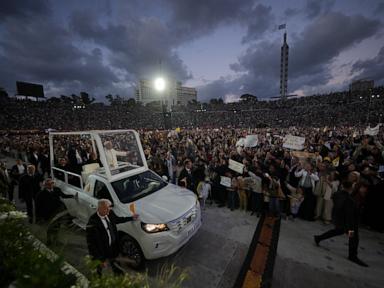
Crossing the Río de la Plata takes less than an hour by plane, yet the political distance between Montevideo and Buenos Aires feels like another planet right now. As the Pope wraps up his visit to Uruguay and heads straight into Argentina, everyone watching Vatican diplomacy knows the easy part of this South American tour is officially over.
Uruguay gave the pontiff a relatively calm, predictable reception. Argentina won't. You're looking at a country caught in severe economic turbulence, deep ideological polarization, and a complicated history with the papacy itself. Whether you follow Catholic Church politics closely or just care about Latin American affairs, understanding why this specific leg of the tour carries so much friction explains a lot about where the region is headed. Read more on a similar subject: this related article.
Why Uruguay Was the Calm Before the Storm
If you've ever spent time in Montevideo, you know the vibe is distinctly secular, understated, and allergic to political theatrics. Uruguay separated church and state back in 1919. Religious holidays there don't even carry their traditional Christian names on the official calendar—Holy Week is literally called Tourism Week, and Christmas is Family Day.
Because of that entrenched secularism, the Pope's stop in Uruguay didn't spark the kind of fierce ideological tug-of-war you see elsewhere in South America. Politicians across the spectrum treated the visit with polite respect. Crowds turned out, bishops celebrated Mass, and nobody tried to weaponize the papal pulpit for domestic partisan gain. Further analysis by The Guardian highlights similar views on this issue.
Honestly, it was almost a warm-up act. The Vatican needed a stable, low-drama environment to open the Southern Cone leg of the itinerary before stepping into the political buzzsaw waiting just across the water in Argentina.
What Makes Argentina the Most Fraught Stop on the Tour
Argentina isn't just another country on a papal itinerary. It's the homeland of the late Pope Francis, Jorge Mario Bergoglio, whose shadow still looms over every church-state interaction in Buenos Aires. During his twelve-year pontificate from 2013 to 2025, Francis never once made an official return trip to his native country, largely because he feared his presence would be manipulated by Argentina's bitterly divided political factions.
Now, stepping into Argentina means walking straight into the unresolved baggage left behind by that decade-long absence. Millions of Argentine Catholics felt neglected for years, watching popes visit neighboring Brazil, Chile, Peru, and Paraguay while Buenos Aires stayed off the map. Expect massive emotional crowds alongside sharp scrutiny from commentators who haven't forgotten how deeply politics and religion have tangled here.
The economic backdrop makes things even tenser. Argentina has spent the last couple of years undergoing aggressive free-market shock therapy—slashing public subsidies, deregulating industries, and wrestling down triple-digit inflation at the cost of painful short-term spikes in poverty rates. Catholic social teaching emphasizes solidarity with the poor and skepticism toward unbridled market capitalism, which puts any visiting pontiff on an immediate collision course with libertarian and conservative economic orthodoxy.
The Tightrope Between Social Justice and State Reform
Every word spoken from a podium in Buenos Aires will be dissected for hidden political endorsements. If the Pope speaks forcefully about rising poverty, soup kitchens running out of food, or workers losing purchasing power, opposition leaders will immediately frame it as a direct rebuke of the national government.
On the flip side, if the Vatican keeps its messaging strictly spiritual and avoids criticizing economic austerity, progressive clergy—especially the curas villeros, the outspoken priests who live and work inside Buenos Aires's poorest shantytowns—will accuse Rome of abandoning the marginalized. There's no neutral ground here. Even a routine homily about charity gets translated into a headline about fiscal policy within ten minutes of the final blessing.
How Local Bishops and Priests Are Caught in the Middle
If you think the pressure is all on the visiting delegation from Rome, talk to anyone working inside the Argentine Episcopal Conference. Local church leaders have spent years trying to hold together a flock that mirrors the country's wider cultural split, often referred to locally as la grieta—the rift.
On one side, you have traditionalist parishes in wealthier neighborhoods of Buenos Aires and Córdoba that applaud deregulation, fiscal discipline, and closer alignment with Western conservative movements. On the other, you have parish priests in Greater Buenos Aires and the northern provinces dealing daily with families who can't afford bus fare or basic groceries.
Church-run charities like Cáritas Argentina have repeatedly warned about surging demand at community dining halls. When the Pope arrives, those priests expect him to validate their frontline struggle. Meanwhile, government officials want photo ops that project international legitimacy and calm investor nerves. Navigating both expectations without alienating half the country requires diplomatic precision that few modern leaders possess.
The Ghosts of Past Papal Diplomacy in the Southern Cone
To really grasp why this border crossing between Uruguay and Argentina matters, you have to look at the history connecting these two neighbors through the Vatican. Back in 1978, Argentina and Chile came within hours of full-scale war over the Beagle Channel islands. It was Pope John Paul II's personal intervention—mediated through Cardinal Antonio Samorè—that stopped the tanks and eventually led to the 1984 Treaty of Peace and Friendship, signed right at the Vatican.
Uruguay played its own quiet role in regional diplomacy during those turbulent decades, often acting as a neutral meeting ground when Argentina's military dictatorship and democratic transitions created regional instability. Because of that history, South Americans don't view the papacy purely as a religious institution. They see Rome as a geopolitical actor capable of tipping public opinion and shifting moral authority during moments of national crisis.
That legacy raises the stakes enormously. People aren't just showing up to pray; they're watching to see which vision of Argentina's future gets moral backing.
What Most Observers Get Wrong About Papal Visits to Latin America
A lot of international coverage treats South America as a monolithic Catholic bloc where a papal visit automatically boosts church attendance and unites the public. That's outdated thinking. According to data from Latinobarómetro and Pew Research Center, Catholic identification across Latin America has dropped steadily over the past two decades, driven by both rapid evangelical growth and rising secularization.
Uruguay is the extreme example—around half the population identifies as having no religion at all—while Argentina sits somewhere in the middle, culturally Catholic at its core yet increasingly pluralistic and skeptical of institutional authority. A papal tour today isn't a victory lap through guaranteed territory. It's a high-stakes effort to prove relevance in societies that no longer automatically defer to clerical authority.
Another common misconception is that Vatican trips are planned primarily around domestic election calendars. In reality, papal itineraries are locked in months ahead through intricate negotiations involving the Secretariat of State, the local apostolic nuncio, and host-country foreign ministries. The timing feels explosive not because Rome picked a fight, but because Argentina's political temperature rarely drops below boiling.
How to Follow the Argentina Leg Without Falling for Partisan Spin
Because both local media and international outlets tend to filter papal speeches through domestic political lenses, you have to read between the lines if you want an accurate picture of what's actually happening on the ground.
- Read the full homily texts on Vatican.va instead of viral clips. Cable news networks in Buenos Aires will pull a single fifteen-second soundbite about "social justice" or "human dignity" and build a two-hour panel debate around it. Reading the whole speech shows whether the remarks were standard theological themes or deliberate policy critiques.
- Watch who gets private audiences. In Vatican protocol, the schedule of closed-door meetings tells you far more than public stadium Masses. Pay close attention to whether the Pope meets separately with labor union leaders, shantytown priests, business chamber heads, or opposition figures alongside official state meetings.
- Compare coverage between Montevideo and Buenos Aires. Looking at how Uruguayan outlets like El País or La Diaria frame the exact same speech compared to Argentine papers like Clarín, La Nación, or Página/12 immediately exposes where national bias is distorting the message.
- Track statements from Cáritas Argentina. If you want to know whether the visit produces tangible institutional backing for anti-poverty programs, watch what local church charity directors say in the week following the departure rather than relying on government press releases.
The short flight across the Río de la Plata marks a sharp pivot from quiet ceremonial diplomacy to one of the sharpest political tests any religious leader could face. Keep your eye on the unscripted moments—the off-the-cuff remarks during motorcades, the unannounced stops in working-class neighborhoods, and the exact phrasing used in front of Argentina's political establishment—because that's where the real story of this tour will be written.