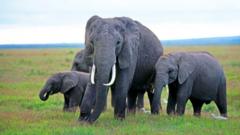
The dust in Tsavo does not merely settle; it clings. It finds the creases in your palms, coats the back of your throat, and carries the ancient, heavy scent of sun-baked earth and distant rain. I remember standing beneath the skeleton of a baobab tree three years ago, watching a matriarch guide her family toward a muddy pan of water. Her steps were slow, deliberate, carrying the weight of decades of memory across a landscape that is forgetting how to be wild.
She did not know the rain was a ghost. She could not smell the invisible chemistry bleeding into the soil. Recently making waves recently: The Narrow Water Where the World Holds Its Breath.
Months later, reports trickled out of Kenya like slow poison. Elephants—massive, resilient, seemingly untouchable icons of the savanna—were dying. Not from the old, familiar thieves of drought or the crack of a poacher's rifle. They were dropping silently, their great bodies folding into the red dirt with foam at their mouths and confusion in their clouded eyes.
Pesticides. Additional insights regarding the matter are explored by TIME.
The word sounds clinical. Sterile. It belongs on a spreadsheet or a warning label printed in a font too small to read without squinting. But out here, where the boundary between human survival and wildlife habitat blurs into a desperate daily negotiation, pesticides are a physical weight. They are an invisible tide rising up the food chain.
Consider what happens when a smallholder farmer watches armyworms devour the maize crop that stands between his children and starvation. Desperation is a terrible counselor. When the local market runs out of approved solutions, or when the cheaper, unregulated alternative arrives in unmarked plastic bottles from across a border, a man makes a choice. He sprays. He protects his livelihood.
He does not picture an eighty-year-old elephant five miles away drinking from a stagnant pool touched by agricultural runoff.
That disconnect is the tragedy of our modern relationship with the earth. We act in isolation, but nature keeps a shared ledger.
When toxic compounds like carbofuran or organophosphates enter the ecosystem, they do not announce themselves. They wait. A blade of grass absorbs them. A localized waterhole concentrates them. By the time an elephant, requiring up to fifty gallons of water a day and hundreds of pounds of vegetation, consumes the tainted resources, the chemical has found its target.
The symptoms are terrifyingly swift. Nervous systems, finely tuned over millions of years of evolution, short-circuit in minutes. Paralysis. Respiratory failure. The monumental collapse of a creature that had survived droughts, wars, and the encroachment of humanity, brought low by a drop of liquid manufactured in a distant laboratory.
To understand why this is happening now, more than ever, we have to look at the shrinking margins of the wild. Kenya is a masterpiece of conservation in motion, yet it is also a pressure cooker. Human populations grow. Infrastructure cuts ribbons through ancient migratory corridors. Fences go up. The spaces where people and animals can exist apart are vanishing.
When you squeeze a sponge, water escapes in every direction. When you squeeze a habitat, conflict is inevitable.
Local wildlife rangers, men and women I have walked alongside in the blistering heat, carry a quiet exhaustion in their eyes. They are used to tracking footprints. They are used to tracking the grim geometry of wire snares. But how do you track an enemy you cannot see until it is already killing?
"We are fighting a ghost," a senior warden told me once, leaning against the warm hood of a Land Cruiser as the sun bled orange over the Chyulu Hills. His uniform was faded, bleached by a merciless sun. "A poacher leaves tracks. A bullet leaves a shell casing. What do we arrest? The rain? The wind? The chemical on the corn?"
The investigation into these mysterious deaths has been agonizingly slow. Veterinary teams race against the unforgiving African sun to perform necropsies before scavengers claim the evidence. Tissue samples are packed in ice, flown to Nairobi, and subjected to chromatography. The laboratory results inevitably confirm the worst. Organophosphate poisoning. Agricultural chemicals misused, mismanaged, or illegally imported.
Yet, simply blaming the farmer is a luxury of the ignorant.
I sat with a farmer named Juma last year, just outside the perimeter of a protected reserve. His hands were calloused, his fingernails permanently stained with the iron-rich dust of the region. He looked at me with a mixture of defiance and profound grief when I brought up the dead wildlife.
"You think I want them to die?" he asked, his voice dropping to a harsh whisper. "The elephants are our pride. But my maize is my children's school fees. It is my plate of food tonight. When the worms come, nobody sends me money to watch my crops disappear. They tell me to spray. They don't tell me what happens to the water downstream."
He was not malicious. He was cornered. And therein lies the knot we have tied ourselves into.
The solutions are not simple, and anyone who tells you they are has never stared down an empty grain silo. Protecting Kenya’s wildlife can no longer be a fortress mentality where fences go higher and guards shoot straight. It requires an intricate, agonizingly human bridge-building.
It means subsidizing safe, biodegradable deterrents so that farmers do not have to choose between their family's survival and the life of an ecosystem. It means enforcing supply chain regulations on agrochemicals that slip through porous borders. It means creating rapid-response veterinary units that can treat poisoned water sources before an entire family herd drinks from them.
Most of all, it means listening.
The death of an elephant is never just the death of an animal. It is a tear in the fabric of a landscape that holds the memory of the continent. When the matriarch falls, generations of seasonal wisdom die with her. The trails she taught her calves to follow, the hidden springs she remembered through decades of drought, the deep, rumbling infrasonic language that communicates safety across miles—silenced by a chemical residue washing off a struggling farmer's field.
As the shadows lengthen across the plains and the evening chill settles over the acacia trees, the savanna holds its breath. Somewhere out in the darkness, a twig snaps. A low rumble vibrates through the earth, felt in the soles of your feet before it is heard by the ear.
They are still out there. Moving through the dark. Drinking from the water. Testing the wind.
And the wind is carrying things we never meant to leave behind.