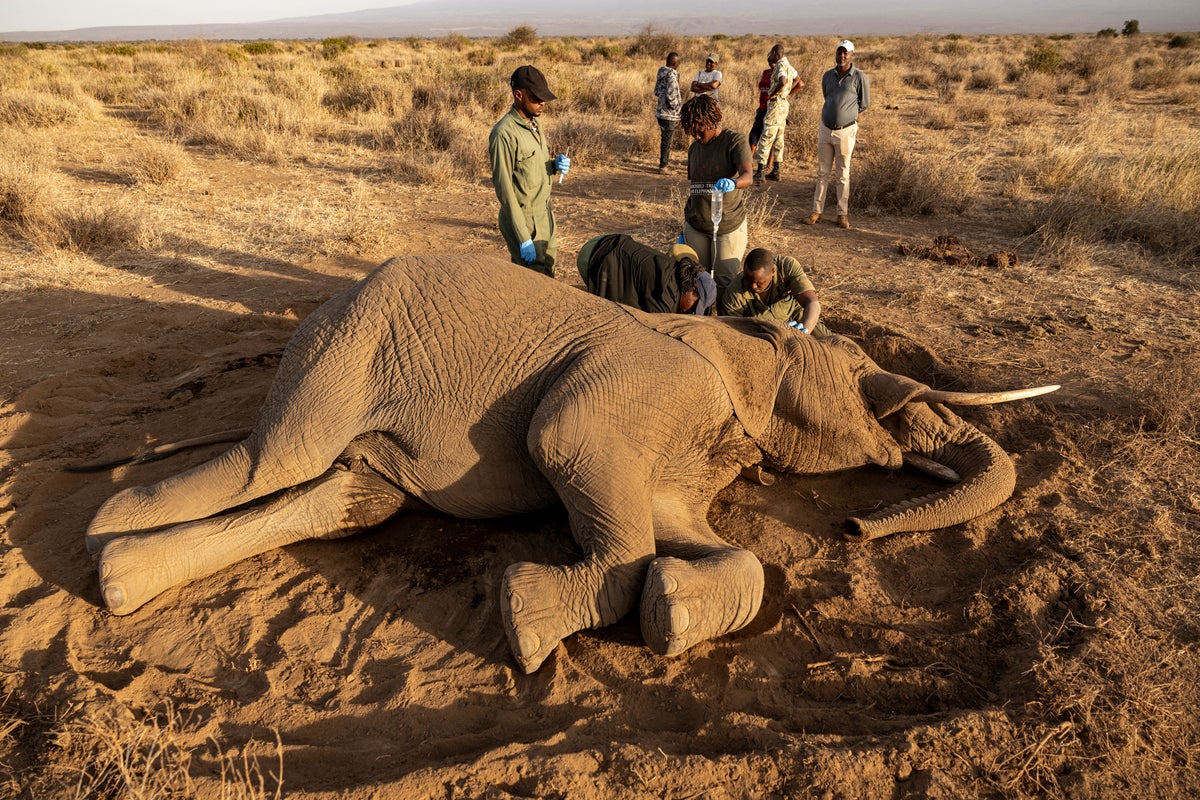
Four suspects stand accused, yet the soil of the Amboseli ecosystem holds darker secrets than a simple police blotter reveals. Over the span of two brutal months, 18 majestic elephants perished across the shadow of Kilimanjaro, victimized by a silent killer that bypassed the traditional armor of anti-poaching patrols. Kenya Wildlife Service officials and multi-agency investigators moved quickly to arrest three Kenyans and one Tanzanian, seizing unlabelled agricultural chemicals smuggled across borders. But focusing purely on the cuffs clicks into a comforting illusion that justice is swift and systemic failure is an anomaly. It is not.
The Anatomy of a Toxic Frontier
The timeline of destruction defies standard poaching profiles. Between June 24 and July 24, fifteen elephants dropped dead in rapid succession, followed by three more fatalities as investigators combed the Tikondo and Kimana areas of Loitoktok subcounty. Autopsies and laboratory evaluations pointed an accusing finger at a terrifying culprit: cyanide.
Initial findings suggest these massive herbivores ingested pesticide-contaminated crops—specifically commercial tomatoes cultivated on the contested boundaries where human agriculture bleeds directly into ancestral wildlife corridors. Cyanide does not belong in tomato farming. It is an industrial agent, prized in gold extraction and heavy manufacturing, making its presence in rural vegetable patches an indicator of illicit cross-border smuggling networks.
Yet, local farmers in Kimana push back against the official narrative with valid ecological questions. Why did only elephants fall in such staggering numbers while other localized herbivores sharing the same grazing zones walked away unscathed? The discrepancy exposes the terrifying precision of human-wildlife conflict escalation. When subsistence meets survival on a shrinking frontier, poison becomes an equalizer of last resort.
Anatomy of Human-Wildlife Collisions
To understand how an entire matriarchal family structure can be wiped out, one must look at the brutal geography of displacement. Amboseli is famous for its open plains, but those plains are filling up with fences, concrete structures, and intensive irrigation projects. Elephants do not recognize property lines drawn on bureaucratic maps in Nairobi. They follow ancient memory, walking straight into newly cleared plots laden with cheap, unregulated chemicals imported from neighboring territories.
The physical mechanics of cyanide poisoning are brutally fast. The compound locks onto cellular respiratory enzymes, starving vital tissues of oxygen. Animals experience rapid paralysis, respiratory collapse, and death within hours of ingestion.
For conservation veterans, this method marks a sinister evolution. Traditional poachers relied on poisoned arrows or crude wire snares, which left obvious forensic trails and targeted individuals. Chemical contamination operates like an invisible bomb. It transforms the environment itself into a weapon, weaponizing the very food chain that sustains both human and beast.
The Limits of State Interventions
Tourism and Wildlife Cabinet Secretary Rebecca Miano emphasized that the apprehension of the four suspects—who were subsequently released on police bail pending further analysis—does not automatically equate to proven criminal culpability. The legal system moves at a deliberate crawl, weighed down by the necessity of airtight forensic validation.
Laboratory samples must undergo rigorous cross-checks to tie the seized substances directly to the stomach contents of the dead pachyderms. If the chain of custody breaks or cross-contamination is argued by defense counsel, the case could collapse in a courtroom. This judicial bottleneck highlights a glaring structural vulnerability. Investigators are attempting to solve a 21st-century chemical crime using 20th-century enforcement frameworks. Border points remain porous, chemical tracking is virtually nonexistent at the retail level, and rural agricultural outposts operate far beyond the reach of regular environmental safety audits.
The Cost of Coexistence
The tragedy of the 18 elephants goes far beyond regional statistics. It represents the fracturing social contract between local communities and conservation authorities. When protective boundaries are enforced without addressing the economic desperation of farmers whose livelihoods are trampled overnight, resentment festers. Unregulated chemical dumping and malicious retaliatory baiting become predictable symptoms of a deeper structural rot.
As forensic teams comb through seized substances and prosecutors prepare for trials that will test the limits of Kenya's wildlife protection acts, the plains of Amboseli remain dangerously tense. The four suspects may face justice, but unless the illegal flow of industrial toxins across porous borders is choked off at the source, the next generation of giants will walk the same invisible minefield.