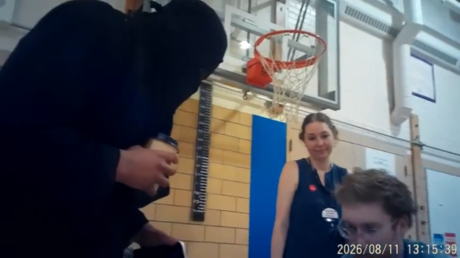
Two conservative activists walked into a polling location wearing full-face burqas, filmed the whole interaction, and ended up facing criminal charges instead of proving their point about election security.
It happens every single election cycle. Someone decides they're going to expose a massive loophole in American voting laws by pulling a theatrical stunt at a local precinct. Usually, it involves a hidden camera, a disguise, and a lot of loud claims on social media about how easy it is to commit voter fraud.
This specific incident, where US conservatives were charged over a burqa voting stunt caught on video, highlights a massive disconnect between viral political theater and how actual election law works on the ground.
Let's break down what really happened, why prosecutors stepped in, and the legal realities that viral videos almost always leave out.
How the Burqa Voting Stunt Played Out
The premise behind these kinds of stunts is always the same. Activists want to argue that without strict photo ID requirements, anyone can walk into a polling place, cover their face, claim to be someone else, and cast an illegal ballot.
In this case, the individuals involved wore traditional full-body Islamic coverings—specifically burqas—to obscure their identities while attempting to navigate the check-in process at a polling site. They recorded the encounter to post online, framing it as an undercover investigation into ballot security.
Here's the problem. Election officials and local prosecutors didn't view it as journalism or peaceful protest.
They viewed it as a direct violation of state election statutes.
When you walk into a polling place and misrepresent your identity—or disrupt the voting process while filming inside a restricted zone—you cross a bright legal line. Poll workers are trained to follow specific statutory procedures, and when activists deliberately try to trick those workers on camera, they often end up handing prosecutors all the video evidence needed for an indictment.
Why Prosecutors Filed Criminal Charges
People frequently assume that if you don't actually cast a fraudulent ballot, you haven't broken the law. That's completely false.
State election codes across the US are written broadly to protect the integrity of the voting environment. You don't have to successfully steal an election to catch a felony or a serious misdemeanor. Depending on the jurisdiction, several specific laws come into play during a stunt like this:
- Attempted Voter Impersonation — Simply asking for a ballot under another person's name, or attempting to circumvent identity verification protocols, triggers criminal liability in most states, regardless of whether the ballot ever hits the scanner.
- Unlawful Photography or Recording — Almost every state strictly regulates or bans filming inside polling places. These rules exist to protect ballot secrecy and prevent voter intimidation. Recording poll workers without consent while executing a prank violates those statutes immediately.
- Election Interference and Disruption — Staging a provocative scene inside a precinct slows down lines, distracts election judges, and intimidates legitimate voters waiting to cast their ballots.
Prosecutors rarely look kindly on political operatives who treat a live polling station like a YouTube soundstage. When the video itself documents the exact elements of the crime, charging decisions become straightforward.
The Myth of the "Easy Impersonation" Loophole
If you've ever worked as an election judge or studied state voting infrastructure, you know why the logic behind the burqa stunt falls apart in practice.
Activists love to portray non-strict ID states as the Wild West where anyone can claim to be their neighbor. In reality, in-person voter impersonation is statistically the least efficient and highest-risk method of fraud imaginable.
Think about the mechanics. To pull it off, you have to know a registered voter's full name, their exact residential address, and their assigned precinct. You also have to gamble that they haven't already voted early, haven't requested an absentee ballot, and aren't standing right behind you in line.
Even in states that don't require a government-issued photo ID at the table, voters still have to sign a poll book under penalty of perjury. Those signatures are logged, audited, and compared against registration records. If the real voter shows up later that afternoon, the discrepancy triggers an immediate investigation.
The idea that wearing a face covering lets someone bypass the entire system ignores how voter rolls actually operate. Poll workers aren't just looking at a face; they're checking live electronic poll books that track ballot issuance in real time.
Religious Garments and Election Law
Using a burqa specifically adds another layer of legal and cultural friction to the story.
Under federal and state religious freedom protections, voters who wear religious head or face coverings—such as niqabs, burqas, or habits—cannot be denied their constitutional right to vote simply because of their attire. Election administrators spend months training poll workers on how to handle these exact situations respectfully and securely.
In states that do require photo identification, standard administrative procedures allow a voter wearing a religious face covering to step into a private area with a female poll worker to briefly verify their identity, or to sign a sworn affidavit confirming who they are.
When conservative activists appropriate religious garments to mock those accommodations, they aren't uncovering a secret flaw. They're exploiting a legal protection designed for religious minorities in order to score political points online.
Why Viral Stunts Backfire on Election Integrity Debates
There are plenty of legitimate, serious policy debates to be had about American election administration. Reasonable people disagree on mail-in ballot deadlines, signature verification standards, voter roll maintenance, and photo ID requirements.
Stunts like this don't advance those conversations. They poison them.
When activists get charged with crimes for trying to manufacture proof of fraud, it undermines the very argument they're trying to make. Critics immediately point to the arrest as proof that the system actually caught the bad actors, while legitimate election officials are forced to spend taxpayer money dealing with legal fallout instead of running smooth elections.
If you actually want to understand how your local precinct prevents fraud, skip the viral videos and look at the real mechanisms in place:
- Sign up to be a poll worker. Every county in America needs election judges from across the political spectrum. Working a 14-hour shift at a check-in table will teach you more about ballot chain-of-custody than a thousand hours of cable news.
- Attend public logic and accuracy testing. Before every election, local boards of elections publicly test voting machines to verify accuracy. Anyone can walk in and watch the process.
- Request your state's election administrator manual. These documents are public record and detail every single check, balance, and audit protocol used to verify voter eligibility.
Watching how the machinery actually runs reveals a system built on boring, redundant paperwork rather than dramatic loopholes. And as the defendants in this burqa stunt learned the hard way, testing those boundaries with a camera rolling is a fast track to a criminal record.