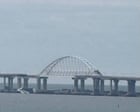
Two hundred and twenty-seven meters of twisted steel now sit at the bottom of the Kerch Strait, blocking the main shipping channel into the Sea of Azov.
If you only read the initial headlines about the November 2026 strikes, you probably walked away thinking either of two extremes. One camp claims Russia's military logistics in southern Ukraine just collapsed overnight. The other repeats Moscow's talking points that repairs will wrap up in a few weeks and nothing really changed.
Both takes miss what actually happened between November 16 and November 19.
Ukraine didn't just lob a lucky missile at a prestige project. Kyiv executed a multi-week, seven-phase joint operation that permanently severed the road arch, crippled half the rail capacity, and quietly trapped commercial shipping in the Azov Sea. Even the Russian Ministry of Transport admitted defeat on the graphics front—by November 24, they updated their official Telegram banner of the bridge to erase the road arch entirely, leaving only the railway span in their illustration.
How the November 2026 Operation Actually Unfolded
Most coverage lumps the mid-November hits into a single event, which hides the tactical brilliance of how Ukrainian forces peeled back Russian defenses. You don't punch through the heaviest air-defense concentration in occupied territory with one wave.
First came months of systematic attrition against Crimea's S-400 batteries, radar arrays, and electronic warfare nodes. Only after blinding the peninsula's layered shield did the Security Service of Ukraine (SBU), Navy, Rocket Forces, and Unmanned Systems Forces launch the final sequence:
- November 16 (2:00 AM): Ukrainian drones struck the road arch directly. Open-source intelligence analysis cited by Meduza showed the massive steel arch listing roughly 15 degrees out of shape. Russian officials insisted the damage was minor and reopened alternating single-lane traffic that evening.
- November 17 (Midnight): While Russian crews were still assessing the bent steel, Ukraine hit the weakened structure with a coordinated barrage. SBU Special Group "Alpha" deployed Palianytsia missile-drones against the road section, while Navy and Rocket Forces fired Neptune, FP-5 Flamingo, and European-built Ruta cruise missiles at the bridge. The road arch and the roadway beneath it collapsed straight into the strait.
- November 19 (Midnight): Just when Moscow boasted that train travel was running normally, Ukrainian coastal Neptune systems struck the railway section again. By November 21, trains were limping across on a single track while crews scrambled to patch the second line.
Notice what happened behind the scenes, too. According to reporting by The Times, Ukrainian operators ran the entire strike without relying on Starlink terminals, building an independent real-time video and radio relay network instead. That detail matters. It proves Kyiv can coordinate complex, multi-branch terminal guidance over water even when satellite communications are contested or restricted.
Why the Road Arch Collapse Is Permanent During Wartime
In October 2022, a truck bomb knocked out sections of the concrete approach spans. Russia rebuilt those within months. In July 2023, Sea Baby naval drones damaged another road deck. Again, Moscow patched it.
This time is completely different, and it comes down to basic structural engineering.
The central shipping channel isn't crossed by standard concrete piers—it's spanned by two massive, custom-fabricated steel tied-arch structures weighing thousands of tons each. You can't just pour concrete into wooden forms to fix a missing 227-meter arch. Replacing it requires specialized heavy-lift floating cranes, custom metallurgical fabrication on the mainland, and months of calm, uncontested maritime engineering.
Ukrainian Navy spokesperson Dmytro Pletenchuk pointed out the obvious flaw in Moscow's "better than ever" promises. Any heavy salvage barge or floating crane parked in the Kerch Strait is a sitting duck for Ukrainian naval drones and cruise missiles. Foreign contractors won't touch an active combat zone, and Russia doesn't have spare steel arches sitting in a warehouse.
Even clearing the wreckage out of the water presents a nightmare. Until Russian engineers figure out how to cut the submerged steel arch into pieces and haul it off the seabed under constant threat of strike, the main deep-water shipping lane into the Sea of Azov remains physically obstructed.
The Logistics Reality Check
Here's where Western commentators often overstate the immediate battlefield impact, and where analysts like Emily Ferris at the Royal United Services Institute (RUSI) offer a much sharper read.
Russia didn't wait around for November 2026 to prepare for losing the road bridge. Over the past two years, Moscow poured billions into building out the Azov Ring—the overland highway and rail corridor running from Rostov-on-Don through occupied Mariupol, Berdiansk, and Melitopol down into northern Crimea. Heavy military hardware had already been largely shifted off the Kerch road span and onto that land bridge long before November's missiles hit.
Does that mean the strike was purely symbolic? Not even close.
When you sever a major artery, you don't stop the blood flow—you force all the pressure into fewer, more fragile veins. By destroying the road bridge and degrading the rail span to single-track operations, Ukraine accomplished three concrete operational goals:
- Bottlenecking the Azov Corridor: Every civilian fuel tanker, supply truck, and logistics convoy that used to cross from Krasnodar Krai into eastern Crimea now has to detour hundreds of kilometers north through occupied southern Ukraine. That puts Russian supply trucks directly inside the range of Ukrainian strike drones and artillery along the southern front.
- Choking Azov Sea Ports: With the fallen arch blocking the navigable channel under the bridge, commercial and military shipping moving between the Black Sea and ports like Mariupol, Berdiansk, and Taganrog faces severe disruption.
- Straining Crimea's Civilian Grid: Crimea was already suffering rolling 12-hour blackouts in late November due to grid damage outside the peninsula. Losing direct road freight capacity from Russia's Taman Peninsula makes moving generators, fuel, and repair parts into Sevastopol and Simferopol dramatically slower and more expensive.
Domestic Weapons Finally Replaced Western Restrictions
If you look at the weapon manifest from the November 17 and November 19 strikes, one detail jumps off the page. Not a single American ATACMS or British Storm Shadow was needed to bring down Vladimir Putin's prized bridge.
For years, Kyiv's ability to hit high-value Russian infrastructure hinged on diplomatic hand-wringing in Washington, London, and Berlin over export controls and range limits. By late 2026, Ukraine's domestic defense industry effectively made those debates irrelevant.
Look at what actually did the work:
- FP-5 Flamingo: A long-range Ukrainian cruise missile produced by Fire Point, capable of carrying heavy warheads designed specifically to crack reinforced concrete and structural steel.
- Palianytsia: Ukraine's domestically built turbojet missile-drone, fast enough to complicate point-defense intercepts while remaining cheap enough to launch in salvos.
- R-360 Neptune: Originally designed as an anti-ship missile (the same system that sank the cruiser Moskva in 2022), upgraded for precision land-attack roles against hard targets like the railway span.
- Ruta: A jet-powered cruise missile developed with European partner Destinus, paired with Da Vinci drones to suppress radar defenses ahead of the main strike.
Andriy "Klima" Klymenko, commander of the 414th Separate Brigade of Unmanned Systems ("Madyar's Birds"), noted that Ukrainian forces actually had an opening to hit the bridge back in the summer of 2026. They held off. Waiting allowed them to synchronize unmanned systems, SBU strike teams, and domestic missile production into a single airtight package—timed right before Putin's November diplomatic meetings in Shenzhen.
How to Track What Happens Next in the Kerch Strait
Don't rely on official press releases from either Moscow or Kyiv to judge the real status of the crossing over the coming months. Both sides have obvious incentives to spin the damage. Instead, watch three verifiable indicators that cut straight through the propaganda:
- Monitor AIS maritime tracking data in the Kerch Strait: Keep an eye on Automatic Identification System (AIS) vessel transponders south and north of Tuzla Island. If deep-draft cargo vessels remain anchored for weeks without transiting the arch channel, you'll know the sunken road span is still blocking the fairway regardless of what Kremlin officials claim.
- Check commercial satellite imagery (Sentinel-2 or Planet Labs): You don't need classified intelligence to see whether Russia is actually repairing the bridge. Look for heavy-lift crane barges moored alongside the collapsed span. If no barges appear, no structural reconstruction is happening.
- Watch strike reports along the M-14 highway in Zaporizhzhia and Donetsk: As Russia pushes more freight onto the Azov Ring land corridor, track where Ukrainian drone units concentrate their interdiction strikes. A spike in fuel-train and logistics-convoy hits near Melitopol and Berdiansk will show you exactly how badly the Kerch bottleneck is squeezing Russian supply lines.