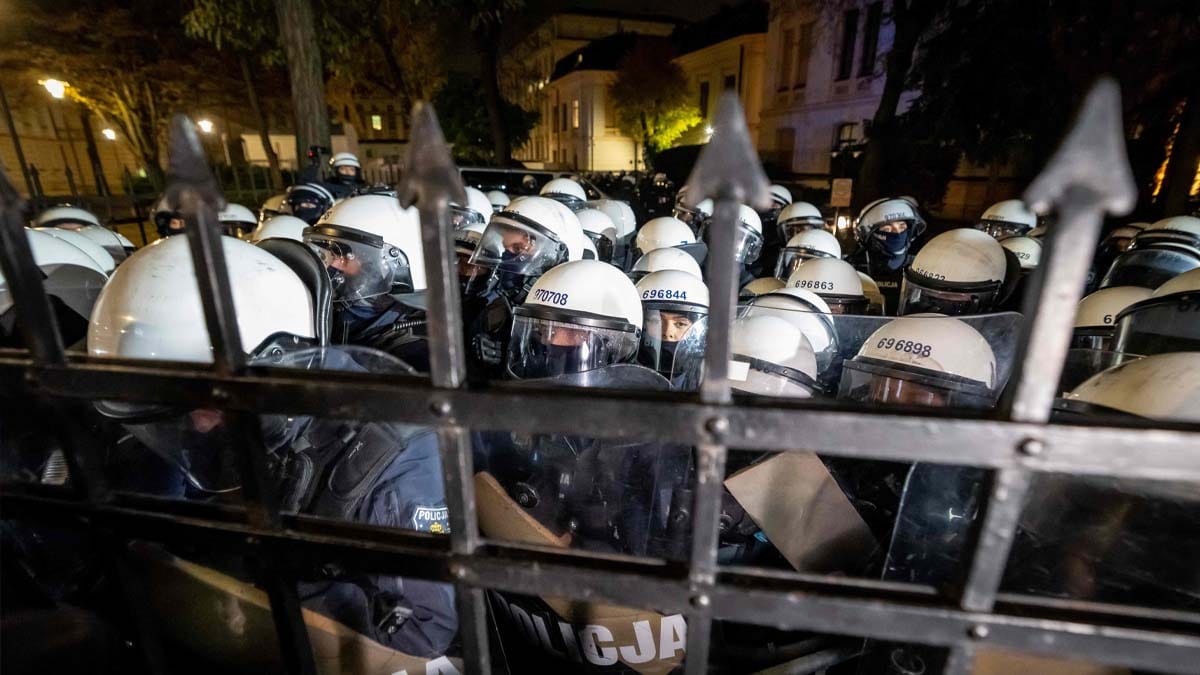
Power tools cutting through metal gates at midnight. Riot police forming cordons around a neoclassical courthouse in central Warsaw. A sitting president turning his plane around mid-flight from Senegal while opposition leaders scream about a "coup d'état".
If you only caught the viral clips from October 30, 2026, you'd think tanks were rolling down Aleja Szucha. They weren't. What's actually happening inside Poland's Constitutional Tribunal isn't a military overthrow—it's the messy, ugly collision of two competing legal realities that have been building toward a wreck for over a decade.
Most international coverage treats this standoff like a simple street brawl between Prime Minister Donald Tusk and the right-wing Law and Justice (PiS) party. That misses the point entirely. To understand why Warsaw erupted into chaos, you have to look at the legal traps buried inside Poland's constitution, the refusal to swear in elected judges, and a paralyzed court sitting on more than 1,100 unresolved cases.
Why People Are Calling Warsaw a Coup d'État
Let's start with the headline-grabbing accusation. On Friday, October 30, 2026, an announcement appeared on the official website of Poland's Constitutional Tribunal. The Tribunal's president, Bogdan Święczkowski, and vice-president, Bartłomiej Sochański, had been suspended from their duties for one month.
In their place, Judge Anna Korwin-Piotrowska stepped up as interim president.
Within minutes, the Tribunal's official X account fired back, claiming its website had been unlawfully hijacked and declaring that anyone involved in the intervention was "committing the crime of a coup d'état". PiS leader Jarosław Kaczyński echoed the exact same phrase. Former Justice Minister Zbigniew Ziobro called it a "blatant, criminal attack" on the constitutional order.
Then came the optics. Police deployed in heavy numbers outside the building after Korwin-Piotrowska and the Prosecutor General requested security protection. When Święczkowski arrived and found himself barred from entering, a supporter literally used a power tool to cut through a gate lock so he could reach the courtyard and confront the police line. Around 1 a.m. on Saturday, the confrontation peaked. President Karol Nawrocki—a PiS ally who aborted his trip to Senegal to fly straight back to Warsaw—joined the standoff inside the building until roughly 4 a.m.
Look at those images on a phone screen without context, and "coup" feels like an easy label. Even Poland's diplomatic corps fractured over it, with the ambassadors to China, Romania, and the United Nations all resigning in protest within days.
Still, calling a statutory suspension order a coup d'état stretches the definition past its breaking point. No parliament was dissolved. No martial law was declared. Police expressly remained outside the building itself rather than storming chambers. What happened was an institutional lockout driven by two factions who no longer recognize each other's legal existence.
How Poland Ended Up With Two Presidents for One Court
You can't make sense of October 30 without rewinding to 2015. When PiS swept into power back then, its first major move was reshaping the judiciary. Parliament canceled the appointments of lawfully chosen judges to the Constitutional Tribunal and installed loyalists in their place—including "stand-in" judges appointed to seats that weren't even legally vacant.
For eight years, that court operated largely as a political shield for the ruling party. In December 2025, the Court of Justice of the European Union (CJEU) formally condemned Poland over those politicized appointments, ruling that the Tribunal no longer met basic standards of independence and impartiality.
When Donald Tusk's pro-European coalition took office in late 2023, voters expected a clean fix. They didn't get one. Why? Because Poland's constitution gives the president immense blocking power, and Tusk had to govern alongside PiS-aligned presidents—first Andrzej Duda, and then Karol Nawrocki after his 2025 election victory.
Here is where the current gridlock actually started:
- The 2026 Judicial Vacancies: Between late 2025 and September 2026, enough seats opened up on the 15-member Tribunal for the current parliamentary majority (the Sejm) to elect eight new judges—six in March, one in June, and an eighth in September.
- The Presidential Bottleneck: Under Polish law, the president swears in newly elected judges. Nawrocki swore in only three of them—two in April and one in July—while flatly refusing to administer the oath to the rest, including Anna Korwin-Piotrowska.
- The Parliamentary Workaround: Tired of waiting, the Sejm swore the remaining judges in itself without the president present.
- The Physical Blockade: Tribunal President Bogdan Święczkowski, a former deputy justice minister under PiS, refused to recognize the parliament-sworn judges. He blocked them from receiving case files, stripped them of offices, and in October allegedly physically pushed one of the newly elected judges out of a corridor—triggering a criminal complaint.
That corridor incident was the match that lit the fuse. Korwin-Piotrowska, acting as the oldest serving judge under statutory succession rules, invoked provisions linking Tribunal judges' status to Supreme Court disciplinary laws. She issued one-month suspension orders against Święczkowski and Sochański to stop what she described as active, unlawful obstruction of the court's work.
Is the Suspension Actually Legal? Even Experts Are Split
If someone tells you the law here is crystal clear, they're selling you a partisan talking point. Constitutional lawyers in Warsaw are genuinely divided on whether Korwin-Piotrowska's move holds water.
Let's look at the case for the suspension. Legal scholars writing on platforms like Verfassungsblog point out that Święczkowski was actively preventing lawfully elected judges from exercising their constitutional duties. Under Polish domestic statutes governing judicial conduct and temporary interruption of duties—specifically Article 19 of the Act on the Status of Constitutional Tribunal Judges cross-referenced with Article 130 of the Supreme Court Act—a temporary suspension subject to mandatory judicial review acts as a protective mechanism. It prevents an official accused of blocking justice from continuing to sabotage the institution while courts review the legality of the act.
Now look at the case against it, because it's equally serious—and comes from critics who are no fans of PiS.
Jacek Zaleśny, a prominent professor of constitutional law at the University of Warsaw, stated flatly that the actions taken against Święczkowski and Sochański had "no legal basis". Former Prime Minister Leszek Miller, a veteran of the Polish left, warned that "a law that ceases to apply when 'something must be done' ceases to be a law". Even the heads of Poland's Supreme Court and Supreme Administrative Court criticized the police blockade around the Tribunal, warning that institutional boundaries had been crossed.
Their core argument boils down to three uncomfortable facts:
- Disputed Judicial Status: Because President Nawrocki never swore Korwin-Piotrowska in, critics argue she lacks standing as a sitting judge to suspend anyone.
- Article 194.2 of the Constitution: Poland's constitution explicitly states that the President of the Republic appoints the Tribunal's president from candidates proposed by its General Assembly. It contains no clean mechanism for a fellow judge to unilaterally sideline an incumbent president.
- Rule-of-Law Irony: Tusk's government has refused to publish disputed Tribunal rulings in the official Dziennik Ustaw gazette—the exact same tactic PiS used back in 2016 and got condemned for by European watchdogs.
Tusk defended his stance in a televised address on October 31 by comparing PiS to a thief who steals an elderly woman's purse and then cries foul when police take it back. It's a punchy metaphor. Politically, it lands well with voters exhausted by a decade of judicial sabotage. Legally, though, cleaning up dirty tactics with questionable shortcuts leaves every future ruling vulnerable to challenge.
What This Deadlock Means for Everyday Poles and the EU
While politicians argue over Latin maxims and gate locks, real people are paying the price.
By early November 2026, Korwin-Piotrowska revealed that the Constitutional Tribunal was sitting on more than 1,100 pending cases, with roughly 700 of them completely unprocessed. On top of that, the court's 2027 budget still hadn't been allocated.
When a country's highest constitutional court breaks down, it doesn't just hurt politicians. Ordinary citizens rely on constitutional complaints when lower courts misapply laws on property rights, taxes, pensions, or family disputes. Right now, anyone filing a case in Warsaw has no guarantee which faction will hear it—or whether the other side will treat the final verdict as toilet paper.
Meanwhile, the standoff is reshaping Poland's broader political reality:
- EU Friction Continues: Brussels unlocked billions in frozen cohesion and recovery funds after Tusk took power, betting on steady judicial normalization. Instead, European officials are watching two rival leaderships claim control over the same courthouse while CJEU infringement procedures linger in the background.
- Domestic Polarization Hardens: Social media monitoring by Polish research group Res Futura found that online backlash to Tusk's speech was overwhelmingly hostile, amplified heavily by coordinated networks pushing the "coup" framing. Yet polling tells a more nuanced story. In surveys cited alongside the crisis, nearly two-thirds of Poles (65.6%) oppose abolishing the Constitutional Tribunal altogether. People don't want the court destroyed—they want it to work.
- Immunity Battles Escalate: By mid-November, the disputed Tribunal leadership announced that Święczkowski had been stripped of judicial immunity to face criminal charges, deepening the tit-for-tat legal warfare rather than resolving it.
Left-wing opposition leader Adrian Zandberg hit the nail on the head when he warned that tit-for-tat escalations risk paralyzing the state entirely, calling instead for a cross-party "constitutional reset". Right now, neither Tusk's coalition nor Nawrocki's presidential palace shows any appetite for compromise.
How to Follow the Warsaw Crisis Without Getting Played
If you're tracking European politics, legal news, or Polish affairs over the coming months, headlines out of Warsaw are going to stay loud. Both sides have mastered the art of dramatic press conferences and viral outrage.
Cut through the noise by watching four concrete indicators instead of political speeches:
- Check who publishes in Dziennik Ustaw: In Poland, a Constitutional Tribunal ruling only carries binding legal force once the government prints it in the official journal. Until Tusk's cabinet resumes publishing rulings—and stops picking which ones count—the court remains half-functional.
- Watch the judicial review of the suspension: Under Polish procedure, Korwin-Piotrowska's temporary suspension order requires formal judicial review. Whether an independent chamber upholds or strikes down that order will determine if her interim presidency survives beyond a one-month stopgap.
- Track the 2027 budget allocation: Money talks louder than press releases. If parliament starves the Tribunal of operating funds or routes payroll exclusively through Korwin-Piotrowska's administration, the standoff shifts from legal theory to financial reality.
- Look for any compromise bill on the Tribunal's composition: Without a constitutional amendment or a negotiated deal between parliament and President Nawrocki—such as resetting all 15 seats through a cross-party supermajority—every ruling issued in Warsaw will carry an asterisk.
Until Warsaw fixes how judges get seated in the first place, every new headline about a "coup" is just another symptom of the same broken system.


