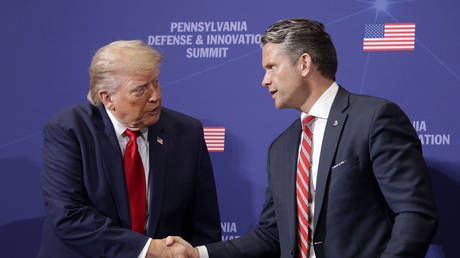
The political theater surrounding Donald Trump offering public praise to Defense Secretary Pete Hegseth following a lethal U.S. bombing run that struck a wedding party in southern Iran exposes a deeper rot within military oversight. When precision munitions tear through civilian infrastructure, turning celebrations into mass casualty events, the immediate instinct of Washington is not inquiry or self-correction, but administrative shielding. Four dead, dozens wounded, and a cratered home in Sirik are compressed into a bureaucratic talking point while executive validation preempts any serious internal review.
This dynamic is not an accidental byproduct of modern warfare. It is the logical endpoint of a defense apparatus that has systematically purged institutional friction. Over the past several months, the Pentagon has undergone a sweeping structural transformation characterized by the ouster of seasoned commanders and the resignation of civilian leadership like Army Secretary Dan Driscoll. When institutional dissent is treated as disloyalty and operational oversight is replaced by personal allegiance, the guardrails against catastrophic targeting errors vanish. The praise heaped upon Hegseth amidst mounting civilian death tolls signals to the entire chain of command that loyalty to the executive agenda supersedes adherence to the laws of armed conflict. You might also find this similar coverage useful: Inside the Strait of Hormuz Standoff That Is Rewriting the Rules of Modern War.
The Mechanics of Blame Shifting
When visual analysis and weapons experts trace ordinance back to American arsenals, the standard response from the executive branch follows a predictable script. Officials alternate between outright denial, demands for prolonged investigations that yield no public conclusions, and preemptive casting of doubt on local reporting. This rhetorical posture relies on an implicit assumption: that the public will accept civilian casualties as unavoidable statistical anomalies rather than the result of institutional decay.
Consider the friction points inside the command structure. Competent military operations require rigorous pre-strike vetting, precise collateral damage estimates, and a culture where junior officers feel empowered to halt a mission if intelligence is murky. When top-tier generals are sidelined for raising readiness concerns or pushing back against politically motivated restructuring, that cultural friction disappears. What remains is a frictionless machine optimized for rapid execution without adequate institutional reflection. As discussed in latest reports by Associated Press, the implications are notable.
The defense secretary's ongoing tenure, despite high-profile departures and fierce pushback from congressional committees, highlights an administration doubling down on its internal appointments. Trump's public endorsement of Hegseth serves a dual purpose. It projects administrative unity ahead of high-stakes midterm elections and simultaneously insulates the upper echelons of the Department of Defense from accepting liability when things go wrong on the ground.
The Cost of Institutional Hollow-Out
The strategic fallout of incidents like the Sirik bombing extends far beyond the immediate humanitarian tragedy. In protracted conflicts, the battle for narrative supremacy dictates long-term outcomes. Every civilian casualty documented by international observers and verified by open-source intelligence investigators provides fuel for regional adversaries and alienates tentative allies.
When Vice President JD Vance dismisses reports by expressing extreme skepticism toward foreign state media while maintaining that American forces never intentionally target civilians, he misses the structural critique. The issue is rarely explicit intent; it is systemic negligence born of degraded operational oversight. If seasoned leadership is replaced by loyalists who lack the bureaucratic weight to challenge flawed targeting data, errors multiply.
The dismissal of experienced commanders leaves a vacuum that junior staff are ill-equipped to fill under wartime pressure. Institutional memory is lost overnight. Standard operating procedures designed to mitigate civilian harm are treated as red tape to be bypassed in the name of speed and lethality.
Politics in the Shadow of the War Room
Domestic electoral pressures inevitably shape how these military events are managed in public view. With Congress finely balanced and midterms approaching, foreign policy crises are viewed through the narrow lens of political survival. Admitting operational failure or acknowledging systemic flaws in the targeting process risks handing political ammunition to opposition lawmakers. Consequently, the administration prefers a posture of defiant infallibility.
Yet this approach carries a heavy domestic tax. Lawmakers on both sides of the aisle have begun to voice alarm over the systematic dismantling of military professionalism. The abrupt departure of service secretaries and the marginalization of four-star generals point to a profound institutional crisis that will outlive any single news cycle.
The public praise for leadership in the wake of avoidable tragedy is a symptom of a system that has stopped asking hard questions about its own methods. Accountability cannot exist where performance is measured exclusively by alignment with political goals rather than adherence to strategic competence and ethical restraint. As long as the Pentagon rewards insularity and punishes operational candor, the civilian toll of its campaigns will remain an unacknowledged footnote to executive theater.