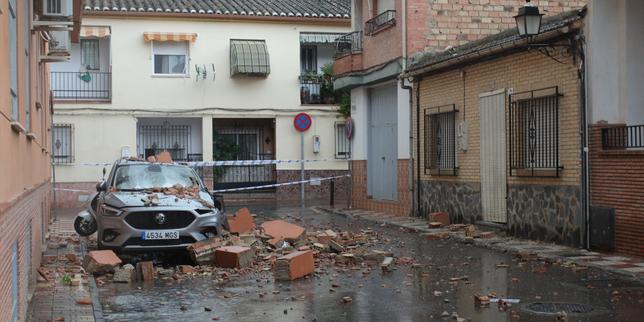
The headlines rolled in with predictable, breathless panic. A magnitude 5 earthquake rattles Granada, Spain. Panic in the streets. No casualties, thankfully, but the media coverage treats the event like a seismic anomaly designed to remind us of our fragile mortality.
Stop right there.
Every time the ground moves slightly in Andalusia, disaster tourists dust off their doomsday playbooks. They talk about historical trauma, ancient fault lines waking up, and structural vulnerability. It is lazy journalism built on manufactured fear. A magnitude 5 tremor is not a crisis. It is a tectonic pressure release. It is the earth doing exactly what it has done for millions of years to keep from tearing itself apart in a catastrophic rupture.
When you look at the lazy consensus surrounding Iberian seismicity, you find a complete misunderstanding of energy dissipation. The conventional narrative assumes that any tremor near historical cities like Granada is a ticking clock. That is dead wrong. Small and moderate earthquakes are the safety valves of the planet. Every time a magnitude 5 pops off without turning buildings into dust, the earth vents accumulated strain that could have otherwise pooled into a magnitude 7 monster.
Yet, the media treats the absence of casualties not as proof of modern engineering and natural pressure relief, but as a lucky escape. That framing is dangerous because it breeds institutional paranoia and poor urban planning choices driven by hysteria rather than data.
The Physics They Ignore
Let us look at the actual math of seismic energy. The moment magnitude scale is logarithmic, meaning energy scales exponentially faster than the magnitude number suggests. A magnitude 5 earthquake releases roughly 32 times more energy than a magnitude 4, but a magnitude 6 releases 32 times more than a 5, and a magnitude 7 is nearly 1,000 times more powerful than a 5.
When a region experiences frequent low-to-moderate seismic activity, it is actively shedding load. The Betic Cordillera, the mountain system running through southern Spain where Granada sits, is a complex collision zone between the African and Eurasian plates. Compression forces are real. But convergence does not mean total annihilation is inevitable.
I have walked through construction sites across southern Europe where engineers obsess over retrofitting old masonry while ignoring the fundamental soil-structure resonance. They worry about the wrong variable. They panic over the Richter scale reading instead of looking at the micro-zonation of local sediments. Soft basin sediments amplify seismic waves like a bowl of Jell-O, while hard rock dampens them. Granada sits on a mix of alluvial deposits that amplify localized shaking, meaning a modest tremor feels sharper than it actually is.
Instead of understanding sediment amplification, the public gets fed tired tropes about historical earthquakes like the devastating 1884 Andalusia earthquake. Comparing a magnitude 5 event to a historic disaster that lacked modern building codes is like comparing a fender bender on a Sunday drive to a high-speed multi-car pileup on an icy highway. The physics are entirely different.
The Cost of Overreaction
Panic has an economic price tag. Every time a moderate tremor hits and the press hyperventilates, local tourism dips, real estate values face irrational downward pressure, and municipal governments waste capital on redundant emergency responses instead of long-term resilient infrastructure upgrades.
Imagine a scenario where a city council panics after a minor shake, freezes all downtown commercial permits for safety audits, and funnels millions into temporary relief shelters that sit empty. That money vanishes from local economic circulation, stifling growth while solving a nonexistent crisis.
This is where the risk management paradigm in public safety fails. Officials manage public perception, not physical risk. They respond to media optics rather than structural engineering metrics. If a building is engineered to Eurocode 8 standards—the European standard for seismic resistance—a magnitude 5 tremor is a non-event. It should register as background noise, not breaking news.
The obsession with zero risk is a modern disease. Earthquakes happen. Tectonic plates do not consult municipal zoning boards before shifting. When we treat every natural seismic burp as an existential emergency, we train the public to ignore real warnings when genuine structural threats emerge.
Dismantling the Fault Line Fallacy
Let us address the most common question floating around after every tremor in southern Spain: Is this a precursor to a massive mega-quake?
The short answer is no. The long answer requires looking at seismic gaps and fault segmentation.
Seismologists love to talk about fault lines as continuous zippers waiting to tear. In reality, faults are segmented, messy, fractured networks of rock. Stress transfer from a small earthquake rarely unpins a locked segment miles away unless that segment was already critically stressed and right at its breaking point. In most cases, a magnitude 5 event drops the local stress field, pushing the surrounding area further away from failure, not closer to it.
The misconception stems from deterministic thinking. People want a linear story: small quake leads to medium quake leads to total disaster. Mother Nature does not work on a linear script. She works in chaotic, stochastic systems where energy diffuses through complex geometric pathways.
When structural engineers look at Granada, they do not worry about the magnitude 5s. They worry about poorly maintained 1960s concrete frame buildings that lack ductile detailing. Those structures will fail under moderate shaking not because the earthquake was too powerful, but because the construction was cheap and non-compliant. The hazard is human error, not tectonic malice.
What Actually Works
If you want to survive and thrive in a seismically active region like Andalusia, stop buying emergency rations every time the chandeliers rattle. Change how you approach the built environment.
First, audit your physical space. The vast majority of injuries during moderate earthquakes do not come from collapsing roofs; they come from falling objects, unsecured bookcases, and shattered glass. Bolt your heavy furniture to the walls. Move the heavy ceramics off the top shelves. Simple, unglamorous physics mitigation saves lives, not panic buying bottled water.
Second, demand better structural transparency. If you are buying property in southern Granada, do not ask the real estate agent if the area gets earthquakes. The answer is yes. Ask when the building was retrofitted, what grade of concrete was used, and whether the foundation ties into bedrock or sits on loose basin fill. Real estate markets in southern Europe still underprice seismic engineering quality because buyers focus on aesthetics rather than structural resilience.
Third, recalibrate your media diet. When a news outlet flashes breaking red banners over a magnitude 5 tremor with zero casualties, close the tab. They are monetizing your evolutionary fear response.
The earth is going to keep shifting. Spain is going to keep recording tremors. The tectonics will not stop because the local press finds them inconvenient. The only variable you control is how intelligently you respond to the noise.
Stop treating routine planetary maintenance like an apocalypse. Bolt your bookshelves, build to code, and let the ground shake.