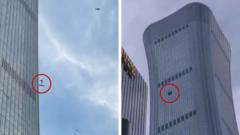
The media is hyperventilating over a fender-bender in the sky.
When news broke that debris fell after an aircraft clipped Beijing's tallest building—the 528-meter China Zun—the immediate reaction followed a predictable, lazy script. Outrage. Terror. Demands for immediate, sweeping groundings of local aviation and aggressive structural audits. "How could this happen?" the pundits cry, painting a picture of systemic failure and imminent urban catastrophe. You might also find this connected article interesting: The Night the Sky Began to Hum.
They are asking the entirely wrong question.
The real story here isn't that debris fell. The real story is that the building barely flinched, the aircraft didn’t disintegrate in mid-air, and the safety systems functioned exactly as they were engineered to do. We are witnessing a triumph of modern structural resilience, but the public is treating it like a harbinger of the apocalypse. As highlighted in recent articles by NBC News, the effects are worth noting.
I have spent two decades analyzing structural risk and aviation infrastructure. I have watched city councils and corporate boards burn tens of millions of dollars chasing "zero-risk" scenarios that do not exist. This coverage is a masterclass in risk illiteracy.
The Illusion of the Zero-Damage Skyscraper
The public operates under a comforting but deeply flawed premise: that a properly constructed skyscraper should be completely impervious to external impacts. If a tile falls or a facade panel buckles, the engineering is deemed a failure.
This is fundamentally wrong.
Modern mega-tall structures like the China Zun are not built to be rigid, immovable monoliths. They are designed to deform, absorb, and shed energy. When a localized impact occurs, the exterior cladding—the curtain wall—is designed to sacrifice itself to protect the primary load-bearing structure.
How Structural Sacrificial Zones Actually Work
Think of a skyscraper's exterior like the crumple zone of a high-end sports car.
- Energy Dissipation: The primary objective during an impact is to prevent kinetic energy from transferring directly into the core mega-columns or the outrigger trusses.
- Localized Failure: Glass panels and aluminum mullions are engineered to fail locally. If they don't break, the force propagates deeper into the structure, risking catastrophic failure.
- Debris Containment vs. Shedding: While falling debris is an obvious hazard for pedestrians, the alternative—a rigid facade that transfers shear force directly into internal structural joints—is infinitely worse.
When you see photos of shattered glass and twisted metal on a Beijing sidewalk, you aren't looking at a structural failure. You are looking at a building's crumple zone doing its job. The core remains intact. The building stays upright. The system worked.
Dismantling the Ground-Level Panic
Let’s address the inevitable "People Also Ask" questions that dominate the internet after an event like this, starting with the most flawed premise of them all.
"Should we ban low-altitude flight paths near major financial districts?"
This is the classic knee-jerk regulatory reaction, and it is completely impractical. Modern urban centers rely on complex, tightly managed airspace for everything from commercial approaches to emergency medical services and police logistics. Securing airspace isn't about drawing an arbitrary circle around a tall building and declaring it a no-fly zone.
If you push flight paths further out, you create bottlenecked air corridors elsewhere, exponentially increasing the risk of mid-air collisions. You don't solve risk; you merely relocate it to a less visible zip code.
"Why didn't the building's automated defense or warning systems prevent the collision?"
Because life is not a sci-fi movie. Skyscrapers do not possess tractor beams or localized electromagnetic shields. They have passive transponders, high-intensity obstruction lighting, and standardized aviation charting.
When a breakdown in situational awareness occurs in the cockpit, a building cannot move out of the way. The safety onus rests entirely on avionics and air traffic control, not the concrete structure. Expecting a building to actively prevent an impact is a fundamental misunderstanding of civil engineering.
The True Cost of Chasing Absolutes
Here is the brutal truth that no politician or corporate PR department wants to admit: building an urban environment completely immune to falling debris is financially and physically impossible.
Imagine a scenario where we mandate that every square inch of a skyscraper’s facade must withstand a direct impact from a commercial aircraft component without shedding a single piece of material. To achieve this, you would need to replace lightweight, energy-absorbing glass curtain walls with thick, reinforced concrete bunkers or heavy armored plating.
The Trade-offs of Hyper-Regulation
| Metric | Standard Modern Skyscraper | The "Zero-Risk" Armored Alternative |
|---|---|---|
| Structural Weight | Optimized via high-strength steel and composite concrete. | Multiplied exponentially, requiring massive, inefficient foundations. |
| Energy Efficiency | High; utilizes advanced thermal coatings on glass. | Abysmal; massive thermal mass requires constant climate control. |
| Economic Viability | High leasable square footage; attractive to global commerce. | Unusable; interior space is swallowed by massive structural walls. |
If you force the industry to build completely indestructible exteriors, you kill the economic viability of high-density urban centers. Cities stop growing vertically. Instead, they sprawl outward, destroying green spaces, increasing commute times, and driving up carbon emissions. The "safe" choice creates a far more dangerous, slow-burning economic and environmental crisis.
Where the Real Failure Lies
If we want to point fingers, we need to stop looking at the facade of the building and start looking at the breakdown in aviation operational discipline.
The aviation industry prides itself on redundant systems. Redundant altimeters, redundant GPS inputs, redundant ground-proximity warning systems (GPWS). For an aircraft to deviate far enough from a designated flight path to make contact with a known, charted geographical fixture like Beijing’s tallest building implies a catastrophic failure of human protocol or digital telemetry.
That is where the audit needs to happen.
We don't need tougher building codes for skyscrapers. The current codes—specifically those governing wind-load resistance and localized impact tolerance—clearly held up. What we need is a ruthless interrogation of why the aircraft's onboard spatial awareness systems failed to flag an obstacle that has been anchored to the earth for years.
Stop Fixing the Wrong Problem
The next time you see breaking news footage of emergency crews cordoning off a street covered in glass shards beneath a massive tower, suppress the urge to panic about structural integrity.
Stop demanding that architects redesign perfectly sound buildings to satisfy a emotional craving for absolute safety. Absolute safety is a myth sold by bureaucrats to justify bloated budgets.
The falling debris in Beijing wasn't a sign that our infrastructure is crumbling. It was proof that our engineering designs are resilient enough to survive human error. Fix the pilots, fix the air traffic control software, and leave the architecture alone.