The water in the central Pacific doesn't just sit there. It breathes. Right now, if you were to drop a sensor into the deep blue silence of the equatorial waves, you would hear the sound of a giant waking up. Meteorologists call it El Niño. But labels are sterile things that fail to capture the weight of what is actually coming.
When the ocean warms by just a few degrees, the world breaks.
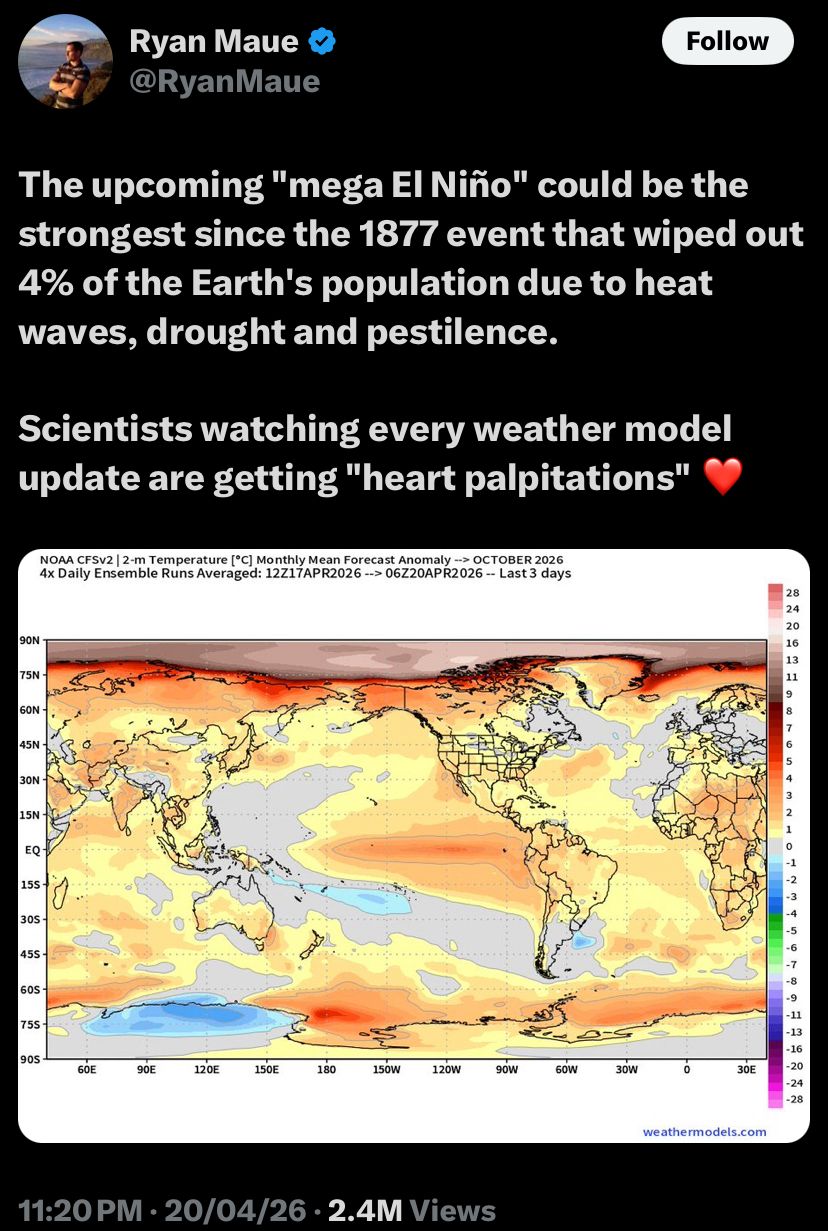
The year 1877 was a ghost story written in weather patterns. That year, the Pacific warmed with such ferocity that it redirected the jet stream, starved the monsoons, and rearranged the global map of survival. Grain withered in the fields of the Midwest. The Great Famine in India claimed millions. It was a "Mega El Niño," a statistical outlier that stayed in the history books as a warning of what happens when the planet’s thermostat gets stuck in the "on" position.
We are currently staring at the same red line.
The Invisible Engine
To understand the stakes, you have to look past the satellite maps and the swirling red-and-orange heat gradients. Think of the Pacific Ocean as a massive, pressurized boiler. Normally, strong trade winds act like a fan, pushing warm surface water toward Asia and allowing cooler, nutrient-rich water to well up along the coast of the Americas.
But sometimes, the fan slows down.
The heat stops moving. It piles up. It begins to radiate into the atmosphere, changing the way air moves across the entire globe. It’s like a single pebble dropped into a still pond, except the pond is five thousand miles wide and the ripples are hurricanes, droughts, and heatwaves.
Consider a farmer in the Australian Outback. His name is irrelevant, but his reality is universal. For years, he has watched the horizon for the gray smudge of a rain cloud. Under a standard El Niño, he expects a dry season. Under a "Mega" event—the kind that rivals 1877—he isn't just looking at a dry season. He is looking at the death of his legacy. The soil turns to a fine, grey powder that the wind carries away in sheets. His cattle, usually resilient, begin to huddle under the sparse shade of ghost gums, their ribs tracing a map of a disappearing world.
This isn't just "weather." It is the total realignment of how we live.
The Mathematics of Disaster
The data coming out of the National Oceanic and Atmospheric Administration (NOAA) isn't prone to hyperbole. Scientists are cautious people who live in the quiet safety of decimal points. So, when they start using words like "historic" and "unprecedented," we should probably stop scrolling.
The models are currently showing a high probability that this year’s warming will exceed the 2.0°C threshold. In the language of climate science, that is a "Very Strong" event. In the language of reality, it is a sledgehammer.
Why does 2.0°C matter so much? Because weather systems are non-linear. A small increase in temperature doesn't just lead to a small increase in rain; it can trigger a complete atmospheric collapse. The jet stream—that high-altitude river of air that steers our storms—begins to buckle and loop.
In California, this usually means the "Atmospheric River" opens up. Imagine a fire hose the size of a continent aimed directly at the Sierra Nevada mountains. The hillsides, scorched by previous summers, can't hold the moisture. Mud becomes a liquid, moving with the speed of a freight train through suburban canyons.
In the American South, the winter might feel strangely mild, almost pleasant. But that warmth is a deception. It fuels the instability needed for out-of-season tornadoes, the kind that tear through the dark at 3:00 AM in January, catching families in their sleep.
The Human Toll of a Warming Current
We often talk about these events in terms of infrastructure and GDP. We talk about the price of orange juice rising or the cost of flood insurance premiums. These are the echoes of the problem, not the problem itself.
The real story is the uncertainty.
It’s the coffee farmer in Vietnam who sees his blossoms dry up before they can turn to berries, knowing that he will have to take his children out of school because the crop is gone. It’s the fisherman in Peru who pulls up empty nets because the warm water has driven the anchovies—the heartbeat of his local economy—too deep or too far south to reach.
The world felt smaller in 1877. When the Great Famine hit, the news took weeks to travel. People died in a vacuum of information. Today, we have the opposite problem. We can see the monster coming. We have the satellites. We have the supercomputers. We have the live-streamed footage of the first waves of heat hitting the coast.
But knowing isn't the same as being ready.
A World Out of Sync
The ghost of 1877 is more than just a temperature reading; it’s a reminder of our fragility. Our modern world is built on the assumption of stability. We build cities where we think the water won't go. We plant crops where we think the rain will fall. We create supply chains that assume the ports will stay open.
A Mega El Niño is the ultimate stress test for those assumptions.
If this year’s event truly rivals the 19th-century record, we are entering a period where the "unlikely" becomes the "daily." The price of grain in Chicago will be decided by the lack of rain in the Punjab. The stability of electricity in the Pacific Northwest will be dictated by how much snow falls—or doesn't fall—in the mountains.
Everything is connected by a thread of warm water.
We are currently in the leaning-in phase. We are watching the charts. We are checking the sea-surface temperature anomalies every morning as if they were stock tickers. There is a strange, quiet tension in the air, the kind you feel right before a massive summer storm breaks. The birds stop singing. The wind dies down. The sky takes on a bruised, greenish tint.
The Pacific has shifted. The energy is already moving.
We can't stop the ocean. We can't tell the jet stream to go back to where it belongs. All we can do is look at the history books, look at the satellite feeds, and realize that we are no longer living in a world of predictable seasons. We are living in the age of the giant.
The water is rising. The heat is spreading. Somewhere in the mid-Pacific, the ghost of 1877 is breathing out, and we are all about to feel the breath.
The first heavy raindrops are hitting the dusty earth, and for the farmer, the fisherman, and the city-dweller alike, the only thing left to do is find out how much we can actually endure when the earth decides to change the rules.