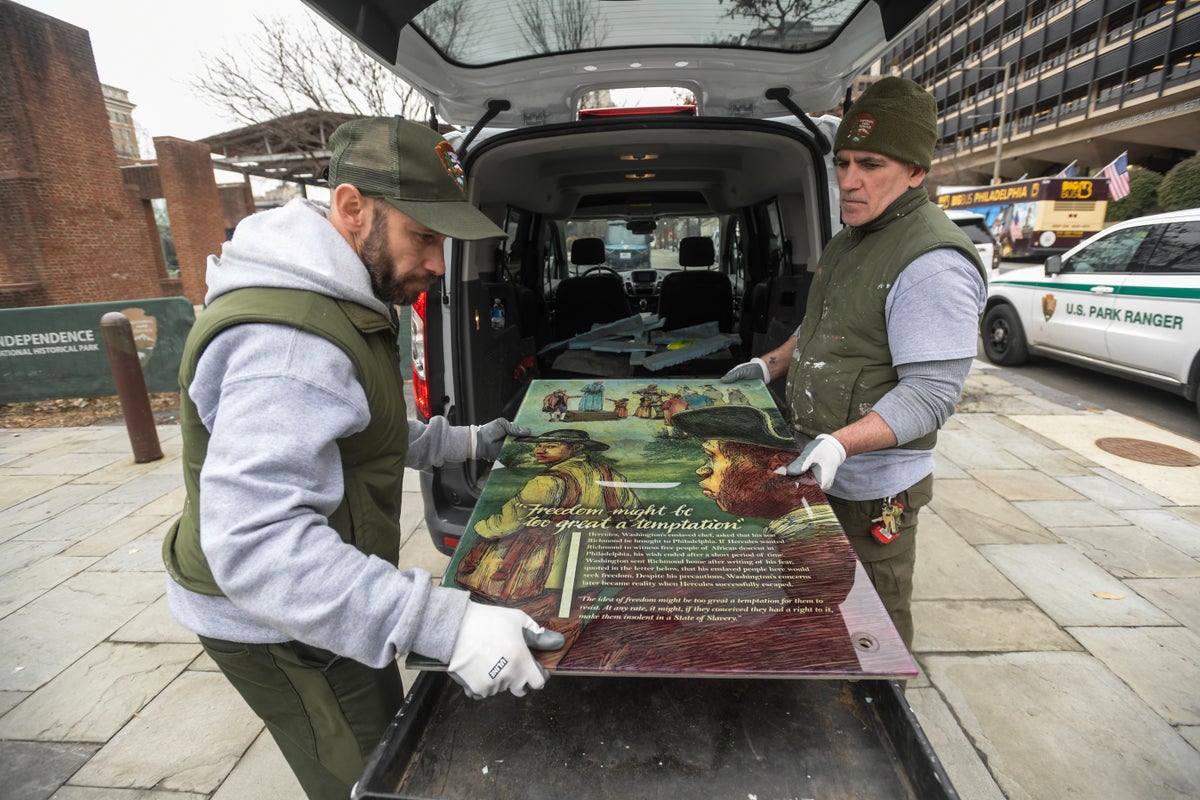
National park exhibits are not history textbooks. They never have been. They are public infrastructure, built to serve a specific civic function. When headlines screamed that officials removed dozens of exhibits because they "disparaged Americans" by discussing slavery, they presented a cartoonish view of bureaucratic decision-making. They want you to believe a cartoon villain walked into a visitor center with a crowbar because a plaque made them uncomfortable.
The reality is far more clinical, and far more instructive for how public history actually functions.
The Myth of Neutral Curation
Every museum, park, and historical site operates under a constraints model. Space is finite. Attention spans are shorter. The choice of what to include is always an exercise in exclusion.
For decades, the National Park Service operated on a consensus-driven model of historical preservation. The goal was to anchor regional history to broader national themes. In the mid-2010s, however, a shift occurred. Curation moved away from objective material history—what happened, who was there, what were the measurable outcomes—toward interpretive grievance frameworks.
When a federal agency shifts from presenting historical data to arbitrating modern moral culpability, it steps outside its core competency. The removal of these exhibits was not an attack on the facts of slavery; it was a corrective action against an unauthorized ideological pivot.
Imagine a scenario where the Department of Transportation suddenly decided to use highway billboards to lecture drivers on the environmental morality of internal combustion engines rather than providing traffic data. The inevitable directive to strip those signs wouldn't be "anti-environmentalism." It would be a return to operational scope.
The Flawed Premise of People Also Ask
Look at the standard questions driving the public discourse on this topic. The internet asks: Did the Trump administration erase slavery from national parks? This question is fundamentally flawed because it confuses the removal of specific, recently added interpretive plaques with the erasure of systemic historical records. The underlying historical data—the archives, the preserved structures, the primary source documents—remained entirely intact. What changed was the editorializing.
Another frequent query: Why did officials say the exhibits disparaged Americans?
The term "disparaged" was weaponized by critics to imply a thin-skinned refusal to face hard truths. In a bureaucratic context, however, national property is legally mandated to serve the entire public, not to alienate specific demographics based on inherited historical guilt. When an exhibit shifts from "This historical event occurred here" to "Your demographic subset is historically accountable for this event," it violates the principle of public utility.
The Cost of Turning History into a Battleground
As someone who has navigated the shifting tides of federal oversight and public sector messaging for years, I have watched organizations waste millions of dollars chasing the cultural trend of the month. They rewrite signage, rebrand public spaces, and alienate their core audience, only for a new administration or leadership team to cycle in and reverse the entire project.
It is an expensive, cyclical exercise in futility.
The contrarian truth that nobody wants to admit is that the Trump administration’s directives merely exposed the fragility of top-down cultural engineering. If your historical interpretation requires a specific political party to remain in power to avoid being thrown in a dumpster, then your interpretation was built on sand, not scholarship.
The Solution the Curation Industry Ignores
If public institutions want to insulate themselves from political whiplash, they must abandon the pursuit of emotional resonance and return to rigorous, unvarnished materialism.
- Prioritize primary sources over narrative summaries. Let the actual letters, bills of sale, and historical records do the talking. If a visitor feels discomfort reading a primary document from 1850, that discomfort is an authentic reaction to history, not a reaction to a modern bureaucrat's lecture.
- Decentralize interpretation. Stop trying to force a unified, federally mandated moral takeaway on every visitor. Provide the raw data, the physical context, and the verified chronology. Trust the public to synthesize the information.
- Acknowledge the limits of the medium. A fiberglass plaque next to a hiking trail is an absurd place to attempt a nuanced breakdown of complex socio-economic systems. Use physical exhibits for local, material history. Leave the systemic sociological theory to universities and libraries.
The downside to this approach is obvious: it satisfies no one looking for a culture war. It won't generate viral tweets, and it won't give partisan actors a victory lap. It is boring, meticulous, and objective.
Stop treating national parks like ideological battlegrounds and expecting them to survive the political meat grinder. Build your historical preservation on concrete facts and primary materials, or watch it get scraped off the walls every four to eight years.