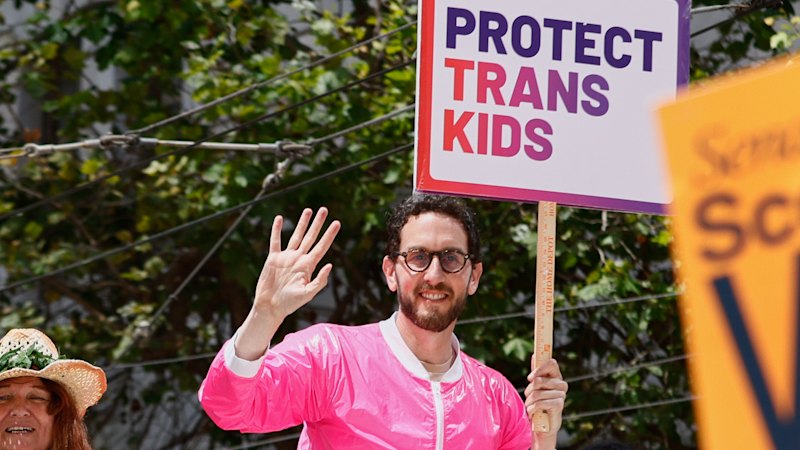
The megaphones are always louder than the human voice. When you stand in the middle of a crowded city square, surrounded by thousands of people who claim to share your hunger for justice, the noise feels like a physical wall. It vibrates in your chest. But for someone like Jonathan, the loudest sound isn't the chanting. It is the sudden, chilling silence that falls when the crowd realizes he does not fit their script.
Jonathan is a walking contradiction to anyone who views the world through a binary lens. He is Jewish. He is gay. He spent years advocating for transgender rights long before the issue dominated cable news. And he speaks out passionately, consistently, for the human rights of Palestinians.
By every metric of modern progressive politics, Jonathan should be at home on the left. Instead, he spends his weekends dodging spit, shielding his face from flying bottles, and listening to people who look just like his friends call him a fascist.
We live in an era obsessed with intersections. We are told that our identities are overlapping lines on a map, and that by understanding these intersections, we can build a more empathetic society. That sounds beautiful in a lecture hall. The reality on the street is much bloodier. When you actually occupy multiple intersections, you quickly discover that you are not protected by the group. You are targeted by every single side.
Consider a Tuesday night at a university campus rally. Jonathan arrived carrying a sign calling for peace and an end to civilian suffering. He expected debate. He expected passion. He did not expect to be surrounded by six masked activists who blocked his path, shoved him against a concrete pillar, and called him a "Zionist infiltrator" because of the small Star of David around his neck. When he tried to explain his decades of work for progressive causes, they shouted him down. They told him his existence was a distraction.
Isolation. That is the true currency of modern political purity.
This isn't an isolated incident or a bad day at a single university. It is a systemic glitch in the way we talk to one another. Ideological movements have ceased to be coalitions of human beings; they have become software programs. If you do not run the exact code of the collective, the system treats you as a virus.
When did nuance become a betrayal?
Historically, the political left prided itself on being a big tent, a chaotic but welcoming space for the marginalized, the eccentric, and the questioning. The foundational idea was solidarity—the belief that my freedom is bound up in yours, even if our lives look entirely different. Today, that tent has been replaced by a velvet rope. The bouncers are ruthless. If your identity doesn't align perfectly with the current dogma of the week, you are cast out into the cold.
Think about the psychological toll of this displacement. When the right-wing establishment rejects you for being gay and supporting trans rights, you expect it. It hurts, but it makes sense within the framework of traditional conservatism. But when the left—the place you went to heal, the place you built your life—turns its back on you because you refuse to disavow your heritage, the wound is entirely different. It feels like an eviction notice from your own soul.
The statistics reflect a broader, quieter migration. Across Western democracies, independent thinkers are quietly retreating from public activism. Data from social researchers shows a sharp rise in self-censorship among politically active individuals. People are terrified. They are not afraid of their enemies; they are terrified of their peers. They watch someone like Jonathan get publicly dismantled for the crime of complexity, and they decide it is safer to stay silent, to nod along, to wear the mask.
But a movement built on fear is a house built on sand.
Let's look at the mechanics of this tribalism through a simpler lens. Imagine a stained-glass window. Each piece of colored glass represents a different human experience: faith, sexuality, ethnicity, political belief. The beauty of the window relies on the lead borders holding the disparate pieces together. What we are doing now is smashing the glass because the blue piece dares to touch the red piece. We are destroying the window and wondering why the room is freezing cold.
Jonathan's phone rings late at night. Sometimes it is an anonymous threat. Other times, it is a whisper. A young student, also Jewish, also queer, calling from a locked dorm room, asking how to survive the hostility of their own student union. Jonathan always answers. He listens to the trembling voices, and he offers the only thing he has left: the truth that they are not crazy.
The current climate demands that we choose between total alignment or total exile. If you support trans rights, you must adopt every single slogan without question. If you support Palestinian statehood, you must erase your Jewish identity or apologize for it. If you fail to check every single box on the orthodoxy checklist, your lifetime of advocacy is wiped clean. You become the enemy.
This is a dangerous trajectory. When we strip away the right to hold complex, seemingly conflicting beliefs, we strip away what makes us human. We become caricatures. We become easily manipulated blocks of votes, managed by ideologues who profit off our division.
Last month, Jonathan stood on the perimeter of another march. He didn't bring a sign this time. He just watched the sea of faces, the flags waving, the fists pumping in unison. He recognized the energy—it was the same hunger for a better world that had driven him into the streets thirty years ago.
A young activist noticed him standing there. She walked over, her eyes burning with the certainty that only youth can provide. She looked at his face, recognized him from a viral video where he had been harassed the week before, and sneered.
"Which side are you even on?" she demanded.
Jonathan looked at her, his hands buried deep in his pockets against the autumn chill. He thought about his grandparents who survived the camps. He thought about the young trans kids he had mentored who were now thriving adults. He thought about the families in Gaza whose names he prayed for every night.
He didn't yell. He didn't quote theory. He just smiled a tired, fiercely stubborn smile.
"I'm on the side of the people who are currently being crushed by the wheels," he said softly.
She blinked, momentarily thrown off balance by a script she hadn't rehearsed, before turning her back and running to rejoin the safety of the chanting crowd. Jonathan stayed on the sidewalk, entirely alone, watching the march disappear into the gray evening light.