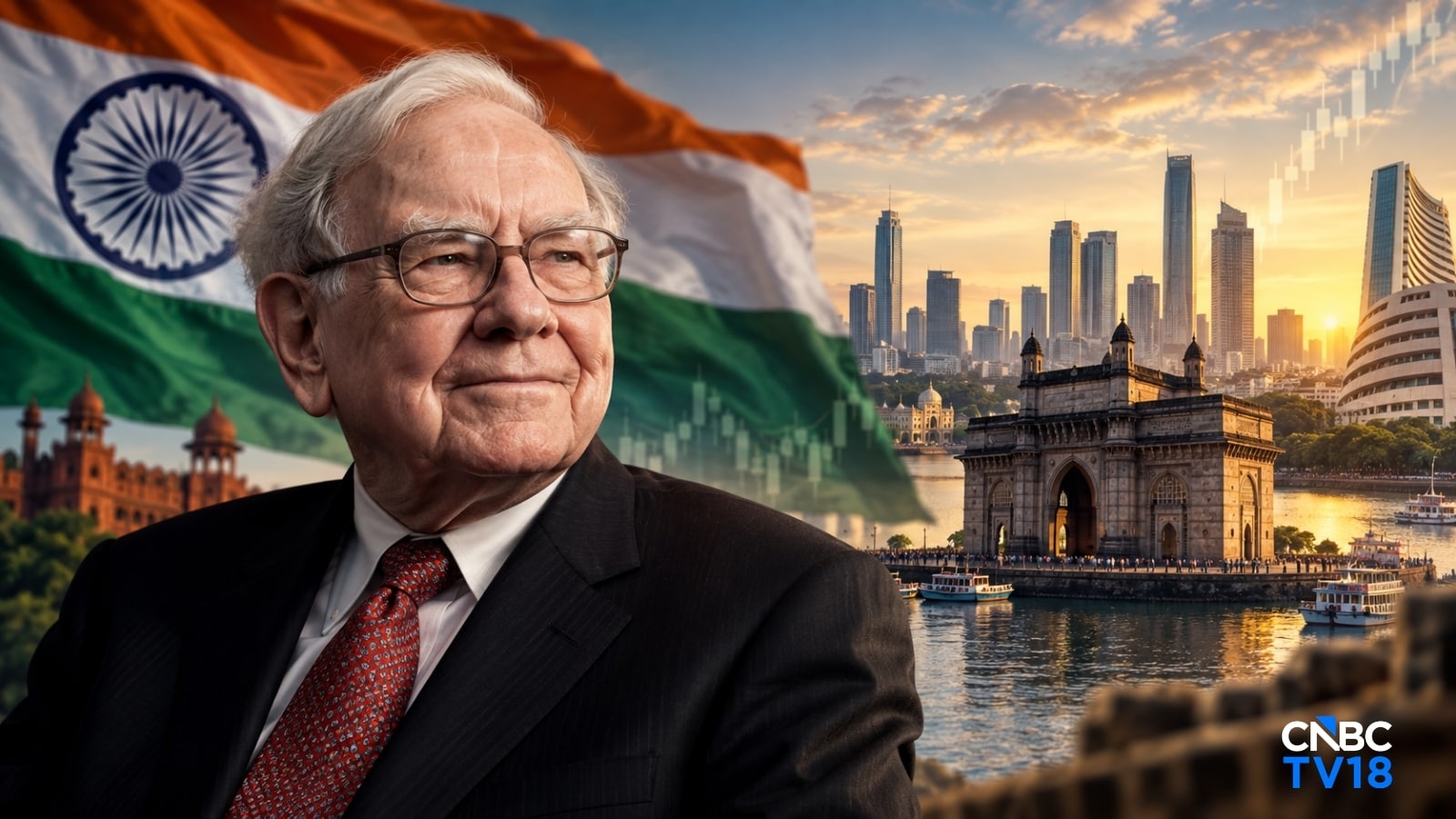
The ticker tape never stopped clicking in Omaha, but across the ocean, a massive subcontinental engine was spinning into overdrive without its most famous mechanic.
Imagine sitting on a goldmine while refusing to pick up the shovel. That is the strange, quiet paradox of Warren Buffett’s relationship with India. For decades, the Sage of Omaha has preached the gospel of economic moats, predictable cash flows, and rational management. Yet, when it came to the fastest-growing major economy on the planet—a sprawling, chaotic powerhouse minting millionaires and unicorns by the minute—Berkshire Hathaway essentially watched from the cheap seats.
Why?
The answer is not a lack of opportunity. India has offered plenty of those. The answer lies in the architecture of doubt, the rigid boundaries of a philosophy built for American boardrooms, and a fundamental mismatch between patience and pace.
Let us walk back to the beginning.
In the late 1950s, Warren Buffett was managing a tiny partnership, scouring American backwaters for cigar-butt stocks—companies so cheap they had one puff of smoke left in them. Thousands of miles away, independent India was a child learning to walk, burdened by licensing raj regulations, bureaucratic red tape, and an inward-looking economy that choked foreign capital. There was no room for Berkshire there. There was no room for anyone.
Fast forward through the decades. India liberalized in 1991. The economic cages were unlocked. A billion consumers woke up with disposable income, mobile phones, and a desperate hunger for upward mobility. Wall Street rushed in. Hedge funds circled like hawks. Private equity poured billions into digital infrastructure, consumer goods, and manufacturing hubs.
And Warren Buffett? He bought a shoe company in Massachusetts.
It is easy to mistake this absence for ignorance. Buffett is rarely ignorant. He knew exactly what was happening in Mumbai and Bengaluru. In fact, during various shareholder meetings, he has openly praised India’s immense potential. He has acknowledged that the country possesses brilliant minds and explosive growth drivers.
So, what stopped him?
Scale.
This is where the mathematical reality of Berkshire Hathaway becomes a cage of its own making. When you manage a portfolio worth hundreds of billions of dollars, small opportunities are useless. If you invest fifty million dollars into an Indian startup that triples in five years, it barely moves the needle for a leviathan like Berkshire. You need whales. And to find a whale in a foreign market, you need transparency, audited predictability, and governance standards that match the strict criteria of Western accounting.
For a long time, Indian corporate governance had a reputation problem. Family-run conglomerates dominated the landscape. Cross-holdings were murky. Regulatory enforcement felt unpredictable to an outsider sitting behind a desk in Nebraska.
Buffett plays poker with cards face up on the table. He likes businesses where you can project earnings ten years into the future with high conviction. India, with its hyper-dynamic, volatile, and fiercely competitive market dynamics, often looked less like a stable annuity and more like a high-speed roller coaster.
To understand why this hesitation was costly, consider the alternative history.
Picture what would have happened if Berkshire had made a definitive, multi-billion-dollar bet on Indian financial services or consumer giants in the early 2000s. Companies like HDFC Bank, Tata Consultancy Services, or Asian Paints possessed the exact compounding DNA that Buffett admires. They had strong pricing power, exceptional management, and structural tailwinds driven by a rising middle class.
Had Berkshire deployed capital into these moats early on, the returns would have rivaled some of its greatest American hits. Instead, the closest Berkshire came to a direct, headline-grabbing venture in India was an aborted partnership with Paytm’s parent company, One97 Communications, executed via his lieutenant Todd Combs or Ted Weschler rather than Buffett himself—a modest bet by Berkshire standards, which later faced valuation contractions and a bumpy public market journey.
That modest foray felt less like a grand strategic invasion and more like dipping a hesitant toe into a boiling ocean.
We must also confront another uncomfortable truth about investing across borders: cultural intuition.
Buffett often emphasizes investing only within your circle of competence. He understands American consumer habits because he drinks Cherry Coke, reads the Wall Street Journal, and watches American businesses operate in real time. Translating that intuitive grasp of consumer psychology to a market with thousands of languages, wildly divergent regional preferences, and complex socioeconomic layers is a monumental task.
How do you price the moat of a company whose customer base spans a tech billionaire in Bangalore and a subsistence farmer in Bihar?
It requires a different kind of lens. It requires trusting local operators who understand the pulse of the streets far better than any financial statement can convey. And historically, Berkshire prefers decentralized control of wholly owned subsidiaries or massive, hands-off equity blocks where the management team is already proven beyond a shadow of a doubt.
Yet, while Berkshire stayed on the sidelines, the game changed.
Indian markets matured. Regulatory bodies like SEBI tightened disclosure norms, bringing institutional transparency closer to global standards. Digital public infrastructure—the India Stack—created a unified digital economy that leapfrogged traditional banking hurdles. Indian enterprises stopped looking like emerging market anomalies and started looking like world-class compounders.
Foreign institutional investors poured trillions into the ecosystem, reaping the rewards of a nation transitioning from survival to scale.
So, does Berkshire’s hesitation mean Buffett missed out?
From a purely financial standpoint, yes. Leaving hundreds of billions of potential compound gains on the table is the opportunity cost of extreme discipline.
But from a philosophical standpoint, Buffett stayed true to his core identity. He has never chased growth for the sake of growth. He chases predictability. When predictability is absent, he walks away, no matter how shiny the growth narrative appears from afar. That strict adherence to his own framework is precisely why he survived every market crash of the last sixty years.
The tragedy of the story, if we can call it that, is not that Buffett failed to see India. It is that India grew too fast, too complex, and too differently for a man who built his empire on the slow, steady hum of American capitalism.
The ticker tape keeps clicking in Omaha. The skyscrapers keep rising in Mumbai. And the investment story that never became a big bet remains one of the great unwritten chapters of modern finance—a reminder that even the greatest investor of all time can look across the world, recognize a miracle unfolding in real time, and still decide the water is too deep to cross.