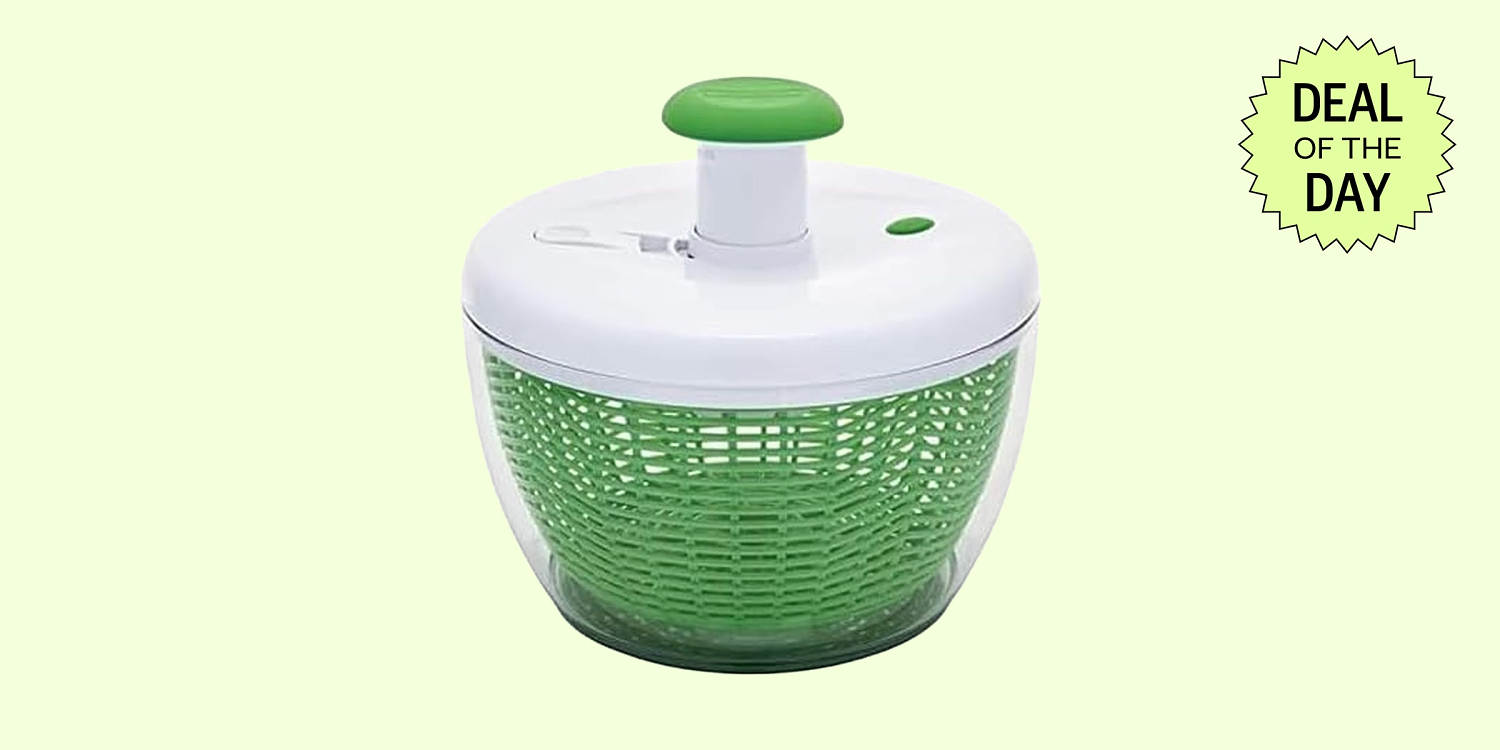
Fresh produce management in residential kitchens hinges on two variables: microbial risk reduction through fluid immersion and the physical extraction of unbound surface moisture. The failure to systematically remove water after washing degrades produce cellular integrity, accelerates decay, and compromises dressing adhesion through lipid emulsification failure. A price reduction exceeding 30 percent on a mechanical dewatering system—specifically the Farberware salad spinner—realigns the capital-to-utility ratio for home culinary operations. Evaluating this appliance requires stripping away promotional marketing to analyze its underlying mechanical physics, material durability, and financial return on reduced food waste.
The Fluid Dynamics of Produce Dewatering
Washing leafy greens introduces excess liquid that adheres to the hydrophobic cuticle layer of vegetable leaves. Surface tension holds water droplets in the micro-grooves of leaf structures. Passive draining leaves up to 40 percent of total liquid mass attached to the plant surface. For another view, see: this related article.
Centrifugal acceleration overcomes capillary retention. When a perforated basket rotates inside an outer basin, the system applies force directed outward from the axis of rotation. This force breaks the surface tension bonds between water molecules and the leaf cuticle.
The mathematical relationship governing water removal follows the centrifugal force equation: Related coverage on this trend has been published by Vogue.
$$F_c = m \cdot \omega^2 \cdot r$$
Where:
- $m$ represents the mass of the water droplet.
- $\omega$ represents the angular velocity of the basket rotation.
- $r$ represents the radius of the inner bowl.
Because force scales with the square of angular velocity, high rotational speed is significantly more critical than basket volume. A smaller basket spun at higher revolutions per minute yields greater moisture displacement than a larger basket spun slowly. The Farberware system utilizes a hand-crank gear ratio designed to convert low-frequency manual input into high-frequency basket rotation, generating sufficient force to dislodge capillary-bound droplets without exceeding the yield strength of fragile leaf tissues.
Excess surface moisture creates three distinct operational bottlenecks in culinary preparation:
- Dressing Dilution: Hydrophobic oil-based dressings cannot bind to wet leaf surfaces. Unbound water forms a barrier layer, causing dressings to pool at the bottom of the vessel rather than forming a uniform emulsion on the produce.
- Thermal Degradation: When wet greens are subjected to cooking heat, surface water converts to steam at 100°C. This changes the thermal application from dry-heat sautéing or searing to wet-heat steaming, preventing Maillard reactions and degrading structural crispness.
- Accelerated Microbe Proliferation: Free water on harvested plant tissue accelerates tissue breakdown and fuels bacterial growth during cold storage.
Food Safety Mechanisms and Moisture-Mediated Microbial Decay
The consumption of unwashed leafy greens represents a primary vector for foodborne pathogens, including Escherichia coli, Salmonella enterica, and Listeria monocytogenes. Water immersion dislodges soil particulates, physical debris, and residual agricultural chemical residues. Water washing alone, however, merely redistributes surface contaminants unless combined with effective mechanical separation.
Submerging produce in a static water bath releases dirt, but removing the produce directly through the surface layer recontaminates the leaves. An integrated spinner architecture solves this through dual-vessel separation. The inner perforated basket acts as a sieve, holding the produce suspended above the liquid layer while centrifugal force drives soil particulates and contaminated runoff into the non-porous outer basin. The isolated wastewater cannot re-contact the clean produce.
Post-wash moisture removal directly governs shelf-life extension. Plant tissue degradation following harvest occurs via respiration and microbial colonisation. Psychrotrophic bacteria multiply in free liquid films at standard refrigeration temperatures (2°C to 4°C). Removing surface moisture through mechanical spinning alters the microclimate of storage containers:
- Turgor Pressure Preservation: Leaves store internal water within vacuoles. External moisture creates an osmotic imbalance and ideal conditions for soft-rot bacteria (Pectobacterium carotovorum) to break down middle lamella cell walls. Dry leaf surfaces arrest this enzymatic degradation.
- Gas Exchange Stabilization: Excessive free water blocks stomatal pores, forcing the plant tissue into anaerobic respiration. Anaerobic metabolism produces ethanol and lactic acid, causing off-odors and tissue yellowing.
Quantifying the biological impact reveals that thorough drying extends the usable storage life of tender greens from 3 days to over 10 days, directly altering the household food depreciation rate.
Mechanical Architecture and Material Ergonomics
Mechanical efficiency in manual kitchen tools relies on simple machine design principles: gear trains, mechanical advantage, and rotational inertia. The Farberware model utilizes a lid-integrated gear assembly driven by a manual rotary handle.
Drive Mechanism Trade-offs
Kitchen dewatering appliances generally utilize one of three drive mechanisms:
- Rotary Hand Crank: Employs a direct gear linkage (planetary or bevel gear arrangement). A single manual rotation of the outer handle yields multiple revolutions of the inner basket. This system provides direct tactile feedback, allowing the operator to adjust speed based on produce fragility.
- Vertical Push-Pump: Uses a helical drive shaft to convert linear downward force into rotational motion. While requiring less lateral force, internal springs present additional failure points over repeated cycles.
- Pull-Cord Assembly: Uses a recoil spring and cord mechanism similar to small internal combustion starters. High rotational velocity is achievable, but cord fraying and internal spring degradation limit long-term operational lifespan.
The rotary crank architecture in the Farberware model prioritizes mechanical simplicity. Frictional resistance within the gear housing is minimized through polymer gear teeth that do not require petroleum lubrication, eliminating food contamination risks.
Material Integrity and Polymer Selection
The functional components of the unit rely on food-grade thermoplastic polymers:
- Outer Basin: Molded from clear Polypropylene (PP) or Acrylonitrile Styrene (AS). These polymers exhibit high impact resistance and non-reactivity with acidic food residues. The transparency permits real-time visibility of water extraction volume.
- Inner Strainer Basket: Constructed from low-density Polypropylene (LDPE/HDPE blend), offering flexible structural ribs that absorb mechanical shocks without fracturing. The hole density and geometry are optimized to maximize fluid egress while preventing small leaf fragments from passing through or clogging apertures.
- Base Stability: A non-skid thermoplastic rubber (TPR) ring or perimeter foot array is co-molded onto the bottom of the outer vessel. This increases the coefficient of friction against smooth countertop surfaces (granite, quartz, stainless steel), preventing axial displacement during high-speed rotation.
Thermal tolerance remains a critical operational constraint. Standard food-grade polymers begin deformation under dishwashing water temperatures exceeding 70°C. Long-term structural integrity requires washing in lower thermal zones or manual cleaning to prevent warping of the gear housing and drive alignment pins.
Financial Valuation and Unit Economics of Food Waste Mitigation
A price drop exceeding 30 percent transforms a non-essential utensil into an active cost-saving asset. To quantify the financial return, the purchase price must be evaluated against the baseline cost of household produce spoilage.
Depreciation Model of Household Produce
The average American household purchases approximately $450 worth of fresh produce annually that is discarded unused due to spoilage. Leafy greens (spinach, arugula, romaine, butter lettuce) represent the highest volatility segment within fresh produce categories due to high respiration rates and rapid moisture-induced decay.
Consider a baseline operational model:
- Weekly Leafy Green Expenditure: $12.00
- Baseline Spoilage Rate (Unwashed/Inadequately Dried): 35% loss per week ($4.20/week)
- Optimized Spoilage Rate (Centrifugally Dewatered/Stored Dry): 10% loss per week ($1.20/week)
- Net Weekly Savings: $3.00
With a purchase price discounted from standard retail down to a sub-$20 price point, the capital payback period is calculated as:
$$\text{Payback Period (Weeks)} = \frac{\text{Discounted Capital Cost}}{\text{Weekly Net Savings}} = \frac{$15.00}{$3.00/week} = 5 \text{ weeks}$$
Past the five-week operational threshold, the device yields a positive financial return through food waste mitigation. The durable life of the polymer assembly under standard usage cycles exceeds 250 weeks, yielding a high return on capital invested.
Furthermore, purchasing whole heads of lettuce instead of pre-washed, pre-packaged bagged greens reduces unit input costs. Pre-packaged bagged greens carry a price premium of up to 200 percent per unit weight compared to intact heads. Intact heads, however, require manual washing and drying to match the convenience of pre-packaged alternatives. The salad spinner removes the labor friction associated with processing bulk, unwashed produce, enabling households to capture lower unit costs without sacrificing prep speed.
Strategic Integration into Culinary Workflows
Maximizing the utility of a centrifugal dewatering system requires a structured operational sequence. Deviations from this sequence diminish sanitization efficacy and degrade produce quality.
Phase 1: Submersion and Agitation
Fill the outer basin with cold water (below 10°C to maintain cell turgor). Place greens into the inner basket and lower it into the water. Agitate gentle greens manually for 30 seconds to dislodge surface particulate matter. Allow the assembly to sit undisturbed for 60 seconds. Heavy inorganic debris (sand, silt) settles to the bottom of the outer bowl through gravity.
Phase 2: Primary Isolation
Lift the inner basket vertically out of the basin, extracting the greens from the dirty water layer. Discard the contaminated water from the outer basin entirely. Do not pour water out with the basket inside, as this filters particulates back through the produce layer.
Phase 3: Centrifugal Dewatering
Re-seat the inner basket into the dry outer basin. Secure the lid locking mechanisms. Engage the drive crank with smooth, accelerating force until maximum rotational velocity is achieved. Maintain peak speed for 15 to 20 seconds. Engage the integrated mechanical brake button (if applicable) or allow the angular momentum to dissipate naturally. Rapid braking can cause soft leaf tissues to impact the basket walls with enough force to cause micro-bruising.
Phase 4: Storage Protocol
Remove greens from the basket. Store in a high-density polyethylene container lined with a dry paper towel or breathable cloth to absorb any remaining ambient humidity. Seal with a lid that allows minimal oxygen exchange. Store at 1°C to 3°C.
Limitations and Operational Constraints
Despite the physical advantages, mechanical dewatering units possess distinct operational boundaries:
- Volumetric Inefficiency: The rigid cylindrical geometry of the outer basin requires significant storage space relative to its active payload volume. The internal basket utilizes roughly 60 to 70 percent of the total enclosure volume.
- Structural Vulnerability: The drive gears in the lid assembly cannot be easily disassembled for cleaning in most budget models. Liquid or food debris entering the gear housing can cause organic buildup over time, requiring periodic flushing with sanitizing solutions.
- Produce Density Limits: Dense, heavy vegetables (such as chopped broccoli, root vegetables, or large quantities of heavy fruit) generate extreme centrifugal force vectors that can unseat the drive spindle or shear polymer gear teeth. The device design is optimized specifically for low-mass, high-surface-area leaf structures.
Deploying Capital for Kitchen Optimization
A 30-plus percent price reduction on the Farberware salad spinner shifts the appliance from a conditional luxury to a practical addition for cost-conscious, high-efficiency kitchens. By leveraging basic centrifugal force to address the fluid dynamics of surface water, the device mitigates microbial degradation vectors, lowers household produce food waste, and optimizes salad dressing performance through friction-based emulsion preservation.
The strategic purchase decision rests not on brand marketing, but on unit economics: by processing intact, unwashed produce and extending product shelf-life, the operational savings clear the initial capital expense within two months of routine culinary use.