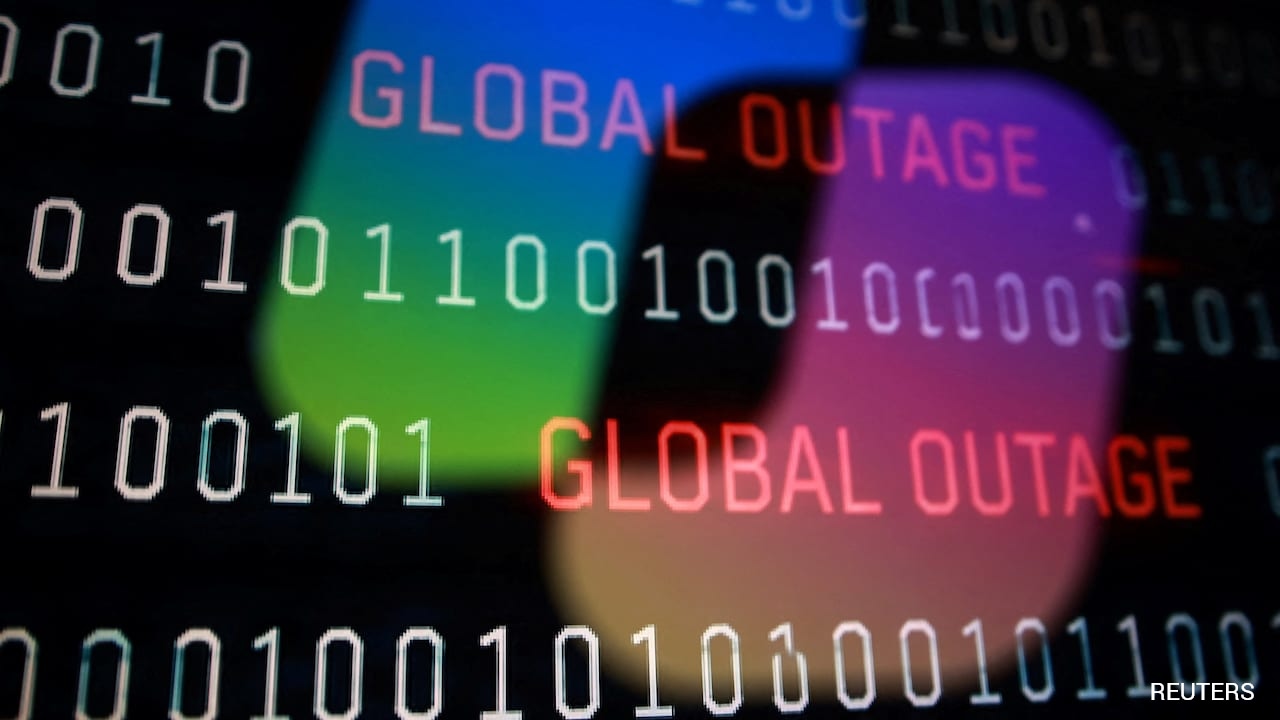
When Marco Rubio stated that there was zero evidence linking major US outages to cyberattacks, he followed a familiar Washington playbook. Officials rush to calm public panic before forensic teams have finished collecting system logs. That distinction matters. Saying there is currently no evidence of a hack is completely different from proving an outage was purely accidental, and the gap between those two realities hides the true fragility of American infrastructure.
Public figures love certainty during a crisis. Markets hate ambiguity even more. When telecom networks go dark, airline reservation systems freeze, or regional power grids trip offline, the immediate political instinct is to suppress rumors of foreign sabotage. An adversary-driven cyberattack carries massive geopolitical weight, potentially triggering national security escalations or demands for retaliation. By contrast, a routine software update gone wrong or a failing transformer looks like a manageable corporate headache.
The Anatomy of an Early Denial
Watch closely whenever critical infrastructure stumbles. Within hours, federal agencies and senior lawmakers almost always issue statements declaring no indication of malicious activity. They are rarely lying, at least not technically.
Early incident response relies on surface-level telemetry. Network engineers look at firewall alerts, intrusion detection triggers, and abnormal traffic spikes. If a system crashes because a configuration file was corrupted or a core router dropped its routing table, the initial crash dump looks identical to human error. Sophisticated threat actors know this. Modern nation-state groups do not kick down the front door with noisy denial-of-service floods anymore. They quietly compromise legitimate administrative credentials, alter routine maintenance scripts, and let the target's own automation break the network.
Forensic attribution takes weeks, sometimes months. Investigators must image affected servers, reconstruct memory states, and trace authentication tokens back through layered proxy networks. When a politician announces on day one that there is zero evidence of a cyberattack, they are simply reporting that the smoke alarm has not detected arson while the building is still burning.
Why Modern Infrastructure Fails Without Help
To understand why officials are so eager to blame routine glitches, you have to look at how consolidated and brittle American technology stacks have become. You do not need a foreign intelligence agency to take down half the country when three vendors control the underlying architecture.
Consider the mechanics of modern cloud and telecommunications routing. Everything runs on software-defined networking, where physical switches obey centralized control planes. A single malformed Border Gateway Protocol update—essentially a typo in the internet's address book—can isolate millions of users in seconds. Engineers saw this during the 2021 Facebook outage, which wiped the company's services off the global map for six hours due to a routine maintenance command that severed their data centers from the internet.
Then there is the concentration of endpoint security and cloud hosting. When a single kernel-level software driver pushes a faulty update across millions of Windows machines simultaneously, hospitals cancel surgeries, flights stay grounded, and payment processors halt. That happened globally during the 2024 CrowdStrike incident. No hostile hacker wrote that broken file. A flawed quality-assurance pipeline did more economic damage in one morning than most ransomware syndicates achieve in a year.
Aging physical hardware compounds the problem. The US electrical grid is a patchwork of regional interconnections operating equipment installed decades ago. Severe weather, deferred maintenance, and surging power demands from massive data centers push transformers to their thermal limits. When a transmission line sags into a tree branch and triggers a cascading trip across state lines, the resulting blackout looks sinister to citizens sitting in the dark.
The Geopolitical Incentive to Downplay Sabotage
There is a deeper strategic reason why Washington avoids pointing fingers at hackers unless forced into a corner by undeniable proof. Attribution is a trap.
Suppose federal intelligence agencies confirm on live television that a foreign military unit compromised a US telecom carrier or regional utility and triggered a multi-state outage. Immediately, the White House faces immense domestic pressure to retaliate. Does the government launch a counter-cyberattack? Impose crippling sanctions? Risk kinetic conflict over a twelve-hour service disruption?
Keeping the official narrative focused on technical glitches buys decision-makers time and room to maneuver. It allows cyber defense teams at the Cybersecurity and Infrastructure Security Agency and the National Security Agency to quietly purge intruders, patch vulnerabilities, and share indicators of compromise with private-sector partners without sparking a public panic or backing the administration into a diplomatic corner.
History shows how long the truth can stay buried. In the 2020 SolarWinds breach, Russian intelligence operatives sat inside federal agency networks and Fortune 500 companies for months before a private security firm noticed anomalous authentication activity. Similarly, Chinese state-sponsored groups—tracked by researchers as Volt Typhoon—spent years embedding themselves inside US communications, energy, and water systems not to steal data, but to pre-position themselves for disruptive attacks during a future crisis. Had any of those compromised systems failed prematurely during testing, initial public statements would almost certainly have blamed routine hardware faults.
The Gray Zone Between Glitch and Attack
The hardest truth for the public to accept is that the line between accidental failure and deliberate sabotage has blurred into irrelevance. From an operational standpoint, a network outage caused by reckless software engineering produces the exact same real-world consequences as an attack launched from an overseas bunker.
Airports close either way. Emergency 911 call centers lose connectivity either way. Small businesses lose thousands of dollars in unprocessed credit card transactions either way.
Furthermore, adversaries actively study our accidental outages as blueprints. When a major telecom provider goes down because of an internal routing error or a faulty database migration, foreign intelligence analysts dissect the post-mortem reports. They map which dependencies failed first, how long manual recovery took, and which backup systems never kicked in. A purely accidental outage today becomes the exact targeting package for an adversary tomorrow.
Relying on the absence of a cyberattack as a reason for relief misses the entire point. If a major American network can collapse because one engineer pushed an untested configuration change on a Tuesday morning, our resilience is already dangerously compromised.
What Actually Protects Critical Systems
Blaming or exonerating hackers does nothing to keep the lights on or the cell towers broadcasting. Real infrastructure resilience requires boring, expensive engineering changes that corporations routinely delay to protect quarterly profit margins.
True Architectural Redundancy
Most corporate disaster recovery plans exist only on paper. Companies buy backup internet circuits from two different telecom providers, only to discover during an outage that both providers lease space inside the exact same underground fiber conduit. Genuine resilience demands physical and logical diversity—separate cloud providers, independent DNS routing, and out-of-band management networks that remain accessible when primary systems lock up.
Staged Rollouts and Kill Switches
Pushing simultaneous updates across an entire national fleet of servers or endpoints is operational negligence. Engineering teams must enforce strict canary deployments, releasing changes to a tiny fraction of non-critical systems first and monitoring telemetry for hours before expanding. Every automated deployment pipeline needs a hard-coded circuit breaker that halts distribution the instant error rates tick upward.
Air-Gapped Manual Overrides
As industrial control systems and utility grids connect to corporate IT networks for remote monitoring, they inherit every vulnerability of modern enterprise software. Critical physical infrastructure—power substations, water treatment plants, rail switches—must retain mechanical and analog overrides that allow human operators to run essential functions locally even if every digital screen goes black.
Officials will continue stepping up to microphones to reassure the public that there is zero evidence of a cyberattack. Sometimes they will be right, and sometimes they will simply be speaking before the forensic team finishes reading the logs. Either way, a system that breaks itself is just as dangerous as a system broken by an enemy.