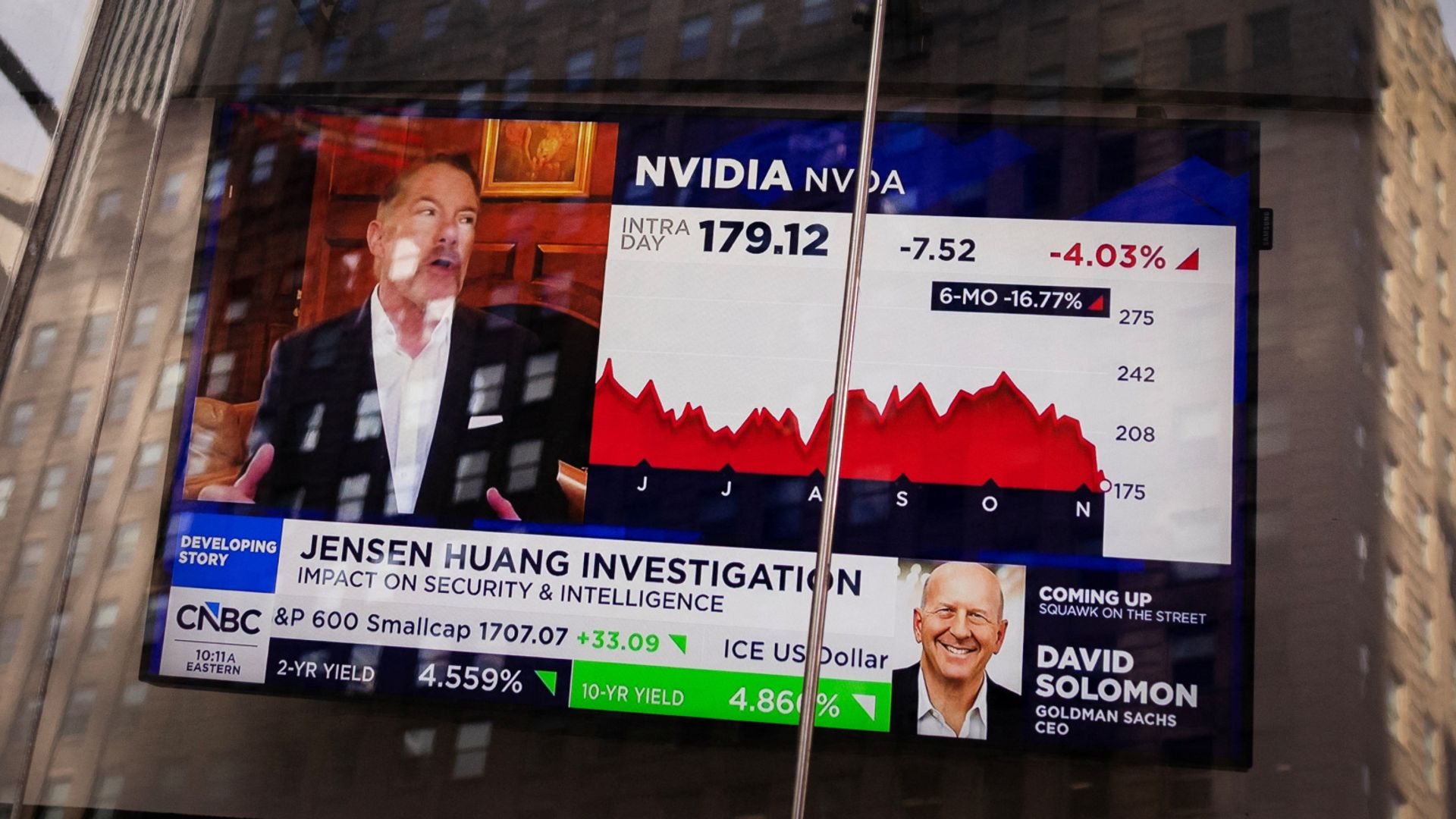
Wall Street loves a bloodbath. Give financial commentators a 13% dip in a three-trillion-dollar stock, and they immediately start sharpening the knives, demanding boardroom coups, and writing obituaries for the very executives who printed their money for the last decade.
The headline screaming across the internet—that Nvidia’s market value plummeted by $430 billion in two days while critics urged CEO Jensen Huang to step down—is peak financial theater. It is lazy consensus wrapped in clickbait panic. It treats a foundational semiconductor monopoly like a failing meme stock, and it fundamentally misunderstands how capital expenditure cycles, silicon physics, and enterprise software lock-in actually work.
If you are reading the panic pieces and wondering if the artificial intelligence bubble has finally popped, you are asking the wrong question entirely. The real question is why anyone expected a vertical line on a stock chart to ignore gravity forever, and why institutional analysts keep confusing market-cap volatility with operational decay.
The $430 Billion Illusion
Let’s look at the math that terrifies retail investors and delights doom-scrolling journalists. Losing $430 billion in 48 hours sounds apocalyptic. It is roughly the entire market capitalization of ExxonMobil or Mastercard evaporating between Tuesday morning and Wednesday afternoon.
Except nothing actually evaporated. Not a single silicon wafer cracked at TSMC. Not a single hyperscaler canceled an order for Blackwell racks. Not a single line of CUDA code stopped executing in a data center.
Market capitalization is a margin-price hallucination. It is simply the price of the last share traded multiplied by the total number of shares outstanding. When a stock runs up more than 200% in a year, passive index funds become overweight, quantitative trading algorithms trigger automated profit-taking, and momentum traders rotate out of mega-cap tech into small-cap value.
I’ve sat in rooms with institutional portfolio managers during drawdowns like this. They aren't selling because they think Nvidia is broken. They are selling because their risk-management software forces them to trim positions once a single equity exceeds a specific percentage of their fund's total weight. When a trillion-dollar behemoth sneezes, the sheer dollar figure of the pullback breaks the brains of reporters who don't understand float dynamics or liquidity depth.
Calling for Jensen Huang to quit over a two-day technical correction is like firing a championship quarterback because he threw an incomplete pass in the second quarter while up by four touchdowns. Huang didn't just ride a wave; he spent twenty years building the ocean. In 2006, when Wall Street mocked Nvidia for burning cash on CUDA—a proprietary parallel computing platform nobody wanted at the time—Huang held the line. He sacrificed short-term gross margins to build an ecosystem that would eventually make Nvidia the sole tollbooth operator for modern computing. Suggesting he step aside now isn't just bad analysis; it's corporate malpractice.
Why "Should I Sell Nvidia Now" Is The Wrong Question
When the headlines turn red, search engines flood with desperate queries. Investors want to know if the top is in, if AMD is finally stealing market share, or if hyperscalers are about to pull the plug on GPU spending.
Let's dismantle the premises behind the panic.
Are Microsoft, Google, and Meta about to stop buying GPUs?
No. In fact, they are trapped in a classic prisoner's dilemma. Mark Zuckerberg and Sundar Pichai have both stated publicly and bluntly that the risk of under-investing in AI infrastructure is vastly greater than the risk of over-investing. If Meta cuts capital expenditures by $10 billion to appease short-term Wall Street margin hawks, and OpenAI or Google uses that exact compute window to train a superior foundational model, Meta becomes an obsolete ad network overnight. Big Tech will burn cash on silicon until their balance sheets bleed before they voluntarily surrender compute capacity to a rival.
Isn't competition from AMD and custom ASICs going to crush Nvidia's margins?
This is the favorite talking point of analysts who look at hardware spec sheets instead of talking to actual machine learning engineers. On paper, AMD’s Instinct accelerators and Google’s TPUs offer compelling price-to-performance ratios for specific workloads. In practice, moving a massive production cluster off Nvidia is an engineering nightmare.
I've watched enterprise infrastructure teams blow millions of dollars trying to migrate inference pipelines onto alternative silicon to save 20% on hardware costs. They end up burning six months of senior engineering hours debugging compiler errors, rewriting custom kernels, and dealing with unstable networking drivers. Hardware is only half the battle. The real moat is the full-stack architecture: NVLink interconnects that allow hundreds of GPUs to act as a single giant processor, InfiniBand networking that eliminates data bottlenecks, and the CUDA software stack that millions of developers already know by heart. You don't rip out the central nervous system of your data center just to save a few basis points on silicon.
The Anatomy Of A Digestion Phase
To understand what is actually happening beneath the volatile ticker symbol, you have to understand the semiconductor CapEx cycle. Unlike consumer software, where you can scale users infinitely with near-zero marginal cost, physical compute moves in jagged, violent waves.
- The Infrastructure Buildout: Hyperscalers buy every available GPU to build out training clusters. Supply is constrained. Lead times stretch past forty weeks. Margins explode.
- The Digestion Phase: Data centers hit physical limits. You cannot plug ten thousand Blackwell chips into a wall socket if the local municipal power grid doesn't have the transformers, substations, or liquid cooling infrastructure to support a 100-megawatt facility.
- The Software Catch-Up: Enterprises buy the hardware first and figure out how to monetize it second. There is always a lag between laying the railroad tracks and running profitable freight trains across them.
Right now, the market is panicking because it sees the early friction of a digestion phase. Power constraints, supply chain bottlenecks at TSMC's CoWoS packaging facilities, and delayed enterprise ROI are real physical hurdles.
Wall Street hates friction. Financial analysts want smooth, predictable, linear growth every ninety days. Physics doesn't care about quarterly earnings calls. Building gigawatt-scale data centers requires pouring concrete, manufacturing custom chillers, and navigating utility regulations. When those physical realities slow down deployment schedules by six weeks, algorithms dump the stock, and pundits scream that the boom is over.
The Real Risks Nobody Is Talking About
If you want to critique Nvidia, do it with precision. Don't parrot the nonsense about CEO succession or two-day market cap dips. Look at the actual structural vulnerabilities that could threaten the empire over the next five years.
First, the customer concentration problem is staggering. Nearly half of Nvidia’s data center revenue comes from a tiny handful of mega-cap cloud providers. These are not passive buyers; they are the richest, most ruthless monopolies on earth. Every single one of them—Amazon with Trainium, Google with TPU, Microsoft with Maia—is pouring billions into custom silicon specifically designed to reduce their dependence on Jensen Huang’s 75% gross margins. They won't replace Nvidia entirely, especially for frontier model training, where flexibility matters most. However, for predictable, high-volume inference workloads, custom ASICs will slowly eat away at Nvidia's pricing power.
Second, the energy wall is non-negotiable. You can print money, and you can build fabs, but you cannot conjure electrical generation capacity out of thin air. As cluster sizes scale from 100,000 GPUs to 1,000,000 GPUs, the thermal and electrical limits of modern data centers become hard ceilings. If the utility sector cannot keep pace with silicon innovation, hardware sales will inevitably plateau—not for lack of demand, but for lack of plugs.
Third, the inference shift changes the economics. Training massive models requires brute-force parallel compute, which is Nvidia’s absolute sweet spot. Running those models in production (inference) is a completely different game. As models become smaller, quantized, and more efficient, inference workloads increasingly migrate toward cheaper hardware, edge devices, and specialized low-power chips. If the industry shifts from massive centralized training runs to distributed, lightweight inference, Nvidia's stranglehold loosens.
How To Actually Navigate Hardware Cycles
If you are an operator, a tech leader, or an investor trying to make sense of this noise, stop watching CNBC and start watching the supply chain.
- Track TSMC's packaging capacity, not daily stock swings. Taiwan Semiconductor Manufacturing Company is the actual bottleneck of the global economy. Watch their quarterly capital expenditure guidance and their commentary on advanced packaging capacity. If TSMC is still expanding packaging lines at breakneck speed, the order books are full, regardless of what the stock market did on Tuesday.
- Watch the power grid, not the press releases. Follow electrical transformer lead times, copper futures, and nuclear power purchase agreements signed by hyperscalers. Money follows megawatts. Where Big Tech secures long-term power, GPU clusters will follow within eighteen months.
- Ignore executive drama. Founder-led technology companies routinely suffer 30% to 50% drawdowns on their way to generational dominance. Amazon lost over 90% of its value during the dot-com bust while Jeff Bezos calmly explained to shareholders that the underlying business metrics were improving every single quarter. Apple was left for dead a dozen times. Governance stability is a massive competitive advantage when navigating multi-year hardware architectures.
Imagine a scenario where Nvidia's board actually listened to the loudest voices in the financial press and forced Jensen Huang out after a rough week on the Nasdaq. Within six months, the strategic coherence between their hardware roadmap, networking acquisitions, and software ecosystem would fracture. A traditional hired-gun MBA CEO would immediately cut R&D spending on speculative ten-year architectures to juice quarterly earnings per share, handing the future of accelerated computing directly to competitors on a silver platter.
The market is a voting machine in the short run and a weighing machine in the long run. Right now, the voters are hysterical because they bought at the top of a vertical rally and forgot that semiconductor stocks are cyclical beasts.
Stop mistaking a crowded exit door for a burning building.