The champagne was still cold.
Somewhere in the quiet shipyard offices of the Italian coast, the paperwork was drying—the final signatures affixed to a monument of human vanity and engineering prowess. It smelled of freshly oiled teak, crisp leather, and the intoxicating, solvent-heavy perfume of a brand-new vessel. Ninety-six feet of pure, unadulterated fiberglass and ambition. A floating palace christened My Saga, built to conquer the Mediterranean with fourteen souls on board. For another look, see: this related article.
Four days.
That was the entirety of its life. Not a decade of sun-drenched anchorages off Sardinia. Not a generation of salt-stained memories passed down through a family. Just ninety-six hours between the pristine showroom gleam and the final, greedy rush of the Ionian Sea swallowing it whole. Related insight on this matter has been shared by Associated Press.
Water is heavy. We forget that. We treat the ocean as a surface, a blue highway for our leisure, a mirror for our sunsets. But beneath that glittering skin lies a crushing, indifferent weight. When a multi-million-dollar superyacht goes down off the coast of Catanzaro, Italy, it does not sink with the dramatic, cinematic slowness of a Hollywood tragedy. It happens with a brutal, clinical swiftness.
Imagine standing on the deck. The sun is warm. The espresso is bitter and rich. Then, a shudder. A strange, metallic groan vibrating up through the soles of your shoes—not the comforting thrum of twin diesel engines, but something wrong. Something hollow.
Bilge alarms do not start as a roar. They begin as a chirp. A polite, electronic insistence that something is drinking water where it shouldn't.
By the time the crew of My Saga realized the stern was dipping too low, the math of physics had already taken over. Modern luxury vessels are marvels of interior design, boasting marble-topped bars, expansive master suites, and cavernous garages for jet skis. They are also, fundamentally, giant boxes filled with air. And air is precisely what the ocean wants to steal.
Panic is a quiet thing at first. It wears the mask of procedure. The captain barks an order. The crew moves with drilled precision, scrambling below decks to check sea chests, hull fittings, and shaft seals. But the water rises faster than human denial can recede. It pours over the thresholds. It shorts out the electrical mainboards, plunging the lower decks into an eerie, flickering twilight. The pumps whine, desperate, spitting meager streams of gray water back into the sea before dying entirely in a shower of sparks.
Then comes the tilt.
The world loses its horizontal axis. Plates slide across mahogany dining tables and shatter. Crystal glasses tumble from built-in racks like falling stars. The fourteen people on board—owners, guests, crew—are suddenly forced to make a terrifying calculation. No matter how much money purchased the hull, no matter how exclusive the shipyard, gravity does not care about your invoice.
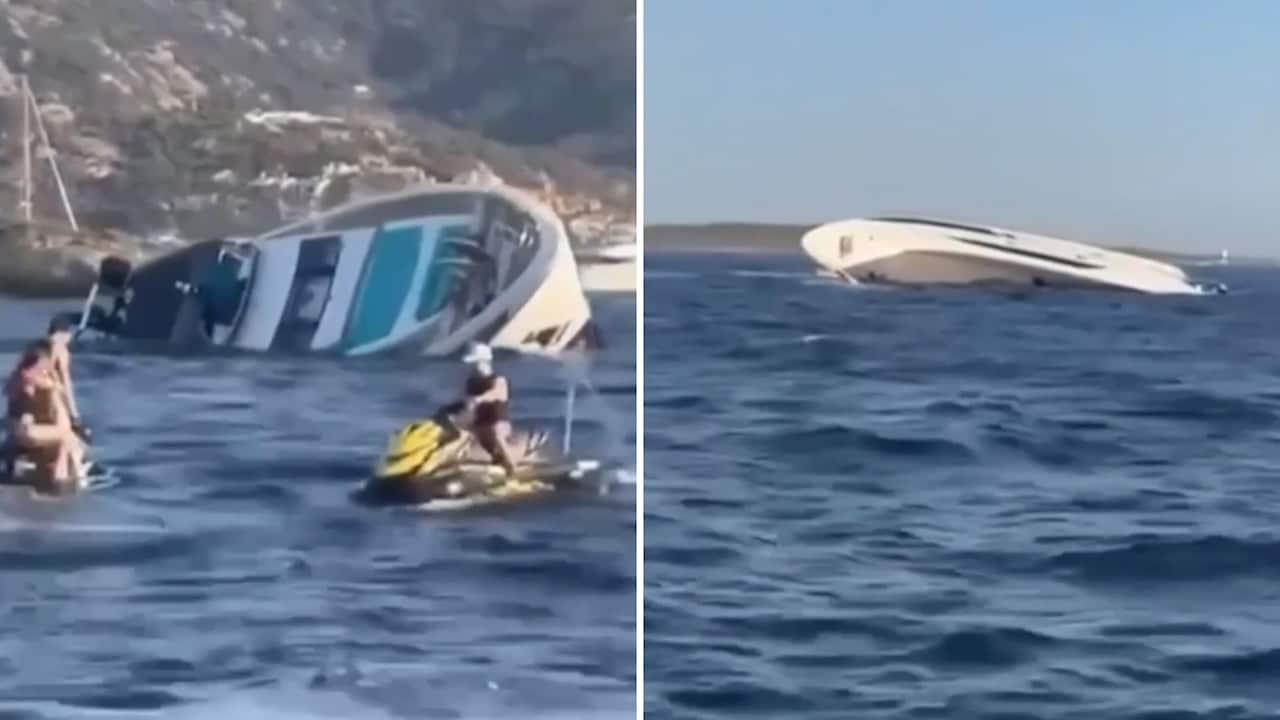
Coast Guard patrol boats, summoned by frantic emergency beacons, arrived to find a surreal scene off the Calabrian coast. A multi-million-dollar silhouette tilting violently toward the abyss. The rescue was clean, mercifully. All fourteen souls were plucked from the life rafts, shivering, watching their floating investment commit suicide against the laws of buoyancy.
Footage later captured the final act: the stern vanished, the bow pointed defiantly toward the clouds for one agonizing second, and then—pop. A final gulp of air, and nothing left on the surface except a widening slick of diesel and floating debris. A ninety-four-foot ghost vanishing into thousands of feet of blue nothingness.
Why did it happen?
Investigations grind forward slowly in the maritime world, operating at the speed of bureaucracy while the wreck rests quietly on the seabed. Theories swirl like silt in a current. A hull breach from an uncharted hazard? A catastrophic failure of a sea-valve fitting? Or something darker, whispers of oversight in the breathless rush to meet a delivery deadline?
We build things to defy nature. We pour fortunes into steel, carbon fiber, and titanium, crafting floating fortresses designed to isolate us from the elements. We surround ourselves with leather and polished chrome to convince ourselves that we are masters of the deep.
Yet the sea remains unimpressed.
Consider the hubris of it. Four days of existence. The ink on the insurance policy was barely settled. The champagne flutes were likely still packed away in some custom cabinet deep in the hull, sinking slowly into the mud, untouched and useless.
Luxury at this scale promises permanence. It whispers that wealth can buy a portable kingdom, a fortress impervious to the chaos of the world. But My Saga delivered a different kind of lesson. A brutal, ancient reminder that we are merely guests on a very old, very heavy planet.
The water does not negotiate. It does not care about the price tag. It only waits for the hull to fail, for the air to escape, and for the silence to return.