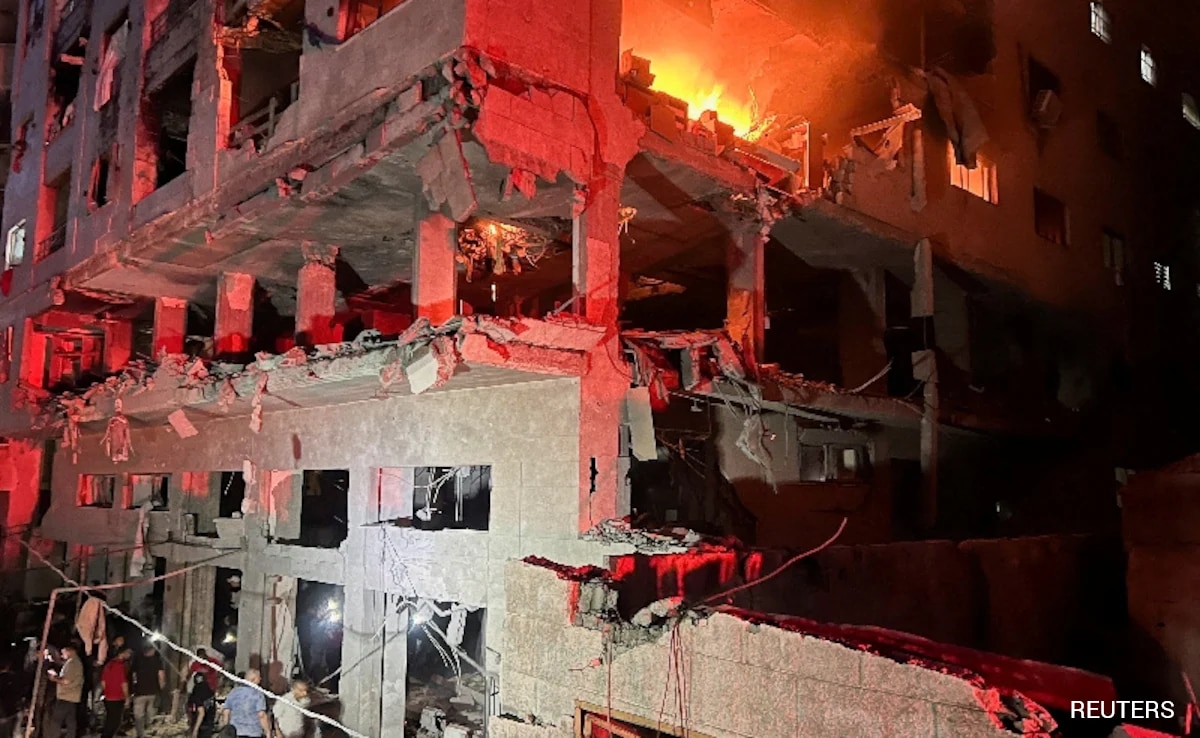
The air in Gaza City has a specific weight right before it breaks. It is a mixture of sea salt from the Mediterranean, concrete dust that never quite settles, and an oppressive, thick silence. When you live in a war zone, you learn to read the silence. A quiet night isn't a relief. It is a breath being held. It is the vacuum that forms right before the pressure drops.
Then comes the sound. It does not start as an explosion. It starts as a tearing fabric, a low, guttural rip across the sky as a missile cuts through the upper atmosphere. If you hear the rip, you are alive. The ones that hit you are silent until the world turns inside out.
On this particular night, the target was not just a grid coordinate on a military map. The target was Yahya Sinwar, the elusive chief of Hamas inside the strip, a man whose name is whispered with a complex cocktail of reverence, terror, and exhaustion by the people living under his shadow. The Israeli military called it a precision strike on a command infrastructure hub.
To the family huddled on the third floor of an apartment block three streets over, it felt like the earth had cracked in half.
Windows blew inward, a cascade of diamond-sharp shards slicing through the dark. The walls groaned, concrete flexing in ways it was never engineered to endure. In those seconds, geopolitical strategies and high-level military briefings dissolve into the most primal human reality. You grab what is closest to you. You hold your breath. You pray that the ceiling holds.
The dry wire copy will tell you the facts. It will state that the Israel Defense Forces launched a series of coordinated airstrikes targeting high-value assets. It will note the political ramifications, the balance of power, the strategic chess moves between Jerusalem and Doha.
But wire copy does not breathe. It does not smell the acrid tang of burning cordite and vaporized insulation that lingers in the back of your throat for days after a strike.
To understand what happened, consider a hypothetical composite of the thousands who live this reality every day: let us call her Amina. She is thirty-four. She has three children. She does not care about the shifting paradigms of Middle Eastern diplomacy when the fighter jets scream overhead. Her entire universe is measured in the distance between her arms and her children’s shoulders as they cower in a hallway.
When the strikes hit, the immediate aftermath is a strange, deafening quiet. Your ears ring with a high-pitched whine. Then, the screaming begins from the street below.
The targets were deep. Israel’s intelligence network had pinpointed locations believed to be utilized by Sinwar and his inner circle—subterranean networks, fortified bunkers hidden beneath the dense urban sprawl. The military calculus is cold and precise: neutralize the leadership to dismantle the apparatus. It is a strategy honed over decades of asymmetric warfare.
Yet, the physics of an airstrike refuse to be entirely precise. When a multi-ton munition detonates, the energy has to go somewhere. It ripples through the sandy soil. It fractures water mains. It collapses the fragile foundations of neighboring homes that have already survived three different wars.
The hunt for Sinwar is not just a military operation; it is a psychological obsession for both sides. For Israel, he represents the architect of their deepest trauma, a shadow figure who must be erased to restore a shattered sense of security. For Hamas, his survival is a potent symbol of defiance, a message written in the rubble that says, We are still here.
But for the shopkeeper whose storefront is now a mountain of jagged cinderblocks, the grand symbolism rings hollow.
The real crisis of this conflict is found in the erosion of the ordinary. Every strike chips away at the collective psyche of a population that has nowhere to run. Gaza is a strip of land roughly the size of Detroit, hemmed in by concrete walls, high-tech fences, and the sea. When the sky falls, there is no countryside to escape to. There are no shelters designed to withstand bunker-busting ordnance. There is only the hope that your building isn't next to the one on the target list.
The daylight always reveals the true cost. It strips away the anonymity of the night strikes. You see the mundane details of shattered lives scattered across the pavement: a pink plastic tricycle crushed beneath a slab of gray pillar; a textbook with its pages fluttering in the morning breeze; a single, dusty shoe.
Neighbors gather, their faces masked in gray dust, digging with bare hands through the remains of what was, just hours before, someone’s living room. They are looking for survivors, but mostly, they are looking for closure.
The political fallout will dominate the evening news cycles in Washington, London, and Jerusalem. Analysts will debate whether the elimination of a leader truly changes the trajectory of an ideology, or if it merely creates a vacuum for someone more radical to fill. They will use clean, sterile words like "collateral damage" and "operational success."
Those words do not fit in the palm of a hand. They do not explain anything to a child who refuses to sleep unless the lights are on, or who wets the bed every time a car backfires.
The strikes achieve their immediate tactical goals. Bunkers are smashed. Tunnels are collapsed. The leadership is forced deeper into the dark, cut off from communication, running out of places to hide. The military machine moves with a brutal, undeniable efficiency.
Yet, as the dust begins to settle over the craters of Gaza City, the deeper question remains unanswered. Every explosion leaves a scar on the land, but the deepest fractures are the ones you cannot see from a drone camera. They are embedded in the hearts of a generation growing up with the sky as an enemy.
The smoke rises in lazy, black plumes against the bright Mediterranean blue, a stark reminder that the truce with gravity is always temporary here.