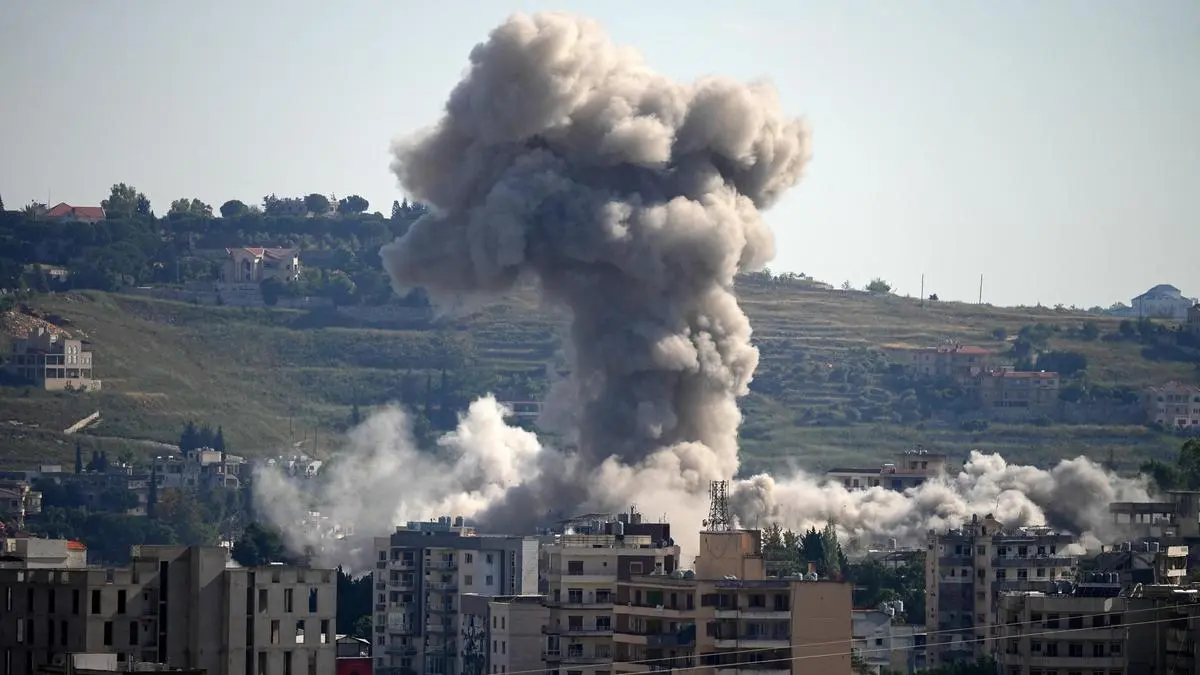
The teacup did not just shake. It rattled against the saucer with a sharp, rhythmic chatter that sounded like teeth freezing in the dark.
For Amira, a schoolteacher living on the coastal fringes of Kuwait City, that tiny ceramic vibration was the first sign that the distant wars she read about on her phone had finally crossed her threshold. Seconds later, the low, guttural roar arrived. It wasn't the sharp crack of thunder. It was a heavy, tearing sound, like giant sheets of canvas being ripped apart directly overhead.
When the sky lit up, it wasn't the soft amber of the streetlights or the neon glow of the downtown shopping districts. It was a violent, chemical crimson.
For years, the geopolitical chess match between Washington and Tehran was played out in bold headlines, dry press briefings, and analytical white papers. Analysts spoke of deterrence, strategic ambiguity, and proxy networks. But on this night, those abstract concepts melted away. They were replaced by the cold, terrifying reality of falling metal, burning fuel, and the realization that lines on a map offer no protection when the skies turn hostile.
The Sound of the Horizon Breaking
To understand how a quiet evening in Kuwait became a theater of panic, one must look at the immense gears grinding across the region. Hours before Amira’s teacup began to rattle, American strike fighters had unleased a massive payload onto Iranian military installations. The targets were specific, hardened, and chosen to send a message. The Pentagon called it a precision response to months of escalating provocations. They used terms like "measured" and "proportional."
But war is rarely proportional to the people living underneath its trajectory.
Imagine throwing a rock into a hornets' nest and expecting the insects to only attack the hand that threw it. The retaliation was swift, chaotic, and blind. Within a short window, the air defense radars across the Persian Gulf lit up like Christmas trees. Shards of the conflict spilled outward, away from the intended targets, raining down on neighbors who had spent decades trying to maintain a delicate neutrality.
Kuwait, a nation that has masterfully walked the tightrope of regional diplomacy for a generation, suddenly found itself in the crosshairs. It wasn't an invasion. It was worse in some ways: it was a stray, violent overflow.
Drone engines, sounding like angry lawnmowers in the night sky, crossed the northern border. Ballistic missiles, tracking through the upper atmosphere, chased erratic trajectories. Local defense systems engaged, painting the night with the streaks of interceptor missiles.
The defense grids did their job, mostly. But what goes up must come down. The debris of modern warfare—shrapnel the size of car doors, unspent rocket fuel, and shattered drone wings—rained down on Kuwaiti soil.
The Illusion of Distance
We live with a comforting lie. We believe that if we do not participate in a conflict, we are safe from it.
Consider the anatomy of a modern drone strike. These are not the sci-fi machines of Hollywood movies; they are often crude, loud, and surprisingly imprecise when damaged. When an interceptor missile hits a suicide drone at ten thousand feet, the explosion doesn't vaporize the threat. It redistributes it.
A piece of twisted aluminum falling from the sky at terminal velocity carries the same destructive energy as a artillery shell. It doesn't care if it lands on a military runway or through the roof of a suburban kitchen where someone is making tea.
The psychological toll of this unpredictability is suffocating. During the height of the strike, the internet in the Gulf flickered, choked by a surge of millions of people trying to find out if the explosions they were hearing were five miles away or fifty. In the absence of clear information, rumor becomes reality. Reports flashed across social media of fires near oil refineries, of closed airports, of chemical plumes.
This is the invisible tax of regional instability. It isn't just the structural damage that costs a society; it is the sudden, violent theft of predictability. One minute you are planning a weekend trip to the mall or arguing about a school curriculum; the next, you are looking at your hallway, wondering if it is structural enough to protect your children from a falling engine block.
The Mechanics of Retaliation
Why Kuwait? The question echoed through international newsrooms as the smoke began to clear. The country hosts American personnel, yes, but it has also been a tireless mediator, often serving as the quiet room where bitter rivals could send messages without losing face.
The brutal logic of modern proxy warfare ignores these nuances. When a major power strikes a nation's military core, the response is often designed to project capability rather than tactical genius. By launching strikes that inevitably bleed into neighboring airspace, the message sent back to Washington is clear: If you touch us, the entire neighborhood burns.
It is a strategy of hostage-taking via geography.
The raw data from the night tells a story of immense technical violence. Dozens of strike aircraft, hundreds of air defense munitions fired, an unknown number of drones launched from obscured sites. But the data fails to capture the smell of ozone and burning rubber that hung over the northern Kuwaiti desert the next morning. It fails to capture the sight of civil defense crews, dressed in high-visibility vests, carefully tagging the wreckage of an Iranian-manufactured guidance system embedded in the asphalt of a quiet highway.
The Morning After the Fire
When the sun rose, it revealed a sky that had returned to its usual, dust-blown, hazy blue. The sirens had stopped. The official state media issued calm, measured statements urging citizens to return to their routines and ignore the panic-mongering online.
But a boundary had been crossed. The psychological architecture of the region had shifted.
Amira walked out to her small garden that morning. The air smelled faintly of burnt plastic, a scent that didn't belong in the clean, crisp air of a desert dawn. On the sidewalk outside her gate lay a tiny, jagged piece of dark grey carbon fiber, no larger than a smartphone. She didn't touch it. She just stood there, looking at it, as the morning traffic began to build on the main road a few blocks away.
The cars were moving. The shops were opening their steel shutters. The appearance of normalcy was returning with the heat of the day. Yet every person driving to work was doing so with one eye on the road and one eye on the horizon, acutely aware that the peace they enjoyed was not a solid fortress, but a fragile glass dome, and the stones were getting bigger.