The air inside the situation room always smells faintly of dry paper, floor wax, and the quiet sweat of men holding coordinates to annihilation.
You do not hear the missiles coming. Not yet. You hear the hum of the fluorescent lights, the scratch of a fountain pen on heavy cardstock, and the distant, muffled clatter of teletype machines spitting out translations from halfway across the globe. History rarely arrives with a cinematic crash. Usually, it sneaks in through a secure telephone line, sounding like a tired aide clearing his throat.
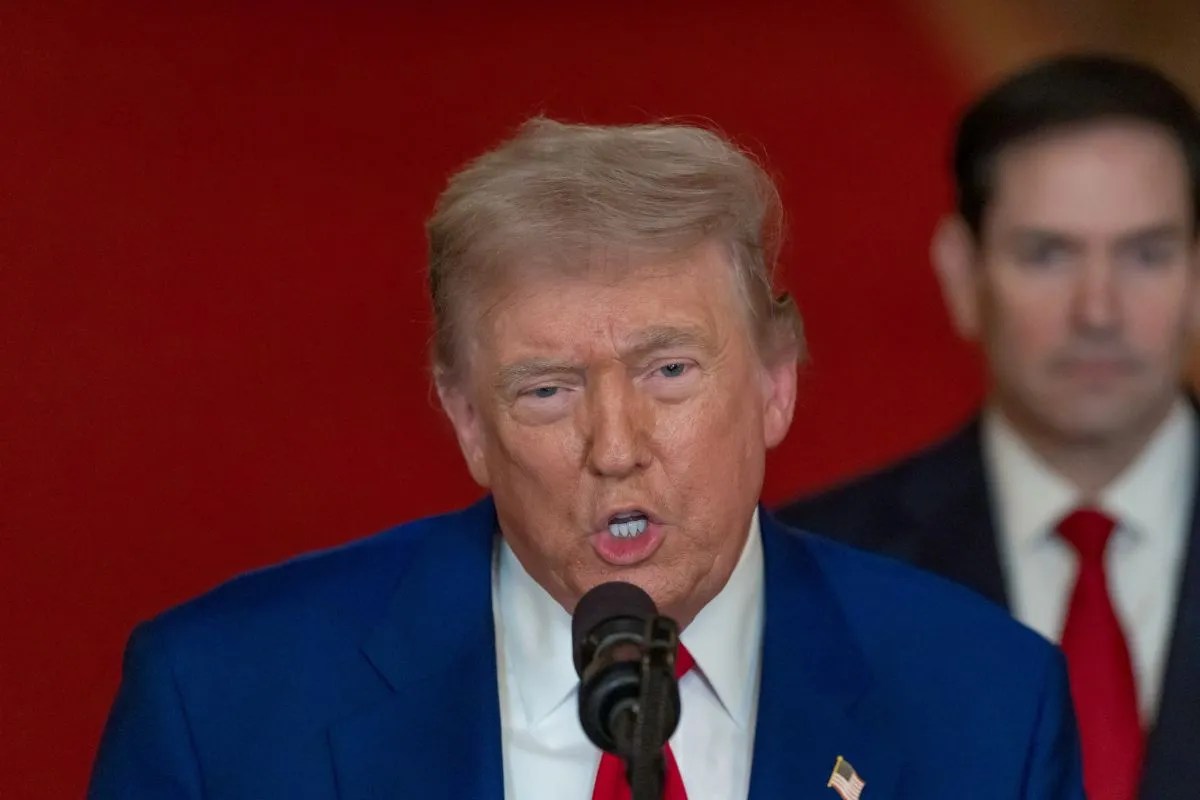
Donald Trump leaned back in his leather chair, staring at a flashing red indicator light that felt less like a piece of hardware and more like a glowing ember. The dossier on his desk spoke of impending catastrophe. Intelligence assessments painted a grim portrait of a retaliatory strike designed to mirror the industrial-scale devastation of past global conflicts. A World War Two style assault, the analysts muttered. Total mobilization. Ports choked with burning tankers. Skies darkened by drone swarms.
Silence.
Then, according to the former president's own dramatic recounting during a televised rally, the line went hot.
"Iran called us. They were begging to make a deal. They were devastated."
The words hang in the air, heavy with the bluster of political theatre, yet they capture a very real psychological truth about the choreography of modern nuclear brinkmanship. We live in an era where entire civilizations are balanced on the razor's edge of a digital trigger, and yet the ultimate resolution often hinges on the oldest human dynamic in existence: raw, unfiltered fear.
Consider the ordinary citizen sitting in a café in Tehran that exact afternoon, sipping tea laced with cardamom, completely unaware that their government's ambassadors were reportedly scrambling for an off-ramp. They watched the same sunset as the generals. They felt the same cold knot in their stomach. Fear does not check your passport. It does not care about your ideology. It simply makes your palms sweat and your chest tighten, whispering that tomorrow might not happen.
We have grown dangerously comfortable with the language of total war. We toss around phrases like regional escalation and kinetic response as if they were stats in a video game. But behind every diplomatic cable and every fiery public pronouncement lies the fragile reality of human panic.
When Trump stood before cheering crowds and declared that he pulled back from the brink only because the adversary buckled, he was feeding a specific narrative of strength. Yet beneath the political theater lies a more complex, unsettling mechanical truth. Wars rarely start because leaders genuinely want them. They start because communication breaks down, because pride hardens into concrete, and because neither side knows how to step backward without looking weak.
Think of a high-stakes poker game played in a pitch-black room. You cannot see your opponent's face. You can only hear their breathing. When the breathing quickens, you know they are sweating.
That is what modern statecraft looks like during a crisis. It is a terrifying exercise in auditory psychology.
For decades, political scientists have studied the mechanics of deterrence. We built elaborate mathematical models around mutually assured destruction, treating nations as cold, rational actors moving pieces on a global chessboard. But nations are not chess pieces. They are collections of frightened human beings trapped in institutional inertia. When the economic sanctions bit deep into the heart of Iranian infrastructure, and when the threat of an overwhelming American counter-strike loomed like a thunderhead, the rational calculus shifted.
According to the narrative pushed by Washington's hawks, it was pure, unadulterated coercion that forced Tehran's hand. The argument goes that absolute pressure yields absolute compliance.
Reality, as always, is far messier.
What actually happened in those crucial seventy-two hours was likely a frantic scramble behind closed velvet curtains. Diplomats whispering through third-party intermediaries in Oman or Switzerland. Messages carried in code, translated by exhausted interns, and read by leaders whose heart rates were spiking. The public sees the tweets. The public hears the rally speeches about begging and breaking. The quiet truth is usually found in the weary compromise, the face-saving maneuver, and the desperate search for any excuse to avoid the abyss.
We must ask ourselves what kind of world we are building when the avoidance of global catastrophe depends entirely on the theatrical humiliation of one side by the other. Is peace truly secured when it is wrapped in the ego of a podium speech? Or are we simply kicking the can down a very steep, very narrow road?
The danger of framing international crises as a simple binary of winners and losers is that it leaves no room for sustainable healing. If one side is perpetually told they crawled on their knees, they spend the next decade planning how to stand back up with a knife behind their back.
The red light on the situation room console eventually stopped flashing. The teletype machines went quiet. The dossier was closed and filed away into a metal cabinet that smelled of dust and bureaucracy.
Somewhere over the Strait of Hormuz, a gulls wing dipped toward the dark water, untouched by the algorithms of destruction waiting on the shore. The crisis passed not with a roar of historic proportions, but with the quiet, anticlimactic click of a telephone receiver settling back onto its cradle.
We survived another day. Not because we are wise, but because someone, somewhere, finally got scared enough to blink.


