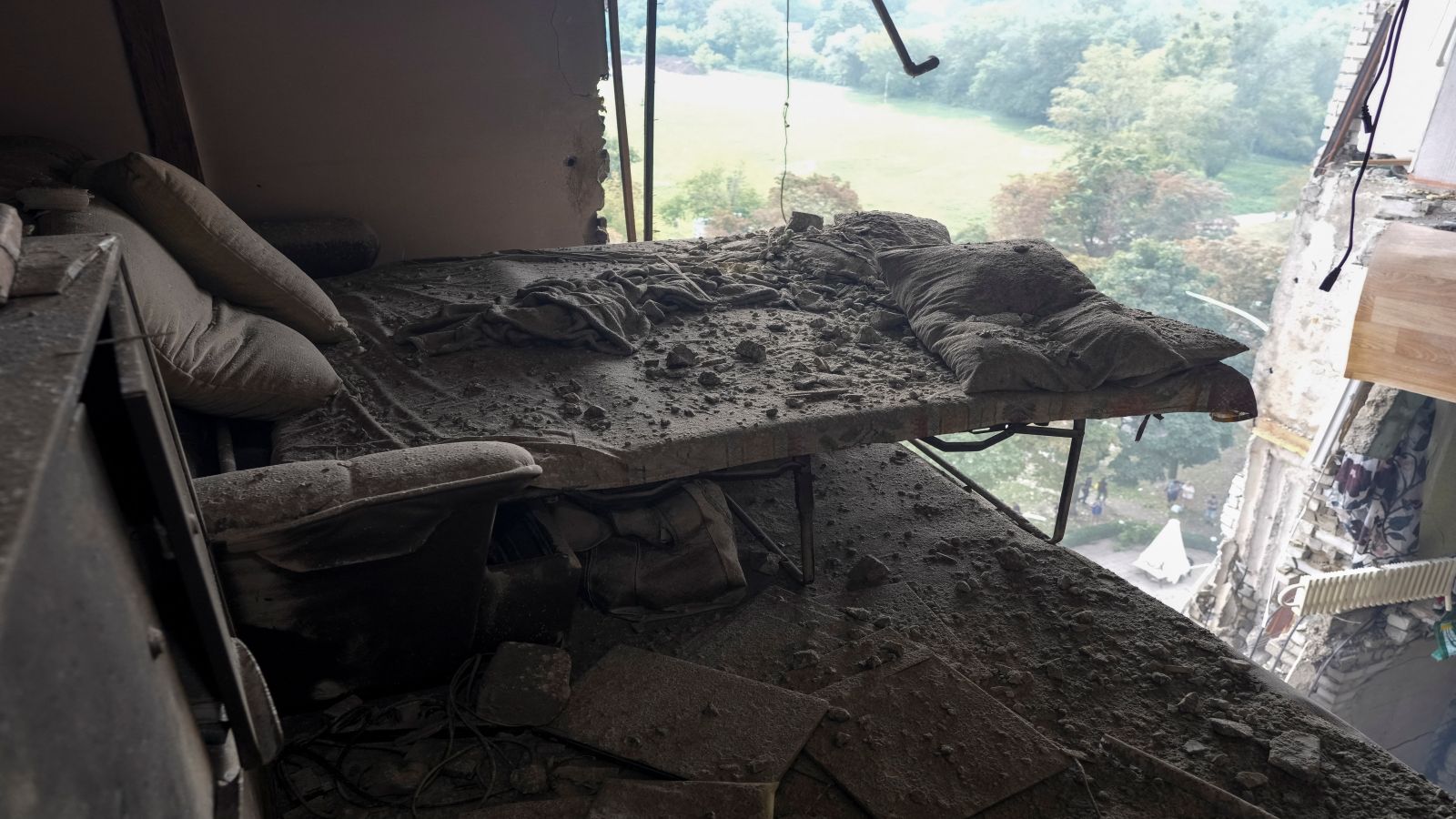
The air over Eastern Europe does not smell like politics. It smells like sulfur, wet earth, and scorched brick. When overnight strikes tear through apartment blocks in border regions and deep interior zones alike, the geopolitical abstraction of the Russia-Ukraine war evaporates instantly. Civilians wake to the scream of incoming propulsion and the blinding flash of high-yield ordinance, discovering that the front line is no longer a trench system hundreds of miles away. It is right where they sleep.
Decisions made in distant command centers manifest as shattered glass and ruined foundations. Understanding how this conflict devolved into a relentless cycle of nocturnal attrition requires looking past the daily casualty tickers. We must examine the strategic calculus driving these nightly barrages, the technological adaptations transforming civilian areas into unintended targets, and the grim reality of a war settling into a permanent state of mutual exhaustion. Also making waves in this space: The Economics of Avian Diplomacy: Structural Analysis of the Ariana Park Peafowl Succession.
The Evolution of Nocturnal Targeting
Military doctrine rarely shifts overnight, but the tactical execution of aerial bombardment has mutated significantly over the last several years. Early phases of the conflict relied heavily on massive, televised missile salvos aimed at critical infrastructure nodes, power grids, and military logistics hubs. Those attacks were loud, predictable, and heavily telegraphed by early warning radar systems.
Today, the playbook is far more insidious. Further insights on this are covered by Al Jazeera.
Commanders on both sides now deploy mixed swarms of low-cost loitering munitions alongside hypersonic delivery systems. The goal is simple exhaustion. By launching coordinated waves during the dead of night, forces attempt to overwhelm air defense batteries, force exhausted populations into damp bomb shelters for the fourth time in a week, and chip away at the economic productivity of the nation.
When a drone or missile misses a military asset by fifty meters, the physics of high explosives ensures that the adjacent residential block absorbs the kinetic debt. Air defense interceptors do not vanish into thin air; falling debris from a successfully neutralized projectile frequently triggers catastrophic ground-level destruction. This is the brutal mathematical reality of modern intercept warfare over urban centers. Every successful defense carries a collateral price tag paid in shattered windows, structural fires, and civilian trauma.
Logistics of Terror and Attrition
War is fundamentally an exercise in logistics, and psychological endurance is a finite resource. When overnight strikes leave dozens injured and homes reduced to smoking rubble, the psychological ripple effects outlast the physical cleanup crews.
- Supply Chain Disruption: Every targeted rail junction or fuel depot near civilian areas halts commercial distribution, slowing food and medicine delivery.
- Infrastructure Degradation: Repeated strikes on municipal transformers force rolling blackouts, turning modern cities into cold, dark environments during freezing winters.
- Workforce Depletion: Hospitals fill with trauma cases, pulling medical professionals away from general healthcare and compounding public health crises.
Observers often ask why air defenses cannot simply create an impenetrable dome over every city. The answer lies in economic asymmetry. Launching a million-dollar interceptor missile to destroy a fifty-thousand-dollar propeller-driven drone is a losing financial proposition over the long term. Industrial manufacturing capacities dictate the pace of survival. As long as suppliers can churn out cheaper offensive hardware faster than defenders can procure high-end interceptors, the night skies will remain contested and perilous.
The Fog of War and Information Control
Reporting on nighttime destruction presents a constant journalistic battle against censorship, propaganda, and strategic ambiguity. Both belligerents maintain tight controls over visual documentation of strike sites. Sharing precise coordinates or unverified damage assessments can inadvertently provide targeting data to opposing artillery spotters.
Consequently, what reaches the public eye is heavily filtered. Official statements speak of "successful neutralizations" while omitting the apartment building flattened by falling shrapnel. Conversely, civilian social media feeds overflow with raw, unverified panic, sometimes magnifying the psychological impact far beyond the physical damage inflicted.
Navigating this fog requires skepticism toward clean narratives. War is messy, chaotic, and inefficient. Innocent lives are extinguished not always out of targeted malice, but frequently due to guidance system drift, electronic jamming interference, and the tragic proximity of legitimate targets to densely populated neighborhoods.
The sirens will wail again before dawn. Families will descend into concrete basements, clutching pets and emergency bags, waiting for the dull thud of impact to confirm whether their neighborhood survived another rotation of the earth. Until diplomatic frameworks catch up with military technology, the civilian population remains the primary shock absorber for a conflict that refuses to slow down.