Geopolitics often moves in quiet, concrete ways. While diplomats argue in glass towers and pundits debate abstract doctrines on television, bulldozers and steel beams redraw the map of East Asia. For decades, Beijing held the master key to North Korea's survival. Almost every ton of food, fuel, and heavy machinery crossing into Pyongyang rolled across Chinese rails or through Chinese ports. China was the undisputed center of gravity for Kim Jong Un's regime, and everyone in Pyongyang knew it.
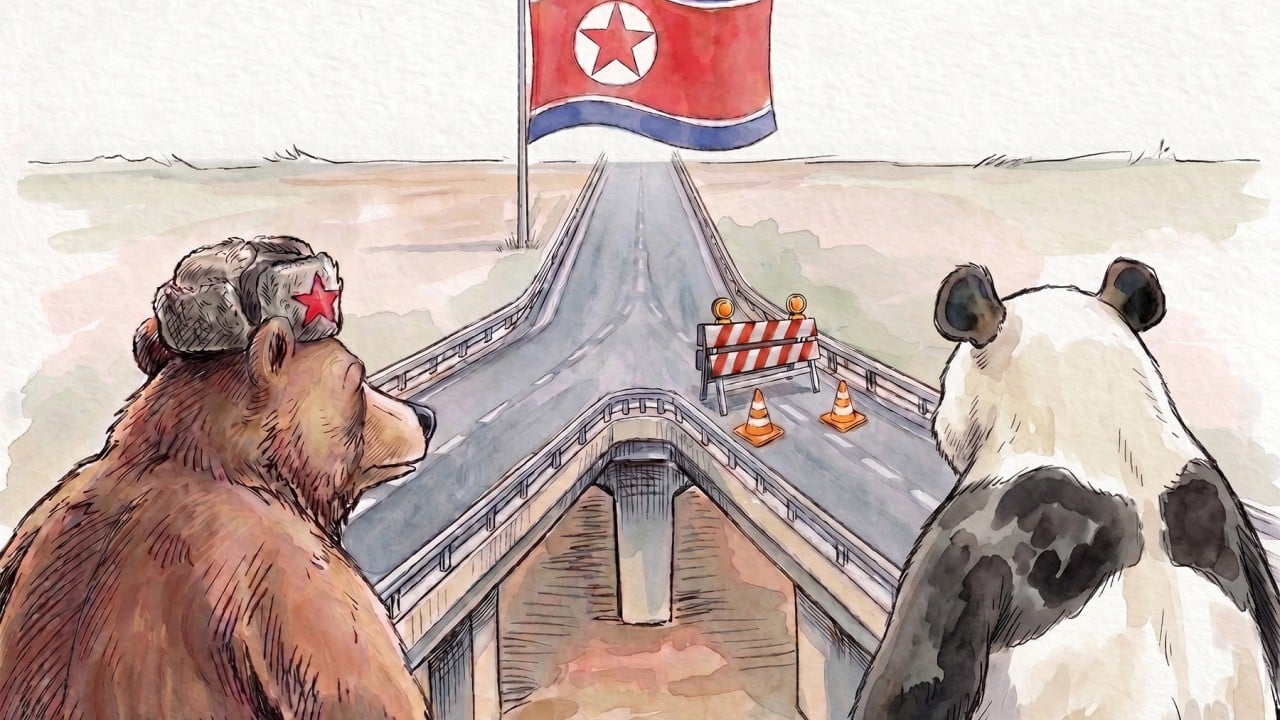
Then Vladimir Putin and Kim Jong Un signed a comprehensive strategic partnership, and the physical reality of the border began to shift overnight. The push for new cross-border infrastructure, including updated transport and bridge links over the Tumen River, isn't just about moving routine cargo. It's a direct signal to Beijing that Pyongyang has found an alternative patron. And Beijing hates being sidestepped.
Moscow and Pyongyang Bypass the Middle Kingdom
For generations, China enjoyed a comfortable monopoly on North Korea's external economic life. If Kim wanted to trade, he went through Dandong or other vital Chinese border hubs. This gave Beijing immense leverage over its prickly neighbor. Xi Jinping's government could squeeze or loosen supply lines whenever Pyongyang stepped out of line with missile tests or nuclear posturing. North Korea was firmly inside China's economic orbit, treated almost like a buffer state that required careful management rather than an equal sovereign partner.
Moscow's return to the Korean Peninsula shatters that traditional asymmetry. By upgrading transport links—reviving old Soviet-era rail connections and pushing for dedicated road bridges across the narrow shared border at the Tumen River—Russia and North Korea are carving out a bilateral corridor that completely bypasses Chinese territory. North Korean laborers, munitions, and raw materials can flow straight into the Russian Far East without asking for Beijing's blessing. In exchange, Russian oil, grain, and military technology can enter North Korea without a single customs stamp from a Chinese official.
This new level of autonomy terrifies Chinese strategists. Beijing has always viewed North Korea primarily as a strategic shield against American forces stationed in South Korea. They never wanted a collapse of the regime, but they certainly didn't want Pyongyang becoming too independent, taking orders from Moscow instead of Beijing. The new bridge is a physical manifestation of that shifting loyalty, and it undermines decades of Chinese diplomatic investment in the region.
The Strategic Reality of Direct Rail and Road Links
To understand why this infrastructure project matters so much, you have to look at the geography. The Russia-North Korea border is tiny—only about eleven miles long, mostly running along the winding Tumen River. Back in the Soviet era, a rail bridge known as the Friendship Bridge was built to connect Khasan to Tumangang. But for a long time, it fell into disrepair, heavily underutilized as Russia turned its economic gaze toward lucrative European markets and Asia's southern tigers.
When the war in Ukraine isolated Moscow from Western markets and depleted its conventional ammunition stocks, everything changed overnight. North Korea possessed massive stockpiles of artillery shells and ballistic missiles that matched Soviet-era weapon systems. Moscow needed munitions immediately, and Pyongyang needed hard currency, refined petroleum products, and advanced aerospace or satellite technology.
The existing rail link quickly proved insufficient for the sheer volume of military traffic moving between the two countries. Upgrading transport links and constructing modern road infrastructure allows for high-speed, high-capacity logistics that don't depend on maritime shipping—which is increasingly monitored by Western intelligence agencies—or Chinese overland transit. When you see heavy transport routes expanding directly between Vladivostok and North Korea's industrial zones, you are looking at the arterial veins of a new wartime alliance.
Why Beijing Hates Being Sidestepped
China wants stability on its periphery above all else. A volatile Korean Peninsula hurts Chinese trade and invites heavier American military deployments in the region. For years, Beijing walked a careful diplomatic tightrope: publicly backing United Nations sanctions against North Korea while quietly keeping the regime afloat so it wouldn't collapse and trigger a refugee crisis on China's border or result in a unified, pro-Western Korea on its doorstep.
Beijing expected to remain the indispensable economic lifeline for Pyongyang indefinitely. When North Korea deepens its military and economic integration with Russia, China loses its monopoly on leverage. Xi Jinping cannot easily dictate terms to Kim Jong Un if Pyongyang can source fuel and diplomatic cover directly from the Kremlin.
Instead, Beijing finds itself in an awkward position. Publicly, Chinese state media plays down the bilateral bonhomie between Moscow and Pyongyang, portraying it as standard neighborly cooperation. Privately, Chinese diplomats are sweating. They worry that Kim Jong Un, emboldened by Russian backing, might feel invincible and launch provocative military actions that drag China into an unwanted regional conflict. Worse, they worry that Russia is trading sensitive nuclear and missile technology to North Korea in exchange for shells, permanently upgrading Pyongyang's strategic threat level without consulting Beijing.
Economic Realignment on the Tumen River
The economic dimension of this rapprochement goes far beyond simple weapons bartering. For years, the Tumen River region has been a geopolitical dead zone because of international sanctions and tight border restrictions. China spent billions trying to develop its own access to the Sea of Japan via the lower Tumen River, leasing piers at the Chinese port of Fangchuan or relying on North Korea's Rajin port to ship goods domestically.
Under the old setup, China controlled the financial terms of access. Now, Russia is cutting its own direct economic deals with North Korea, investing in port modernizations, agricultural trade, and energy pipelines that bypass Chinese middlemen entirely. Russian tourists are even starting to visit North Korean ski resorts, a bizarre micro-trend that highlights how normalization between Moscow and Pyongyang is expanding past military supply chains into civilian sectors.
When two heavily sanctioned authoritarian states pool their resources, they create a parallel economic ecosystem. They trade in national currencies, bypass Western banking networks, and share technical know-how out of sight of international inspectors. This erodes the effectiveness of global sanctions regimes that Beijing historically complied with, at least on paper. If Russia and North Korea can trade freely across their shared land border without Western or Chinese interference, other isolated states will take notes.
Sanctions and the New Axis of Convenience
The United Nations Security Council resolutions restricting North Korean trade were once treated as international law by almost every major power, including Beijing. Today, Moscow routinely blocks sanctions renewals at the UN, effectively tearing up the rulebook that constrained North Korea's economic expansion for decades.
Russia's permanent seat on the Security Council gives Pyongyang diplomatic immunity it never had before. Combined with physical infrastructure like new bridges and rail terminals, this diplomatic shield means North Korea's isolation is effectively over. They no longer need to sneak coal shipments onto dark ships at sea; they can send goods right across the border on trains that Russia protects.
This direct conduit undermines Beijing's preferred balancing act. China wants to maintain normal trade relations with the West while keeping North Korea on a tight leash. But as Moscow and Pyongyang forge a tighter operational bond, Beijing is forced to choose between endorsing an unmoored, nuclear-armed North Korea backed by Russia or pushing back against its historic partner in Moscow. Neither option appeals to Chinese leadership.
What This Means for Regional Stability
The construction of new transport and bridge links between Russia and North Korea is not a minor local project. It is a tectonic shift in East Asian security architecture. It signals that the post-Cold War diplomatic order in Asia is fracturing into competing blocs, replacing the old unipolar or Chinese-dominated paradigm with a hardened bilateral axis of alienated powers.
For Washington, Seoul, and Tokyo, this axis presents a nightmare scenario of integrated missile, artillery, and cyber capabilities shared between Moscow and Pyongyang. For Beijing, it represents a loss of control over its unruly neighbor, turning a dependent buffer state into an unpredictable wild card backed by a revanchist nuclear superpower.
The next time you hear about a new bridge or railway opening up in the remote corner where Russia, China, and North Korea meet, remember what it really represents. It's not just concrete and steel. It's the physical proof that old alliances are breaking down, and a new, more dangerous game is being played along the Tumen River.