Forget everything you know about tiny, cramped space outposts.
When NASA Administrator Jared Isaacman stood before reporters to lay out the agency's blueprint for a permanent lunar settlement, he wasn't talking about a lonely capsule sitting in the gray dust. He dropped a bombshell that caught even veteran space watchers off guard. The planned Moon Base will eventually span hundreds of square miles across the lunar south pole.
This isn't just a science experiment. It is a massive, decentralized infrastructure project. The space agency just kicked off a three-phase strategy aimed at establishing a semi-permanent human presence on another world. If you think this is a distant fantasy, check the calendar. Three uncrewed construction missions are scheduled to launch later this year to lay the groundwork.
The real story here isn't just that we're going back to the Moon. It's how radically different this strategy is compared to the Apollo era.
The Wild Reality of a Hundreds of Square Miles Base
When the Moon Base program chief Carlos Garcia-Galan detailed the footprint of the project, people naturally wondered why an outpost needs to occupy an area larger than many major cities. The answer comes down to survival and geology.
According to Nujoud Merancy, the program's chief architect, no single location on the Moon ticks every box. You can't put your solar panels in a deep, permanently shadowed crater, and you can't harvest water ice from a sunlit mountain peak. To make a settlement work, NASA has to separate its assets.
- The Summits: Habitats and solar arrays will sit on high ridges and hills to catch maximum sunlight for power and warmth.
- The Craters: Robotic mining equipment will descend into pitch-black craters, like the Shackleton de Gerlache Ridge, where temperatures hover around -200°C to dig up frozen water.
- The Perimeters: Autonomous drones will operate at the far edges of the camp, essentially marking territory and mapping the shifting terrain.
This vast layout creates a logistical nightmare. You can't just walk outside and grab what you need. Everything depends on an autonomous transportation network that connects these distant nodes.
The Private Money Driving the Mission
The old way of doing space exploration involved NASA designing a rocket, hiring a contractor to build it to exact blueprints, and footed the entire multi-billion-dollar bill. That model is dead.
NASA is spending $20 billion on this initiative, but it's stretching that money by forcing private companies to put their own skin in the game. Jeff Bezos’s Blue Origin scored a $230.4 million contract to handle the very first uncrewed construction mission this fall. It sounds like a lot of money, but Blue Origin is actually self-funding the vast majority of the flight.
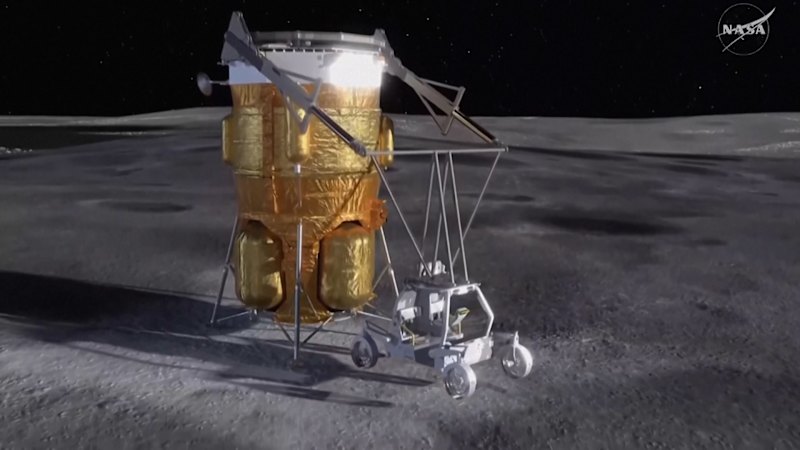
The vehicle taking center stage is Endurance, Blue Origin’s cryogenically propelled cargo lander. It will carry heavy scientific instruments, site-preparation tech, and commercial payloads straight to the south pole.
NASA is purposefully sparking a brutal corporate rivalry. While Blue Origin handles the initial infrastructure drops, Elon Musk’s SpaceX is aggressively developing its Starship Human Landing System. NASA plans to test both flight systems in Earth orbit during the Artemis III mission in 2027 before deciding who gets the marquee crewed landings. By pitting billionaires against each other, the agency gets cheaper tech and redundant flight options.
A Three Step Blueprint for Lunar Settlement
NASA isn't throwing astronauts into the deep end. The agency's official roadmap breaks the construction into three distinct, iterative phases designed to build capability over time.
Phase One (Now to 2029)
The focus is pure logistics and securing reliable surface access. This phase is incredibly busy, packing 25 launches and 21 separate uncrewed landings. The goal is to drop 4,000 kilograms of hardware onto the dirt before humans arrive.
This is where the MoonFall mission comes in. NASA will deploy four highly mobile hopping drones based on the technology developed for the Ingenuity Mars helicopter. They'll drop during a lander's descent, land independently, and spend 14 Earth days surveying crater walls and mapping the perimeter. Simultaneously, uncrewed Lunar Terrain Vehicles (LTVs) built by companies like Lunar Outpost and Astrolab will be dropped off. These rovers can travel up to 800 kilometers autonomously, navigating 20-degree slopes and surviving 150 hours of pure darkness using radioisotope heating units.
Phase Two (2029 to 2032)
Once the scouts finish mapping, the heavy lifting begins. Phase Two scales up aggressively with 27 launches and 24 landings, moving nearly 60,000 kilograms of payload. This is when the Foundation Surface Habitat will be deployed, alongside semi-annual crewed missions. Astronauts will start regolith manipulation, using lunar soil to build protective berms around landing pads to shield equipment from blast debris.
Phase Three (2032 and Beyond)
The final stage establishes a fully operational base with a continuous human presence. With 29 launches and 28 landings delivering 150,000 kilograms of equipment, the site transitions from a fragile outpost to an industrial hub. This phase introduces cargo return systems to send pristine lunar core samples back to Earth.
Surviving the Worst Environment Imaginable
It is easy to get swept up in the excitement of a new space age, but the engineering hurdles are terrifying. The lunar south pole is a brutal landscape of stark contrasts.
The dust is the first major problem. Lunar regolith consists of tiny, razor-sharp shards of rock that carry a static charge. It sticks to spacesuits, destroys seals, and eats through mechanical joints. Without aggressive mitigation tech, a rover's moving parts will grind to a halt within weeks.
Then there's the cold. In the permanently shadowed regions where the water ice hides, there is no atmosphere to trap heat. Battery chemistry fails at these temperatures. To keep the rovers and drones from freezing into useless blocks of metal during the long lunar nights, NASA is relying heavily on radioisotope heating units. These small devices use the decay of radioactive material to generate constant warmth, bypassing the need for solar power during the dark periods.
Why This Matters Right Now
If you think this timeline sounds overly optimistic, you aren't alone. Plenty of industry insiders look at 81 planned launches over the next decade and see a recipe for delays.
But there is a massive geopolitical driver behind this sudden urgency. The United States is locked in a direct race with China to control the strategic high ground of the Moon's south pole. China is targeting its own crewed landing by 2030 and rapidly advancing its hardware. Space exploration has always been driven by competition, and the threat of finishing second is what's keeping NASA's budget secure through shifting political tides.
The immediate next steps are already in motion. Keep an eye out for the Blue Origin Endurance launch later this year. That uncrewed flight will tell us if the autonomous precision landing tech can actually handle the jagged terrain of the Shackleton ridge. If it succeeds, the foundation for humanity's first true off-world city will be officially set.