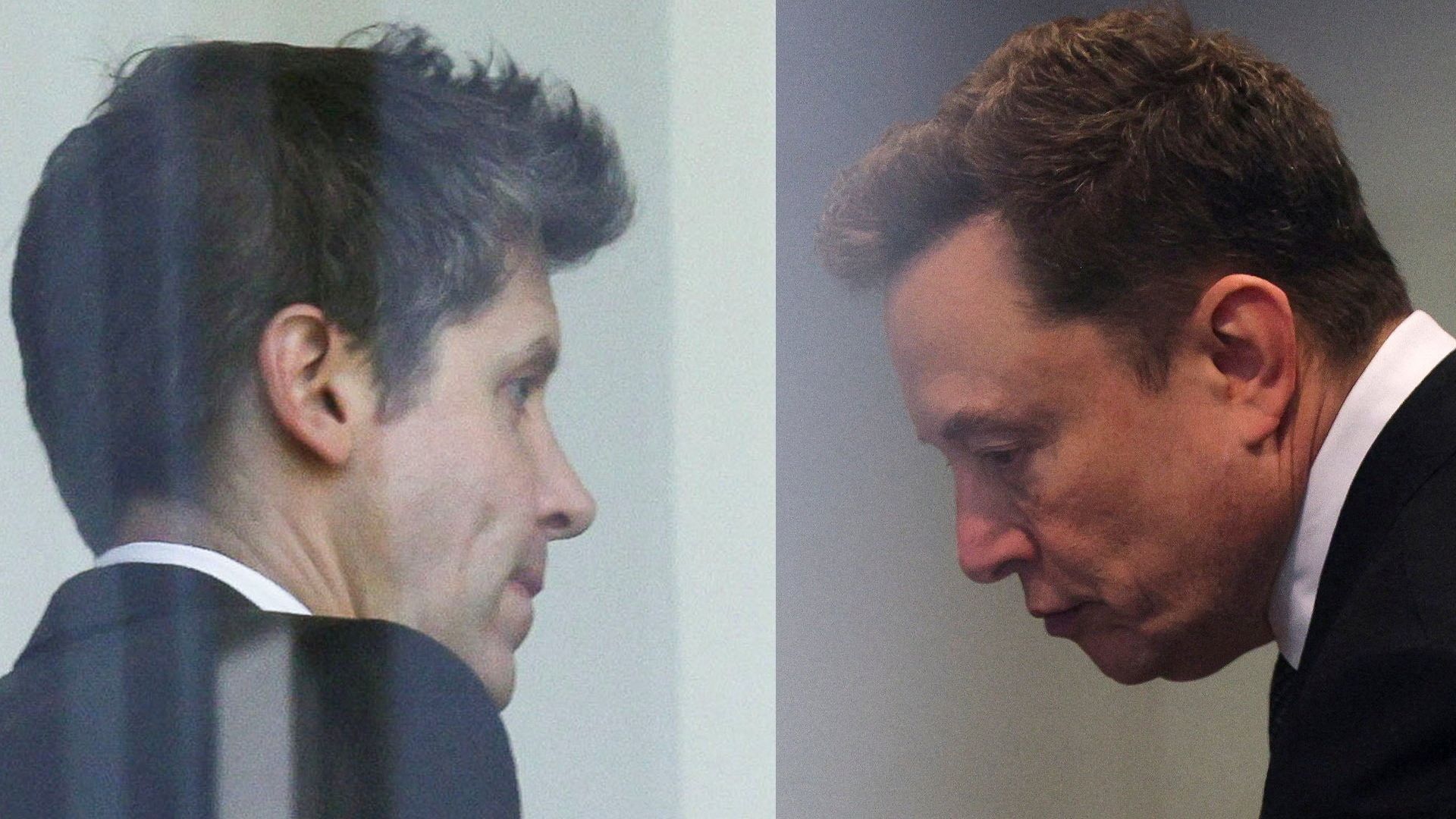
Elon Musk and Sam Altman aren't fighting over the soul of humanity. They are fighting over the most valuable deed in history.
The mainstream narrative—the one you’ve likely swallowed from breathless headlines—paints a picture of a fallen eden. It’s a story of a "charity" that was "stolen" by greedy capitalists, leaving a visionary founder out in the cold. It’s a narrative that frames the $150 billion legal war as a moral crusade. Discover more on a related topic: this related article.
It isn't. It’s a messy, inevitable divorce between two high-stakes gamblers who both knew exactly what they were doing from day one. To suggest that OpenAI could have stayed a pure nonprofit while pursuing Artificial General Intelligence (AGI) isn't just naive; it’s mathematically impossible.
The Nonprofit Illusion
Let’s burn the biggest straw man first: the idea that OpenAI was "hijacked." More reporting by Mashable delves into comparable perspectives on this issue.
In the world of high-compute AI, "nonprofit" is a fiscal suicide note. The "lazy consensus" suggests that Altman pulled a fast one on Musk by pivoting to a capped-profit model. In reality, the laws of physics and capital markets forced the pivot.
Building AGI requires three things: talent, data, and compute.
- Talent: You don't hire the world’s top researchers with "vibes" and a tax-exempt status. You hire them with equity that has a clear path to liquidity.
- Compute: NVIDIA does not accept "social good" as a form of payment for H100 clusters.
By 2018, OpenAI’s burn rate was scaling exponentially. Musk’s initial $1 billion pledge? It was a drop in the bucket compared to the $13 billion Microsoft eventually parked on the table. When Musk stopped funding the project, he didn't just leave a void; he created a scenario where the entity had to evolve or die.
Musk’s lawsuit claims Altman "betrayed" the founding mission. But look at the math. A nonprofit cannot raise $10 billion in a seed round. If OpenAI had remained a 501(c)(3), GPT-4 would not exist. We would still be playing with Markov chains and basic chatbots while Google and Meta built the real future behind closed doors.
The Secret Logic of the Pivot
Everyone asks: "Is it legal to turn a charity into a $150 billion corporation?"
The better question is: "Was it ever actually a charity?"
From a structural standpoint, OpenAI was always an R&D lab disguised as a church. The nonprofit board was a governance experiment that failed because it tried to apply academic oversight to a hyper-growth tech startup. When the board fired Altman in late 2023, they weren't protecting the mission; they were proving why the mission was structurally unsound.
The ensuing chaos showed that the employees—the real value of the company—didn't care about the nonprofit status. They cared about the work and their stock options. Musk knows this. He’s an expert at using the legal system to slow down competitors while building his own for-profit rival, xAI.
The "Open" in OpenAI Was a Marketing Tactic
One of the loudest complaints is that OpenAI is no longer "open."
This is where the contrarian truth hurts: Transparency is a security risk. In the early days, being "open" was a way to attract talent that was tired of the secrecy at Google DeepMind. It was a recruiting tool, not a religious commandment. As models became more capable, the "openness" became a liability. If you have a model capable of helping a novice engineer design a bioweapon, you don't post the weights on GitHub for the sake of "charity."
The industry is moving toward a "closed-source for safety" model, and while that sounds like a corporate excuse to hoard profits, it’s also the only responsible way to deploy a dual-use technology. Musk’s demand for transparency is a tactical move to force OpenAI to give away its intellectual property, which would conveniently help xAI catch up.
Why the $150 Billion Valuation Is Actually Conservative
Critics argue the current valuation is a bubble fueled by the Musk-Altman drama. They are wrong.
If OpenAI achieves even a fraction of what it claims—a system that can perform any intellectual task better than a human—$150 billion is a rounding error. We are talking about the automation of the entire services sector.
The legal battle isn't about "stealing" a charity; it’s about who gets to control the transition from a labor-based economy to a compute-based economy. Musk isn't mad that Altman is making money; he’s mad that he’s not the one holding the keys to the kingdom he helped fund.
The Hard Truth About Corporate "Souls"
We love to anthropomorphize these companies. We want them to have missions and ethics. But OpenAI is a machine designed to produce intelligence. To do that, it needs more capital than any nonprofit in history has ever managed.
The Trade-off Matrix
| Feature | Nonprofit Model (The Dream) | Capped-Profit Model (The Reality) |
|---|---|---|
| Funding Source | Donations/Grants | Private Equity/Venture Capital |
| Talent Retention | Altruism-driven | Equity-driven |
| Speed | Slow, academic | Hyper-growth |
| Safety | Theoretical | Applied/Red-teamed |
The "betrayal" Musk cites was actually a necessary adaptation. You cannot fight a war with a bake sale budget.
Stop Asking if OpenAI is "Good"
The common question—"Is OpenAI still following its mission?"—is the wrong question.
The right question is: "Can any entity develop AGI without becoming a massive corporation?"
The answer is a resounding no. The infrastructure costs alone mandate a return on investment. If you want a tool that can solve cancer and climate change, you have to accept that it will be built by people who want to be billionaires. The friction between Musk and Altman is just the friction of two tectonic plates shifting the entire landscape of global power.
Musk isn't the hero defending the public good, and Altman isn't the villain who stole the fire. They are both participants in a high-stakes capture-the-flag game where the flag is the future of human labor.
The court case will drag on, but the verdict is already in: The nonprofit era of AI is dead, and it was killed by the very scale of the ambition that birthed it.
If you’re still waiting for OpenAI to return to its "charitable roots," you aren't paying attention to the bills. AGI isn't a public park. It’s a nuclear reactor. And nobody builds a nuclear reactor with a "GoFundMe" and a dream.
Get used to the $150 billion price tag. It’s only going up.