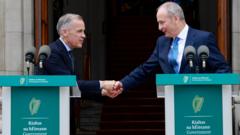
The media consensus surrounding Mark Carney’s two-day visit to Ireland reads like a boilerplate press release for the global establishment. He is framed as the prodigal son returning "home" to his ancestral roots, a financial titan dispensing wisdom to European leaders while keeping a warm eye on the leadership of the Liberal Party of Canada.
It is a comfortable, lazy narrative. It is also entirely wrong. Read more on a related topic: this related article.
What the breathless coverage of Carney’s Dublin itinerary misses is the profound structural failure of the economic philosophy he represents. The assumption that a globe-trotting central banker can seamlessly transition from managing fiat currencies to solving the deeply localized, structural crises of a modern nation-state is a dangerous delusion. Carney’s Irish excursion is not a victory lap; it is a case study in the limitations of technocratic governance.
The Irish Economic Miracle is an Illusion
To understand why Carney’s insights are being overvalued, you have to look at the ground he is walking on. Ireland is frequently touted by international economists as a shining example of corporate-led growth. The gross domestic product (GDP) figures look spectacular on paper. More journalism by The Washington Post delves into related perspectives on the subject.
But anyone who has spent time analyzing real corporate balance sheets knows the truth. Ireland’s economic metrics are heavily distorted by "leprechaun economics"—a term coined by economist Paul Krugman to describe the massive distortion of GDP caused by multinational tax planning. When a Silicon Valley tech giant or a Swiss pharmaceutical firm registers its intellectual property in Dublin, the resulting spike in GDP does not reflect factories built or high-paying jobs created for ordinary Irish citizens. It reflects accounting entries.
Modified Gross National Income (GNI*), a metric designed by the Central Statistics Office of Ireland to strip out these multinational distortions, paints a drastically different picture. While GDP suggests Ireland is one of the wealthiest nations on earth, GNI* reveals a country facing severe infrastructure deficits, a punishing cost of living, and an acute housing shortage that rivals the crisis in Toronto or Vancouver.
When Carney stands before Irish business leaders to preach the gospel of sustainable finance and green transition frameworks, he is speaking to an elite class that has profited from this paper wealth. He is ignoring the reality that the average resident of Dublin cannot find an affordable apartment because the underlying economy has been financialized to the point of breaking.
The Flaw of the Central Bank Mindset
I have spent decades watching central bankers try to fix problems they lack the tools to understand. The core flaw of the central bank mindset is the belief that every human problem can be solved by adjusting interest rates, managing liquidity, or creating new regulatory compliance burdens.
Carney’s career is defined by this top-down approach. As Governor of the Bank of Canada and later the Bank of England, he mastered the art of forward guidance—telling the markets what he planned to do years before doing it. It worked to stabilize markets during periods of acute panic. But forward guidance is useless when you are dealing with physical constraints.
You cannot use forward guidance to build a transmission line. You cannot use macroprudential policy to pour concrete for a housing development.
Consider the current state of Canada’s productivity crisis. For years, the country has relied on cheap credit and massive population growth to drive headline GDP figures, while capital investment in machinery, equipment, and technology has plummeted. The Fraser Institute and the C.D. Howe Institute have repeatedly pointed out that Canadian workers are being left behind because businesses are not investing in the tools that increase output per hour.
What is Carney’s proposed solution? More frameworks. More task forces on climate-related financial disclosures. More integration between corporate boards and global governance bodies.
This is the classic technocratic trap. When faced with a crisis of production, the technocrat prescribes a crisis of administration. They build a bigger bureaucracy to monitor the decline instead of clearing the regulatory hurdles that prevent actual growth.
The Cost of the Green Transition Bureaucracy
Let us dismantle the cornerstone of Carney’s current platform: the financialization of the net-zero transition. As the UN Special Envoy on Climate Action and Finance, Carney has championed the Glasgow Financial Alliance for Net Zero (GFANZ), a coalition of financial institutions managing trillions in assets, all pledged to align their portfolios with the Paris Agreement goals.
On the surface, it sounds noble. In practice, it is a massive rent-seeking apparatus.
Imagine a scenario where a mid-sized Canadian manufacturing firm wants to upgrade its facility to reduce emissions. Under the current framework championed by global technocrats, that firm cannot simply borrow money based on its creditworthiness. It must hire an army of environmental, social, and governance (ESG) consultants to audit its supply chain, calculate its Scope 3 emissions, and produce a multi-hundred-page report to satisfy a compliance officer at a major bank in Toronto or London.
The cost of this capital increases not because the business model is bad, but because the compliance friction is immense. The capital does not go into the engineering; it goes into the auditing.
The downside of this approach is obvious to anyone who operates outside the boardroom. It starves traditional, capital-intensive industries—like mining, agriculture, and conventional energy—of the resources they need to function efficiently today, long before the green alternatives are ready to scale at the same cost and reliability. The result is artificial scarcity, structurally higher inflation, and a lower standard of living for working-class citizens.
The Problem with the Resumed Political Ambition
The subtext of Carney’s trip to Ireland is entirely political. Every major Canadian media outlet is framing this international tour as a vetting process for a man who wants to lead the country. The assumption is that international prestige automatically translates into domestic competence.
This is a dangerous miscalculation. The skill set required to navigate a G7 central banking summit is fundamentally different from the skill set required to govern a fractious, resource-dependent nation.
A central banker operates in an environment insulated from public accountability. They do not have to negotiate with provincial premiers who are fiercely protective of their natural resources. They do not have to answer to voters who are choosing between heating their homes and buying groceries. They communicate in "FedSpeak"—a highly calibrated, ambiguous language designed to prevent market volatility, not to inspire or unite a population.
When a leader insulated by this culture enters the political arena, the results are often disastrous. They view political opposition not as a legitimate manifestation of differing values, but as an intellectual error that can be corrected with a better PowerPoint presentation. They treat citizens as inputs in an econometric model rather than human beings with distinct, localized needs.
The Reality of Global Subsidies
During his speeches in Dublin, Carney will undoubtedly praise international cooperation and the alignment of transatlantic economic policies. But this rhetoric ignores the aggressive, protectionist reality of modern industrial policy.
The United States’ Inflation Reduction Act (IRA) did not rely on international consensus or global financial frameworks. It was a massive, unilateral deployment of state capital designed to suck investment out of Europe and Canada and into the American domestic market. The European Union responded with its own subsidies.
Canada, under its current leadership, has tried to match these subsidies dollar-for-dollar, committing tens of billions to international automotive giants to build battery plants in Ontario. It is a game Canada cannot win. The country does not have the fiscal headroom to compete in a global subsidy war against Washington and Brussels without bankrupting its future.
A true insider understands that the solution is not to join the global consensus on corporate welfare. The solution is to create a hyper-competitive domestic environment by slashing corporate tax rates, stream-lining environmental assessments from ten years down to one, and eliminating the internal trade barriers that make it harder for Alberta to trade with Quebec than with the United States.
But you will not hear that from a global technocrat. That requires picking fights with entrenched interests. It requires dismantling the very regulatory structures they spent their careers building.
Stop Looking to Global Icons to Solve Local Crises
The Canadian electorate is desperate for a savior. The current administration is exhausted, unpopular, and intellectually bankrupt. In this environment, Mark Carney looks like central casting's version of a Prime Minister. He is polished, credentialed, and endorsed by the international elite.
But looking to a global financier to fix Canada’s structural rot is asking the wrong question. The question is not "Who has the best standing at the World Economic Forum?" The question is "Who understands how to unlock the physical, productive capacity of this country?"
We do not need more global carbon accounting frameworks. We do not need more high-level bilateral discussions in Dublin or Davos. We need roads, pipelines, mines, houses, and factories. We need a system that rewards the people who build things rather than the people who audit them.
The technocratic experiment of the last two decades has run its course. It gave us asset inflation, stagnant wages, real estate bubbles, and a deeply divided society. Doubling down on that philosophy by electing its chief architect will not fix the damage. It will ensure it becomes permanent.