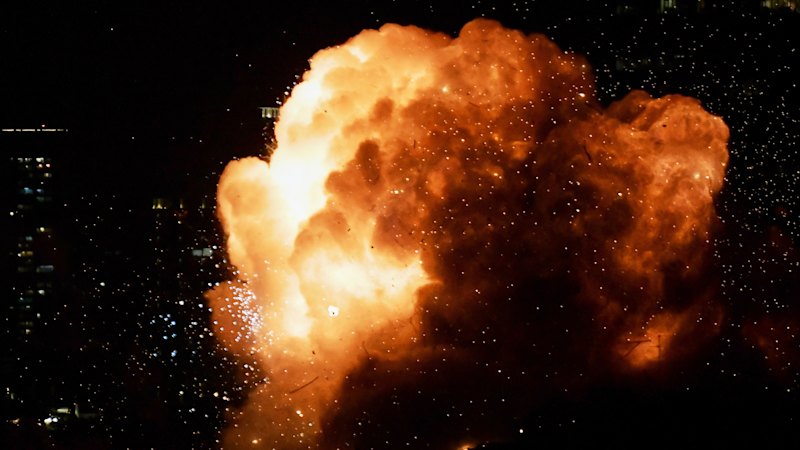
The headlines are screaming about "Epic Fury" and "Roaring Lion." Pundits are salivating over the "massive and ongoing" strikes that have supposedly decapitated the Iranian leadership. The narrative is as seductive as it is dangerous: blow up enough missile silos, assassinate enough clerics, and a democratic, Western-aligned Iran will magically emerge from the rubble.
I have watched boards of directors and national security councils fall for this same "clean break" fallacy for decades. It is the belief that a complex, deeply-entrenched system can be rebooted like a crashed laptop. It never works.
What the current US-Israeli campaign is actually doing is not "liberating" Iran. It is creating a power vacuum in a region that eats vacuums for breakfast. If you think a series of precision-guided munitions and high-end cyberattacks on the BadeSaba app can dismantle a forty-year-old security apparatus, you aren't paying attention to the physics of power.
The Decapitation Delusion
The death of Supreme Leader Ali Khamenei is being hailed as the "final blow." It isn't. In fact, it's the moment the real chaos begins.
In any hyper-centralized regime, the "head" is rarely just one person. It is a distributed network of interests, and the IRGC is the ultimate stakeholder. By removing the clerical figurehead, the US and Israel haven't destroyed the regime; they’ve simply removed the only person capable of reigning in the most radical elements of the military.
Imagine a scenario where a global corporation loses its CEO in a hostile takeover, but the middle management—the people who actually run the logistics, the security, and the supply chains—is still armed to the teeth and suddenly has no oversight. That’s Iran right now. The IRGC isn't going to "lay down its arms" because Donald Trump told them to on Truth Social. They are going to fight for their lives and their billions in black-market assets.
The Cyber-Information Gap
The media is obsessed with the "sophistication" of the cyberattacks. Hacking a religious calendar to tell people "it's time for reckoning" is a cute parlor trick. It makes for a great segment on cable news.
But here is the reality: cyberwarfare is a tool of disruption, not a tool of governance.
- Connectivity isn't Conviction: Dropping internet connectivity in Tehran doesn't make people love the West. It makes it impossible for them to organize, yes, but it also isolates the very "democratic" elements the West claims to support.
- Psychological Operations (PSYOPS) vs. Reality: Sending messages to IRGC commanders telling them their "shot clock" is running out is a gamble. In my experience, when you corner a dog, it doesn't defect; it bites.
- Infrastructure Fragility: We are seeing strikes on "nuclear-related infrastructure." We’ve seen this movie before in June 2025. You can delay a program, but you cannot delete the knowledge required to rebuild it.
The Economic Backfire
The "lazy consensus" says this is a localized conflict. The data says otherwise.
The Iranian strikes on the port of Jebel Ali in Dubai and the closure of the Strait of Hormuz are not "desperate lashing out." They are a calculated economic counter-offensive. If the world’s busiest international travel hub—Dubai International—stays shut, the global aviation industry loses billions every 24 hours.
The "Epic Fury" campaign is currently undergoing a "cost-of-living test" that it is failing. You cannot bomb a major oil-producing region and expect your midterm election year to go smoothly. The market doesn't care about "regime change"; the market cares about the $150-per-barrel oil that is looming on the horizon.
The "Democratic Iran" Fantasy
Every interventionist loves to cite the December 2025 protests as proof that the Iranian people are ready to embrace a Western-aligned government.
This is a fundamental misunderstanding of Iranian nationalism. There is a massive difference between wanting to overthrow a corrupt local cleric and wanting your country to be turned into a smoking crater by foreign powers. By launching "Operation Genesis" and "Epic Fury," the US and Israel have handed the regime the ultimate gift: the ability to frame every dissenter as a foreign asset.
I’ve seen this play out in corporate turnarounds. You can't force a culture shift from the outside by firing the board and burning the warehouse. All you get is a workforce that hates you and a brand that is permanently toxic.
The Real Question
Instead of asking "Is the regime falling?" we should be asking "What comes after the IRGC realizes it has nothing left to lose?"
The strikes on civilian infrastructure in Bahrain, Qatar, and the UAE are a warning. Iran is signaling that if it goes down, it is taking the global economy with it. This isn't a "pre-emptive attack" to remove threats; it is a catalyst for a multi-front regional war that has no clear exit strategy.
Tactical brilliance is not strategic wisdom. We are watching the most expensive, high-tech tactical success in history lead directly into a strategic catastrophe.
Would you like me to analyze the specific economic impact of the Strait of Hormuz closure on global shipping routes?