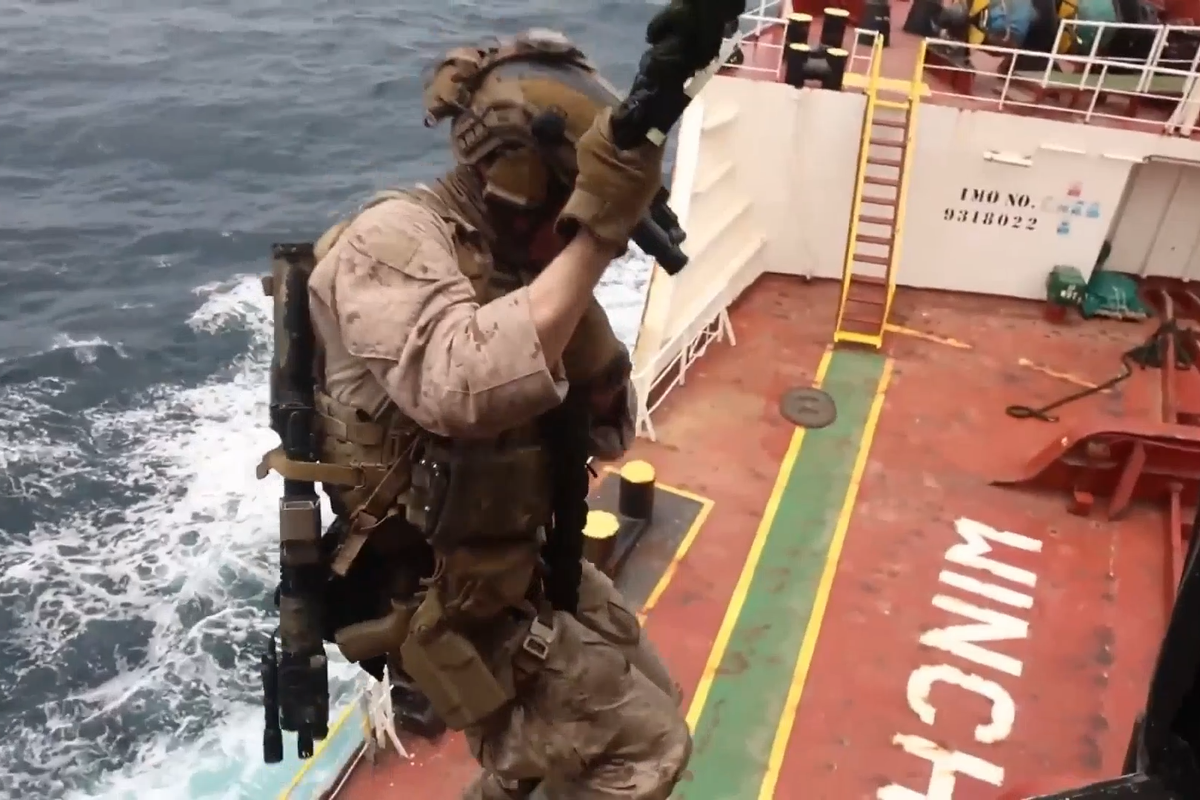
The footage goes viral in minutes. High-speed rigid-hull inflatable boats slamming into the gray hull of a massive crude carrier. Armed operators fast-roping from a helicopter, boots hitting the deck with synchronized thuds. Cable news anchors whisper breathlessly about escalating blockades, geopolitical chess, and the fragile choke points of global energy.
It looks like the climax of a summer blockbuster. It is actually an expensive, choreographed distraction from the mundane reality of modern maritime logistics. For a deeper dive into this area, we suggest: this related article.
For decades, the lazy consensus among defense analysts and media pundits has been that boarding commercial tankers in contested zones represents a decisive assertion of sovereign power or a vital enforcement of international sanctions. Every time a flag gets changed or a cargo gets impounded under the banner of an Iran blockade narrative, the talking heads treat it like a masterclass in naval dominance.
They are missing the forest for the trees. Or more accurately, they are staring at a shiny prop while the entire economic engine slips out the back door. For additional information on this development, extensive coverage can also be found at Reuters.
I have spent years advising maritime risk firms and watching capital flow through the Strait of Hormuz. I have seen underwriters panic over a single grain of bad intelligence, jacking up war risk premiums by millions overnight based entirely on the aesthetic of a military raid. The dirty little secret of these high-profile vessel boardings is that they do not alter the flow of global commerce by a single barrel. They are performative compliance theater designed to satisfy domestic political audiences who demand action, while the actual trade routes adapt before the ink on the seizure order dries.
The Mechanics of Shadow Logistics
To understand why these dramatic interdictions are functionally useless, you have to look past the hardware and examine the software of the black-market energy trade.
When commentators talk about a blockade, they picture a nineteenth-century naval cordon of ironclads stopping every single ship from passing through a narrow channel. That model died with the coal engine. Today, maritime commerce is decentralized, digitized, and remarkably resilient to physical disruption.
Consider a scenario where a tanker is flagged down, boarded, and diverted to a friendly port under the pretext of violating embargoes. The media treats this as a major blow to illicit smuggling networks. In reality, the ship you see on your screen is already a write-off by the time the boarding team touches the deck.
The real operators—the brokers in Dubai, the shell companies registered in tax havens from the Marshall Islands to Panama, and the network of ship-to-ship transfer operators lurking just outside territorial waters—do not care about a single hull. They operate fleets of aging, uninsured "dark ships" that turn off their automatic identification systems (AIS), disguise their names with high-pressure paint, and shuffle crude oil through a dozen corporate layers before it ever reaches a legitimate refinery.
When one vessel is intercepted, three more slip through the electronic blind spots of the Persian Gulf. The boarding is not a choke point victory; it is a tax on inefficiency. The smugglers simply bake the loss of an occasional expendable rust-bucket into their operating margins, much like a retail corporation accounting for shrinkage. The price of oil adjusts by a fraction of a dollar, the end consumer absorbs the cost, and the network continues to pump.
The Myth of Strategic Deterrence
Another persistent falsehood parroted by defense commentators is that seizing commercial vessels deters future hostile actions by state actors like Iran.
History shows the exact opposite. Every time a Western coalition or a regional ally stages a high-visibility boarding of a fuel carrier, it triggers an immediate tit-for-tat response. Within forty-eight hours, local revolutionary guard speedboats swarm a foreign-flagged tug or harass a container ship transiting the same corridor.
Deterrence requires a credible threat of disproportionate escalation. Boarding a commercial tanker offers neither. It is a symmetric response to an asymmetric reality. You are using billion-dollar destroyers and elite special operations units to play expensive whack-a-mole with tramp steamers.
The strategic thinkers cheering for these operations are fighting the last war. They think in terms of command of the sea, reminiscent of Mahan's maritime strategy. But command of the sea is irrelevant when the adversary's primary goal is not to control the sea, but to exploit its vast, unmonitored gray zones. You cannot blockade a concept, and you certainly cannot intimidate a decentralized criminal cartel with a photo-op on a supertanker deck.
Dismantling the People Also Ask Fallacy
If you search for information regarding these maritime confrontations, you will invariably run into a series of predictable queries generated by algorithmic curiosity. Let us take them apart.
Are commercial ships protected by international law during a blockade?
The standard legal answer drones on about the San Remo Manual on International Law Applicable to Armed Conflicts at Sea. It discusses contraband, visit and search rights, and the protection of neutral shipping. This is charmingly naive. International law only works when all parties agree to play by the same rulebook and fear the consequences of breaking it. When dealing with state-backed proxies and shadow fleets operating outside conventional jurisdiction, legal frameworks are nothing more than polite suggestions. A piece of paper signed in Geneva does not stop a masked operative with an assault rifle from seizing a rudder.
Can a country legally block a commercial strait?
Under the United Nations Convention on the Law of the Sea, the doctrine of transit passage guarantees vessels the freedom of navigation through straits used for international navigation. A formal blockade of a vital transit corridor like the Strait of Hormuz is an act of war. That is why governments never call it a blockade. They use euphemisms like "enforcement operations," "maritime security patrols," or "interdiction protocols." They walk right up to the legal line of an act of war, perform a dramatic stunt for the domestic news cycle, and step back before anyone has to answer difficult constitutional questions.
Who actually pays for these high-seas seizures?
You do. Every time a dramatic boarding incident makes the evening news, marine insurance syndicates in London recalculate their risk models. Premiums for hull and machinery protection spike. Those increased costs are baked directly into the price of imported goods and petroleum products. The dramatic rescue on your screen is secretly being funded out of your own pocket at the gas pump.
The Uncomfortable Truth About Naval Power
We cling to the imagery of naval dominance because it offers emotional comfort. It is much easier to watch a video of operators fast-roping onto a deck and feel like someone is in control than it is to accept that global supply chains are fundamentally anarchic, sprawling, and impossible to police completely.
Governments know this. Military planners know this. Yet the theater persists because a policy of quiet, unglamorous economic containment and intelligence-driven financial disruption does not fit into a thirty-second TikTok clip or a breaking news banner.
Stop looking at the flashing lights on the water. The real war for global trade is not being fought with rifles on the deck of a rolling oil tanker. It is being fought in the dark corners of offshore banking, through the silent manipulation of corporate registries, and across encrypted servers where a single keystroke changes a ship's flag before anyone has time to load a magazine.
The next time you see dramatic footage of a military boarding crew taking over a commercial vessel, remember that you are watching an expensive magic trick. While your eyes are fixed on the sailors sliding down the ropes, the real cargo has already cleared customs under a fake name three ports away.