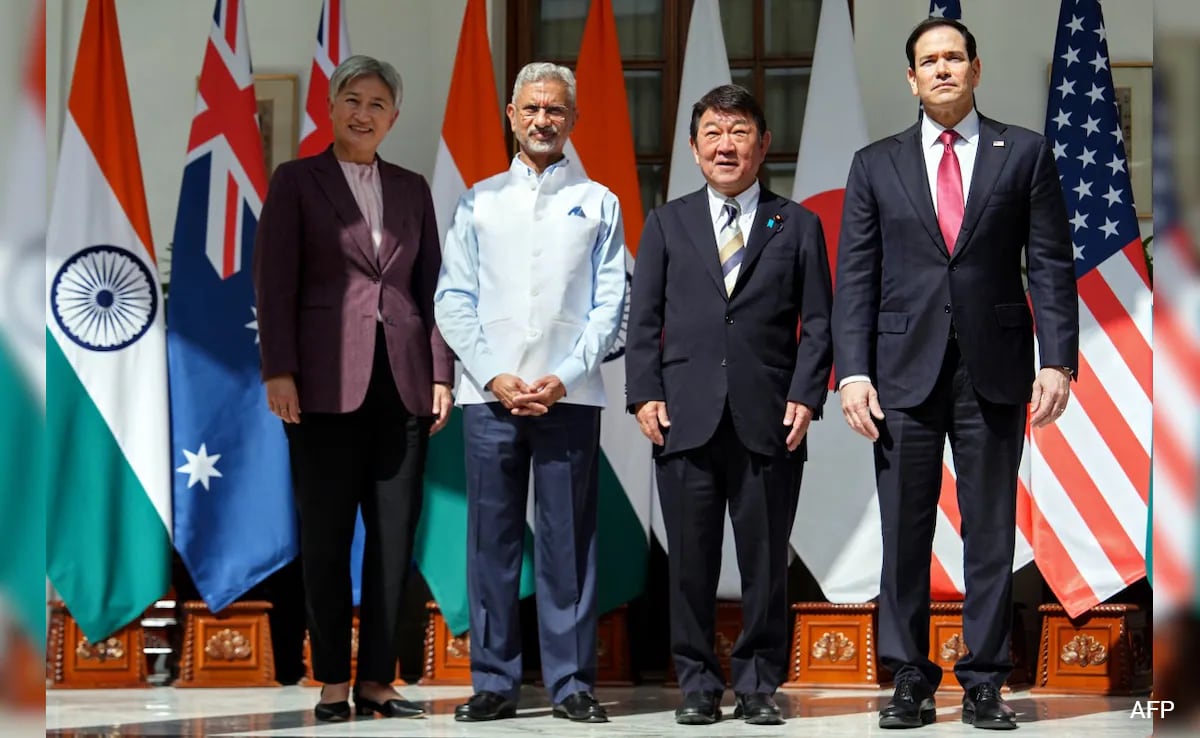
The $20 billion critical minerals framework announced by the Quad alliance—the United States, India, Japan, and Australia—at the New Delhi ministerial establishes a clear intent to disrupt China's near-monopoly over the upstream and midstream segments of clean energy and defense supply chains. By pooling public and private capital through export credit agencies, development finance institutions, and loan guarantees, the four-nation bloc aims to insulate technologies like semiconductors, electric vehicle batteries, and precision-guided munitions from unilateral export restrictions.
However, evaluating this initiative as a straightforward geopolitical win ignores the underlying structural economics of industrial mining and chemical processing. In critical minerals, dominance is not merely a function of state-directed financing; it is an optimization problem governed by capital expenditure (CapEx) amortisation timelines, regulatory permitting durations, and deliberate market-clearing pricing strategies implemented by the incumbent monopoly. To build a functional alternative supply ecosystem, the Quad must overcome three specific operational bottlenecks that $20 billion can initiate but cannot completely resolve.
The Structural Anatomy of the Supply Chain Asymmetry
The primary error in conventional analyses of critical mineral security is conflating raw geological extraction with chemical refining capacity. China's leverage does not stem primarily from possessing the largest subterranean reserves of every element; it stems from an intentional, multi-decade capitalization of the midstream processing infrastructure.
The supply chain operates across three distinct structural tiers, each presenting a unique barrier to entry for the Quad partnership:
- Upstream Extraction: The physical mining of ore. While Australia possesses massive reserves of lithium and hard-rock deposits, and India holds substantial unexploited beach sand minerals, raw ore is structurally useless without chemical transformation.
- Midstream Refining and Metallurgy: The conversion of raw concentrates into high-purity chemical compounds (such as battery-grade lithium carbonate, unsintered neodymium-iron-boron magnets, or purified synthetic graphite). This is where the true chokehold exists. Refining is highly capital-intensive, energy-dense, and environmentally damaging.
- Downstream Integration: The manufacturing of components like cathodes, anodes, semiconductor substrates, and permanent motors.
The economic reality is that mining companies outside of China routinely export their raw extracted materials directly to Chinese facilities for midstream processing because alternative processing infrastructure either does not exist or operates at a severe cost disadvantage. This structural flow creates a circular dependency: Western or allied public capital finances an upstream mine, yet the output must still flow through the precise midstream bottleneck the financing intended to bypass.
The Three Pillars of the Quad Framework: An Execution Assessment
The Quad Critical Minerals Initiative Framework addresses these systemic vulnerabilities through a tripartite architecture. Each pillar represents a specific policy lever designed to counter China's state-backed industrial model, though each faces distinct execution risks.
                  ┌─────────────────────────────────────────┐
                  │   Quad Critical Minerals Initiative     │
                  └────────────────────┬────────────────────┘
                                       │
         ┌─────────────────────────────┼─────────────────────────────┐
         ▼                             ▼                             ▼
┌──────────────────┐          ┌──────────────────┐          ┌──────────────────┐
│ Investment Drive │          │    Regulatory    │          │  Recycling &     │
│ ($20B CapEx)     │          │    Alignment     │          │  E-Waste         │
└──────────────────┘          └──────────────────┘          └──────────────────┘
Pillar I: The $20 Billion Investment Drive and the Cost Function of Scaling
The allocation of $20 billion in combined sovereign and private sector capital represents a necessary mechanism for risk mitigation. Because critical mineral projects carry immense geological, execution, and market risks, commercial banks rarely finance them without state-backed guarantees. The Quad's strategy utilizes equity participation, loan guarantees, and offtake agreements to lower the cost of capital for projects displaying a "Quad nexus"—meaning projects located within the partner nations, operated by allied corporations, or bound for allied industrial bases.
The capital allocation problem, however, is a matter of scale. A single world-class rare earth separation facility or a commercial-scale lithium hydroxide processing plant can easily demand $1 billion to $1.5 billion in initial CapEx. When distributed across four nations and divided among multiple mineral supply chains—including lithium, cobalt, nickel, manganese, graphite, and heavy rare earths—the $20 billion acts as a catalyst rather than a complete funding solution.
The primary mechanism here is the debt-to-equity leverage ratio. For the initiative to succeed, every dollar of public capital deployed via development finance institutions must crowd in four to five dollars of private commercial debt. If private institutional asset managers remain risk-averse due to commodity price volatility, the sovereign funds risk being spent on early-stage exploration without reaching the asset-heavy construction phase.
Pillar II: Regulatory Alignment and the Permitting Bottleneck
The second pillar seeks to address the chronological disadvantage faced by Western extraction projects: the permitting timeline gap. In North America and Australia, the duration required to advance a greenfield mining project from initial economic assessment to commercial production regularly spans 10 to 15 years. This delay is driven by fragmented environmental reviews, local licensing requirements, and litigation risks. Conversely, Chinese state-directed projects frequently achieve production status within three to five years.
The Quad framework proposes to share operational data to streamline approval timelines and standardize environmental, social, and governance (ESG) metrics. The strategic friction lies in the execution of localized law. While the federal governments of the United States or Australia can agree to accelerate administrative review processes, actual statutory authority over land use, water rights, and mining concessions frequently resides at the state, provincial, or indigenous land council level. Regulatory alignment at an international ministerial level does not automatically truncate domestic legal challenges.
A critical, defensive component of this pillar is the deployment of coordinated transaction screening mechanisms. These tools are designed to block foreign state-owned enterprises from executing hostile acquisitions or purchasing minority equity stakes in distressed allied mining firms. This creates an investment firewall, preventing adversaries from acquiring the very intellectual property and physical assets that Quad capital intends to seed.
Pillar III: Closed-Loop Recycling and Circular E-Waste Recovery
The final pillar shifts focus from primary extraction to secondary recovery, aiming to reclaim strategic elements from electronic waste, industrial scrap, and spent batteries. This represents an elegant macroeconomic hedge. By maximizing the domestic recovery of elements like cobalt and nickel from spent lithium-ion cells, the Quad can theoretically lower its aggregate reliance on primary mining operations.
The bottleneck here is thermodynamic and chemical rather than purely financial. Pyrometallurgical and hydrometallurgical recycling processes require substantial energy inputs and generate chemical secondary waste streams that must be treated. Furthermore, the logistics of e-waste collection are highly distributed. Without structural policy mandates—such as domestic battery passports or mandatory minimum recycled-content thresholds for manufacturers—the cost of collecting, sorting, and processing highly distributed consumer electronic waste frequently exceeds the spot market price of extracting virgin material.
The Weaponization of the Cost Curve: The Predator-Pricing Risk
The most significant strategic vulnerability omitted by conventional commentary is the weaponization of the commodity cost curve. China's dominance is protected by an aggressive cost advantage rooted in concentrated scaling, lower environmental compliance costs, and state subsidized energy inputs.
When allied nations announce public funding to build alternative processing infrastructure, the incumbent monopolist possesses the market power to alter global spot prices. By deliberately increasing production volumes and flooding international markets—as observed in recent historic gluts in the lithium carbonate and nickel markets—prices can be forced below the marginal cash cost of production of new Western market entrants.
Price per Ton
  ▲
  │       ┌──────────────────────────────────────┐
  │       │ New Quad Processing Facility         │
  │       │ Cost Floor (Higher CapEx + ESG)      │
  │── ── ─┴──────────────────────────────────────┴─ ─ ─ High Market Cost
  │
  │       ┌──────────────────────────────────────┐
  │       │ Chinese Competitor Cost Floor        │
  │── ── ─┴──────────────────────────────────────┴─ ─ ─ Low Market Cost
  │
  └──────────────────────────────────────────────────► Output Volume
This creates a capital destruction cycle:
- Quad financing backs a new processing facility in Australia or the United States.
- The facility operates with higher structural overhead due to stringent labor laws and environmental standards.
- The incumbent monopoly lowers prices globally, creating an unsustainable margin squeeze.
- The newly funded facility faces bankruptcy or requires continuous sovereign subsidies to remain solvent.
Without structural demand-side policies to insulate these new facilities from predatory pricing, the $20 billion framework addresses only the supply side of the ledger, leaving projects exposed to price manipulation.
Tactical Requirements for Alternative Supply Chain Viability
To convert the Quad Critical Minerals Initiative from a diplomatic memorandum into a durable industrial counterweight, the member states must move past general capital deployment and implement distinct structural economic mechanisms.
- Guaranteed Offtake Agreements with Price Floors: Export credit agencies must provide long-term contract-for-difference (CfD) mechanisms. If the global market price for a material like battery-grade lithium falls below the operational cost of an allied facility, a sovereign entity must commit to purchasing the output at a pre-determined floor price to preserve the facility's solvency.
- The High-Standard Marketplace Premium: The Quad must establish regulatory mandates that penalize carbon-intensive or low-ESG refining methods. By implementing border adjustment tariffs or domestic procurement mandates that require verification of low-carbon processing, they can artificially insulate domestic producers from low-cost, high-pollution competitors.
- Unified Strategic Stockpiles: Rather than operating isolated national reserves, the Quad partners require a shared inventory system. This would allow the rapid redirection of physical mineral inputs to any member nation facing immediate geopolitical supply disruptions, neutralizing short-term export bans.
The Quad framework represents an essential pivot toward industrial policy among market democracies. However, its success will not be measured by the headline value of the capital pledged. It will be determined by whether that capital can successfully construct a self-sustaining midstream processing infrastructure capable of surviving the severe economic pressures of a highly distorted global commodity market.